

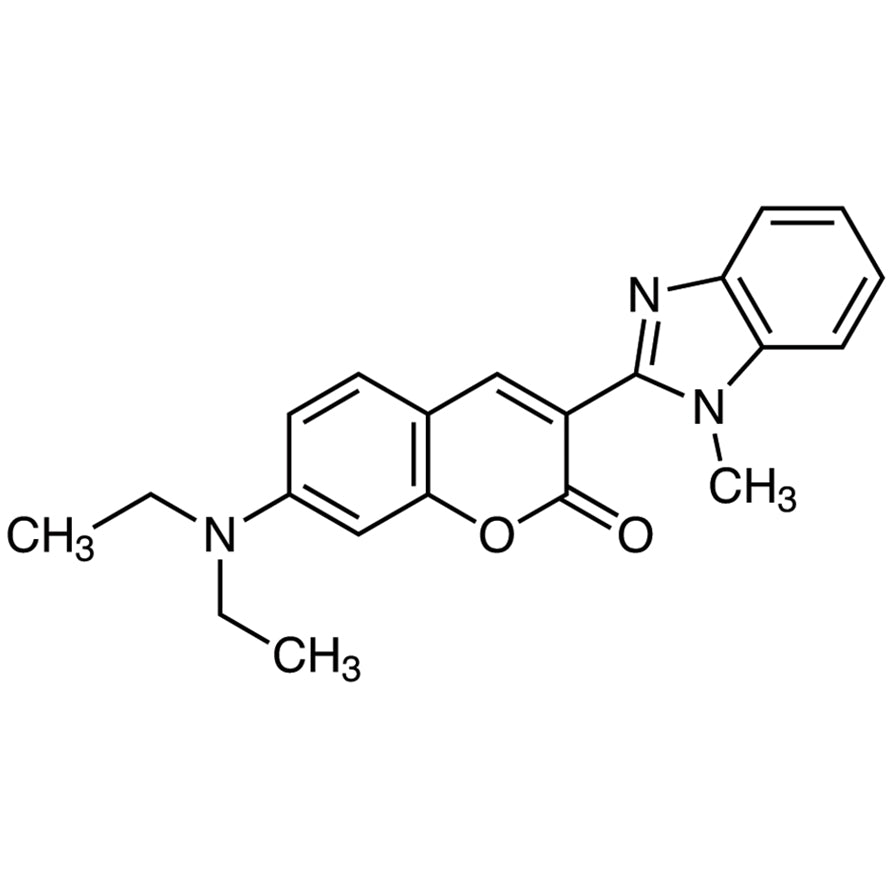
7-(Diethylamino)-3-(1-methyl-2-benzimidazolyl)coumarin is an organic compound widely used in optical and electrochemical material research. This compound plays a crucial role in the development of advanced optical devices, particularly in the field of Organic Light-Emitting Diodes (OLEDs). Its ability to emit light under specific conditions makes it an essential component for creating efficient and sustainable light-emitting technologies. In laboratory settings, it is often employed as an active material in the synthesis of novel optoelectronic components.
The compound is valued for its chemical stability and its capacity to emit light at specific wavelengths, which are critical for high-performance optical applications. The unique combination of a coumarin ring and a benzimidazolyl group contributes to its distinctive optical properties. These characteristics make it a preferred choice for researchers aiming to develop materials with tailored light-emission profiles. Its versatility allows it to be used in various advanced technological applications.
In Indonesian laboratories, this compound is commonly used in OLED material research, particularly in academic and research institutions focused on cutting-edge technology. It is an integral part of projects that require materials with specific optical properties for both industrial and academic applications. Its role in the development of next-generation display technologies is increasingly important in the region’s scientific community.
TCI brochures (PDF)
- Organic Light-Emitting Diode (OLED) Materials 2026-08-18 · p. 7
Related TCI products
- TCI C3640 53518-18-6 Coumarin 153 (purified by sublimation)
- TCI C2858 53518-18-6 Coumarin 153
- TCI B2111 27425-55-4 3-(2-Benzimidazolyl)-7-(diethylamino)coumarin
- TCI B2088 38215-36-0 3-(2-Benzothiazolyl)-7-(diethylamino)coumarin
- TCI B1149 27030-97-3 N-[4-(2-Benzimidazolyl)phenyl]maleimide
- TCI B4257 155306-71-1 Coumarin 545T
- OLED Material Development: This compound is ideal for creating high-performance OLEDs due to its light-emitting properties and chemical stability.
- Optical Sensor Fabrication: Its ability to emit light at specific wavelengths makes it suitable for use in precision optical sensors.
- Photovoltaic Research: The compound’s optical characteristics are useful in the development of advanced photovoltaic materials.
- Material Characterization Studies: Its unique structure allows for detailed analysis in material science research.
- Light-Emitting Diode (LED) Innovation: It contributes to the development of new LED technologies by enabling precise light emission control.
| Brand | TCI |
|---|---|
| CAS number | 41044-12-6 |
| Molecular formula | — |
| Purity | — |
| Category | Materials Science > Electronic Materials > Organic Light-Emitting Diode (OLED) Materials |
| Pack sizes | Available in various quantities as per supplier specifications |
| Physical form | Solid powder |
| Storage | Store in a cool, dry place away from direct light |
This compound should be stored in a cool, dry environment, away from direct light and sources of heat. It is recommended to use airtight containers to prevent moisture absorption and contamination. Due to its chemical nature, it should be handled in a well-ventilated area, and appropriate personal protective equipment should be worn when working with it. Avoid exposure to incompatible substances to ensure safety. Proper storage conditions help maintain the compound’s stability and effectiveness for laboratory use.
—
Product Categories
Produk Terkait
-
Coumarin153(purifiedbysublimation) TCI C3640
Regular price Rp 5.141.850,00Regular priceRp 3.610.950,00Sale price Rp 5.141.850,00 -
Coumarin153 TCI C2858
Regular price From Rp 2.439.150,00Regular priceRp 1.720.950,00Sale price From Rp 2.439.150,00 -
3-(2-Benzimidazolyl)-7-(diethylamino)coumarin TCI B2111
Regular price From Rp 1.246.350,00Regular priceRp 887.250,00Sale price From Rp 1.246.350,00 -
3-(2-Benzothiazolyl)-7-(diethylamino)coumarin TCI B2088
Regular price From Rp 2.068.500,00Regular priceRp 1.461.600,00Sale price From Rp 2.068.500,00 -
N-[4-(2-Benzimidazolyl)phenyl]maleimide TCI B1149
Regular price From Rp 3.735.900,00Regular priceRp 2.628.150,00Sale price From Rp 3.735.900,00 -
Coumarin545T TCI B4257
Regular price Rp 4.982.250,00Regular priceRp 3.499.650,00Sale price Rp 4.982.250,00 -
Coumarin6H TCI C2836
Regular price Rp 2.809.800,00Regular priceRp 1.980.300,00Sale price Rp 2.809.800,00 -
Coumarin314 TCI C2268
Regular price Rp 4.108.650,00Regular priceRp 2.888.550,00Sale price Rp 4.108.650,00


