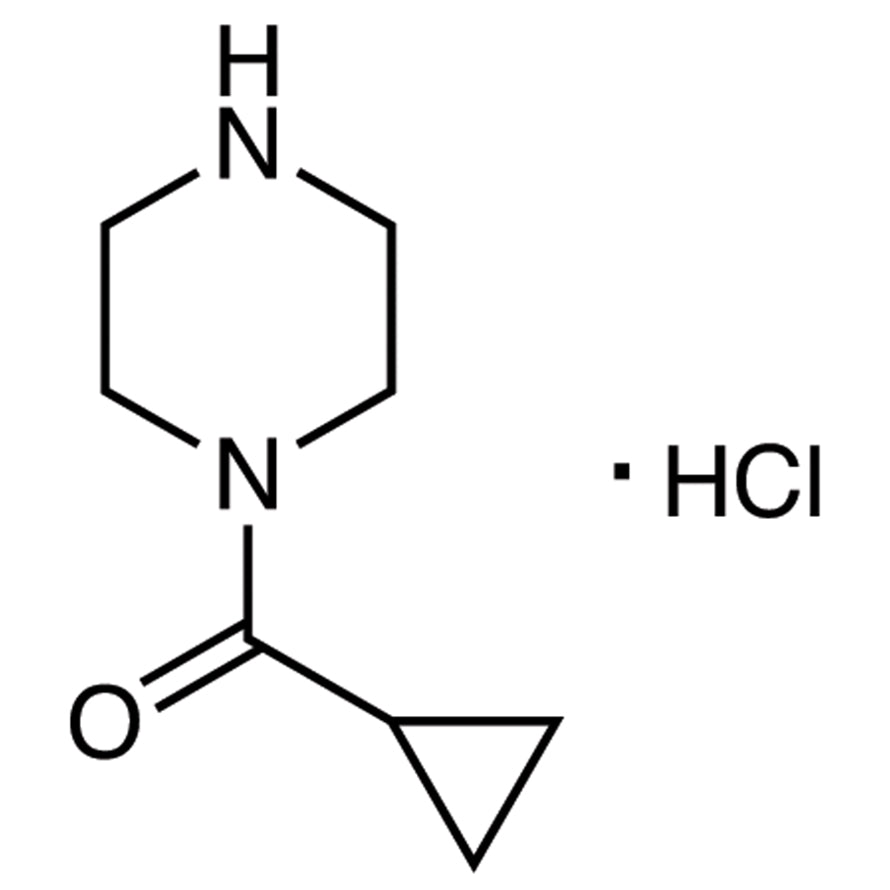
The TCI C3112 1-(Cyclopropylcarbonyl)piperazine Hydrochloride is a piperazine that has been selectively acylated at one of its two nitrogen atoms with a cyclopropanecarbonyl group, and is then supplied as the hydrochloride salt. Registered under CAS number 1021298-67-8, this compound serves as a highly practical heterocyclic building block in synthesis laboratories, because piperazine is one of the most frequently occurring structural motifs in drug molecules. With one nitrogen already protected by the acyl group, researchers can directly functionalise the remaining nitrogen without the trouble of controlling double reaction.
Its principal advantage is the selectivity that is already built into the structure. Free piperazine has two nitrogen atoms of comparable reactivity, so it is prone to producing diacylated or dialkylated products that reduce yield; in this compound that problem has already been solved from the outset. The cyclopropyl carbonyl group itself is widely used in medicinal chemistry, because the strained cyclopropane ring imparts conformational rigidity and often improves metabolic stability. The hydrochloride salt form makes the solid easier to handle, more stable in storage, and free of the amine odour associated with the free base.
In Indonesian laboratories, this building block is typically used in university and institutional research groups working on medicinal chemistry and organic synthesis, as well as in pharmaceutical research and development units preparing analogue series. It suits workflows where a mono-protected piperazine is needed as the starting point for a library of derivatives, and where a ready-made, well-defined intermediate saves the time and reagent consumption that in-house mono-acylation of piperazine would otherwise require.
Related TCI products
- Medicinal chemistry analogue synthesis — the free nitrogen accepts alkylation, arylation, or further acylation, allowing rapid preparation of derivative series around a drug-like piperazine core.
- Heterocyclic building block coupling — the compound provides a defined mono-functionalised piperazine unit that can be joined to aromatic or heteroaromatic fragments without competing reaction at a second nitrogen.
- Selective mono-functionalisation studies — because one nitrogen is already acylated, chemists avoid the diacylation and dialkylation side products that lower yield when starting from free piperazine.
- Structure–activity relationship investigation — the rigid cyclopropanecarbonyl group contributes conformational constraint and often improved metabolic stability, making it valuable when probing structural effects on activity.
- Reference intermediate for method development — as a well-defined, stable hydrochloride solid, it is convenient for developing and validating synthetic routes and analytical procedures involving piperazine derivatives.
| Brand | TCI, catalogue code C3112 |
|---|---|
| CAS number | 1021298-67-8 |
| Molecular formula | — |
| Purity | — |
| Category | Chemistry > Building Blocks > Heterocyclic Building Blocks |
| Pack sizes | available in the standard research-scale packaging offered for this TCI catalogue item |
| Physical form | — |
| Storage | keep in a tightly closed container in a cool, dry place away from moisture |
- Chemical form: hydrochloride salt of 1-(cyclopropylcarbonyl)piperazine, supplied as a solid
Store the container tightly closed in a cool, dry, well-ventilated area, protected from moisture and away from direct sunlight and heat sources. The original manufacturer bottle is the most suitable container; if transferring material, use clean, dry, chemically resistant glass or plastic vessels that seal properly, and label them clearly. Weigh and handle the solid in a fume hood or well-ventilated workspace to limit dust exposure. Wear a laboratory coat, safety glasses, and chemical-resistant gloves during handling, and avoid contact with skin, eyes, and clothing. Use dry spatulas to prevent contamination, close the container immediately after use, and consult the manufacturer's safety data sheet before first use and for disposal guidance.
—
Produk Terkait
-
5-Cyclopropyl-1H-pyrazol-3-amine TCI C3878
Regular price From Rp 1.087.800,00Regular price -
Cyclopropyl(piperazin-1-yl)methanone TCI C3850
Regular price From Rp 903.000,00Regular price -
N-(2-Aminoethyl)piperazine TCI A0304
Regular price From Rp 505.050,00Regular price -
1-(o-Tolyl)piperazine TCI T3404
Regular price From Rp 1.670.550,00Regular price -
1-(2-Thiazolyl)piperazine TCI T3273
Regular price Rp 1.326.150,00Regular price -
1-(p-Tolyl)piperazine TCI T2956
Regular price From Rp 1.298.850,00Regular price -
1-(Tetrahydro-2-furoyl)piperazine TCI T2617
Regular price From Rp 769.650,00Regular price -
1-(m-Tolyl)piperazine TCI T2260
Regular price From Rp 1.431.150,00Regular price