

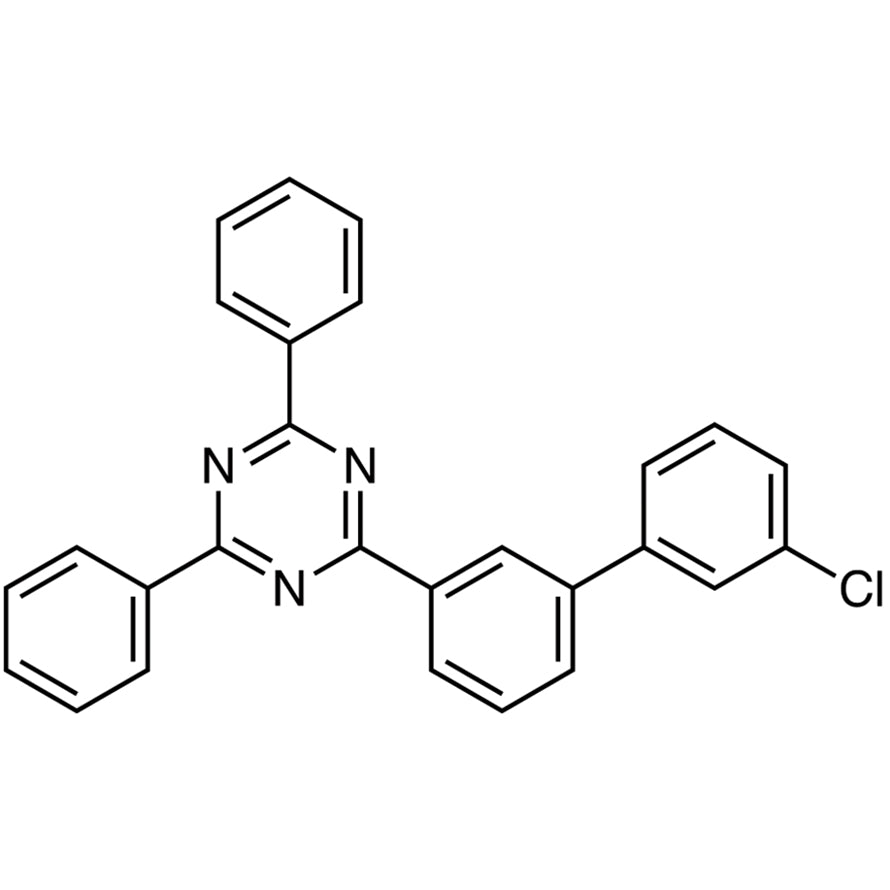
2-(3'-Chlorobiphenyl-3-yl)-4,6-diphenyl-1,3,5-triazine is a triazine-core compound engineered as a building block for small molecule semiconductors. The molecular architecture integrates an electron-deficient 1,3,5-triazine ring with two phenyl substituents and one chlorobiphenyl unit, producing a rigid and extended aromatic framework. In materials science research laboratories, this compound occupies a strategic position as a precursor for constructing electron transport materials and host materials used in organic light-emitting diode devices, where the triazine core serves as a dependable acceptor unit.
The characteristics that make this compound a preferred choice stem from its combination of electronic properties and synthetic reactivity. The triazine ring effectively lowers molecular orbital energy levels, thereby facilitating electron injection and transport while enhancing stability against reduction—two factors that directly determine device efficiency and operational lifetime. Meanwhile, the chlorine atom positioned on the biphenyl unit functions as a reactive site ready for palladium-catalyzed cross-coupling reactions, including Suzuki–Miyaura and Buchwald–Hartwig methodologies, enabling researchers to attach donor units, carbazole moieties, or other functional groups.
Indonesian research institutions and materials science laboratories working on organic electronics and advanced semiconductor materials utilize this compound for developing next-generation optoelectronic devices. Its versatility in molecular design and compatibility with standard synthetic protocols make it particularly valuable for academic and industrial research programs focused on improving organic semiconductor performance and device architecture innovation.
TCI brochures (PDF)
- Building Blocks for Organic Semiconductor 2026-03-24 · p. 17
Related TCI products
- TCI B4939 80984-79-8 2-Bromo-4,6-diphenyl-1,3,5-triazine
- TCI B4927 23449-08-3 2-(4-Bromophenyl)-4,6-diphenyl-1,3,5-triazine
- TCI B4894 864377-31-1 2-(3-Bromophenyl)-4,6-diphenyl-1,3,5-triazine
- TCI F1045 203450-08-2 2-(4-Fluorophenyl)-4,6-diphenyl-1,3,5-triazine
- TCI D5271 1219956-23-6 2,4-Diphenyl-6-[4-(4,4,5,5-tetramethyl-1,3,2-dioxaborolan-2-yl)phenyl]-1,3,5-triazine
- TCI D4902 1073062-59-5 2-(3,5-Dibromophenyl)-4,6-diphenyl-1,3,5-triazine
- Organic light-emitting diode research: serves as an electron transport layer precursor and host material component for high-efficiency OLED device fabrication
- Small molecule semiconductor synthesis: provides a reliable triazine-based acceptor core for building customized molecular architectures through cross-coupling reactions
- Materials science research: enables development of advanced electronic materials with tailored energy levels and charge transport properties for optoelectronic applications
- Palladium-catalyzed coupling studies: offers a reactive chlorine site suitable for Suzuki–Miyaura and Buchwald–Hartwig reactions to introduce diverse functional substituents
- Molecular engineering projects: supports construction of rigid aromatic frameworks with extended conjugation for investigating structure-property relationships in organic semiconductors
| Brand | TCI (product code C3162) |
|---|---|
| CAS number | 1443049-83-9 |
| Molecular formula | — |
| Purity | — |
| Category | Materials Science > Material Building Blocks > Small Molecule Semiconductor Building Blocks |
| Pack sizes | — |
| Physical form | Solid compound suitable for synthetic transformations |
| Storage | Keep container tightly closed and store in a cool, dry place away from light |
- Chemical name: 2-(3'-Chlorobiphenyl-3-yl)-4,6-diphenyl-1,3,5-triazine
Store this compound in its original container with the lid securely tightened, preferably in a cool and dry environment protected from direct light exposure. Standard laboratory precautions apply: wear appropriate personal protective equipment including gloves and safety glasses when handling. Avoid generating dust and prevent contact with skin or eyes. Keep away from incompatible materials such as strong oxidizing agents. Ensure adequate ventilation in the work area and follow institutional chemical hygiene protocols for aromatic heterocyclic compounds.
—
Produk Terkait
-
2-Bromo-4,6-diphenyl-1,3,5-triazine TCI B4939
Regular price From Rp 3.843.000,00Regular price -
2-(4-Bromophenyl)-4,6-diphenyl-1,3,5-triazine TCI B4927
Regular price From Rp 2.041.200,00Regular price -
2-(3-Bromophenyl)-4,6-diphenyl-1,3,5-triazine TCI B4894
Regular price From Rp 2.227.050,00Regular price -
2-(4-Fluorophenyl)-4,6-diphenyl-1,3,5-triazine TCI F1045
Regular price From Rp 584.850,00Regular price -
2,4-Diphenyl-6-[4-(4,4,5,5-tetramethyl-1,3,2-dioxaborolan-2-yl)phenyl]-1,3,5-triazine TCI D5271
Regular price From Rp 3.127.950,00Regular price -
2-(3,5-Dibromophenyl)-4,6-diphenyl-1,3,5-triazine TCI D4902
Regular price From Rp 1.353.450,00Regular price -
2-(4'-Chlorobiphenyl-3-yl)-4,6-diphenyl-1,3,5-triazine TCI C3164
Regular price From Rp 1.167.600,00Regular price -
2-(3'-Chlorobiphenyl-4-yl)-4,6-diphenyl-1,3,5-triazine TCI C3163
Regular price From Rp 1.115.100,00Regular price


![2,4-Diphenyl-6-[4-(4,4,5,5-tetramethyl-1,3,2-dioxaborolan-2-yl)phenyl]-1,3,5-triazine (CAS 1219956-23-6) - TCI D5271 - AMI Scientific](http://amiscientific.com/cdn/shop/files/TCI2510D5271.jpg?v=1769142099&width=533)


