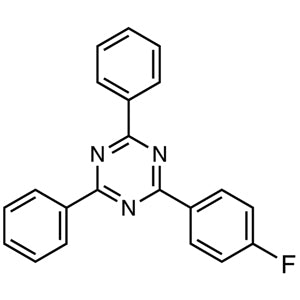
2-Bromo-4,6-diphenyl-1,3,5-triazine is a chemical compound widely used in scientific research, particularly in the fields of materials science and organic chemistry. This compound plays a crucial role in the development of advanced materials and electronic components due to its unique molecular structure. In laboratory settings, it serves as a foundational building block for synthesizing complex compounds with specific functional properties. Its application spans various research areas, including semiconductor technology and optical materials, where precise chemical control is essential.
The compound’s stability and controlled reactivity make it a preferred choice for researchers aiming to create materials with tailored properties. Its molecular structure, featuring bromo and phenyl groups, allows for versatile chemical interactions under specific conditions. This makes it ideal for high-precision chemical reactions that require both stability and reactivity. The predictable behavior of 2-Bromo-4,6-diphenyl-1,3,5-triazine ensures reliable results in experimental processes, contributing to the reproducibility of scientific findings.
In Indonesian laboratories, this compound is commonly used in semiconductor and optical component research. Local researchers and academic institutions rely on it for developing new materials with enhanced performance characteristics. Its presence in research projects highlights its importance in advancing technological innovation within the scientific community. The compound’s consistent performance and reliability make it a trusted resource for laboratory applications in Indonesia.
TCI brochures (PDF)
- Building Blocks for Organic Semiconductor 2026-03-24 · p. 17
Related TCI products
- TCI B4927 23449-08-3 2-(4-Bromophenyl)-4,6-diphenyl-1,3,5-triazine
- TCI B4894 864377-31-1 2-(3-Bromophenyl)-4,6-diphenyl-1,3,5-triazine
- TCI F1045 203450-08-2 2-(4-Fluorophenyl)-4,6-diphenyl-1,3,5-triazine
- TCI D5271 1219956-23-6 2,4-Diphenyl-6-[4-(4,4,5,5-tetramethyl-1,3,2-dioxaborolan-2-yl)phenyl]-1,3,5-triazine
- TCI D4902 1073062-59-5 2-(3,5-Dibromophenyl)-4,6-diphenyl-1,3,5-triazine
- TCI C3164 1443049-85-1 2-(4'-Chlorobiphenyl-3-yl)-4,6-diphenyl-1,3,5-triazine
- Semiconductor material synthesis due to its ability to form stable and reactive molecular structures necessary for advanced electronic components.
- Optical material development because of its unique chemical properties that enable precise tuning of optical characteristics in compound formulations.
- Organic chemistry research as a versatile building block for creating complex molecules with tailored functional groups.
- Material engineering applications where controlled reactivity and molecular stability are critical for developing high-performance materials.
- Chemical reaction optimization in research settings requiring precise molecular interactions and predictable chemical behavior.
| Brand | TCI |
|---|---|
| CAS number | 80984-79-8 |
| Molecular formula | — |
| Purity | — |
| Category | Materials Science > Material Building Blocks > Small Molecule Semiconductor Building Blocks |
| Pack sizes | Available in various quantities as per standard laboratory supply specifications |
| Physical form | Solid |
| Storage | Store in a cool, dry place away from direct sunlight and incompatible substances |
This compound should be stored in a cool, dry environment to maintain its chemical stability. It is recommended to use airtight containers to prevent exposure to moisture and air, which could affect its reactivity. Due to its chemical nature, it should be kept away from incompatible substances such as strong acids or bases. Laboratory personnel should handle it with appropriate personal protective equipment, including gloves and safety goggles, to ensure safe handling. Regular monitoring of storage conditions is advised to maintain the integrity of the material and ensure safe usage in experimental settings.
—
Produk Terkait
-
2-(4-Bromophenyl)-4,6-diphenyl-1,3,5-triazine TCI B4927
Regular price From Rp 2.093.700,00Regular priceRp 1.479.450,00Sale price From Rp 2.093.700,00 -
2-(3-Bromophenyl)-4,6-diphenyl-1,3,5-triazine TCI B4894
Regular price From Rp 2.279.550,00Regular priceRp 1.609.650,00Sale price From Rp 2.279.550,00 -
2-(4-Fluorophenyl)-4,6-diphenyl-1,3,5-triazine TCI F1045
Regular price From Rp 637.350,00Regular priceRp 460.950,00Sale price From Rp 637.350,00 -
2,4-Diphenyl-6-[4-(4,4,5,5-tetramethyl-1,3,2-dioxaborolan-2-yl)phenyl]-1,3,5-triazine TCI D5271
Regular price From Rp 3.180.450,00Regular priceRp 2.239.650,00Sale price From Rp 3.180.450,00 -
2-(3,5-Dibromophenyl)-4,6-diphenyl-1,3,5-triazine TCI D4902
Regular price From Rp 1.405.950,00Regular priceRp 998.550,00Sale price From Rp 1.405.950,00 -
2-(4'-Chlorobiphenyl-3-yl)-4,6-diphenyl-1,3,5-triazine TCI C3164
Regular price From Rp 1.220.100,00Regular priceRp 868.350,00Sale price From Rp 1.220.100,00 -
2-(3'-Chlorobiphenyl-4-yl)-4,6-diphenyl-1,3,5-triazine TCI C3163
Regular price From Rp 1.167.600,00Regular priceRp 831.600,00Sale price From Rp 1.167.600,00 -
2-(3'-Chlorobiphenyl-3-yl)-4,6-diphenyl-1,3,5-triazine TCI C3162
Regular price From Rp 1.140.300,00Regular priceRp 812.700,00Sale price From Rp 1.140.300,00