

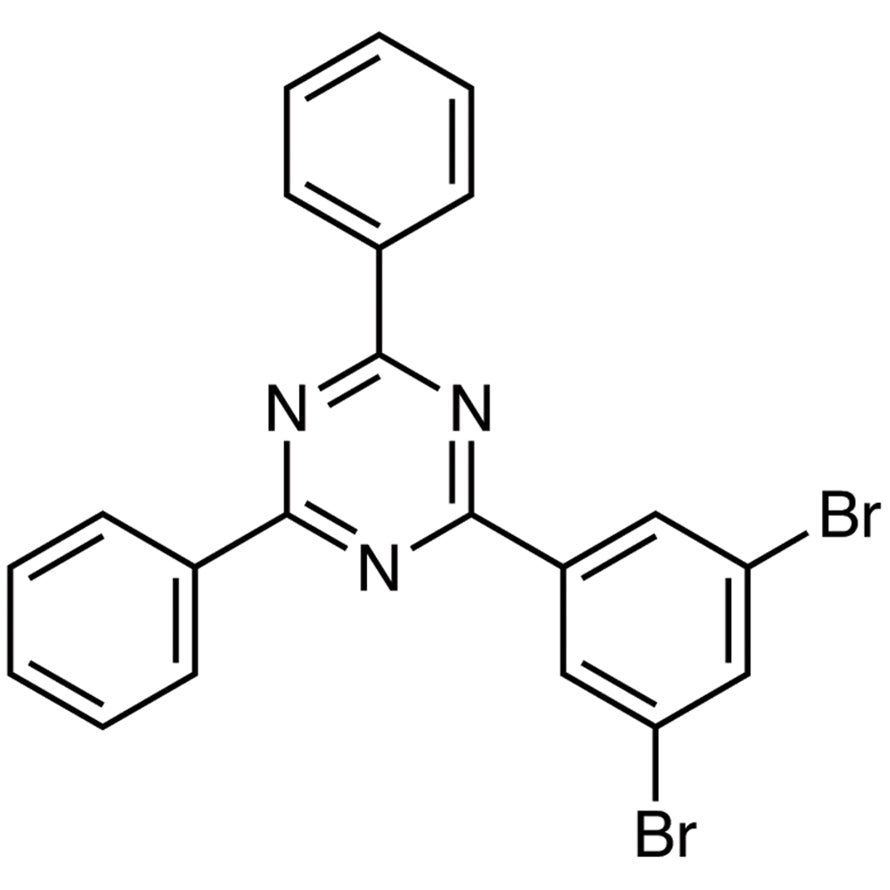
2-(3,5-Dibromophenyl)-4,6-diphenyl-1,3,5-triazine is a complex chemical compound widely used in scientific research, particularly in the development of advanced semiconductor materials. This compound is a key building block in the synthesis of organic materials with tailored optical and electronic properties. Its unique molecular structure, consisting of a triazine ring linked with phenyl and dibromophenyl groups, makes it highly versatile for chemical modifications. In the laboratory, it serves as a crucial component in the creation of materials for various technological applications, including optoelectronics and photovoltaic devices.
The compound is valued for its chemical stability and controlled reactivity, allowing researchers to fine-tune its optical and electronic characteristics for specific applications. Its molecular complexity enables strong interactions with a variety of reagents, making it an ideal choice for synthetic processes that require precision. Additionally, its resistance to diverse chemical conditions simplifies handling and processing in laboratory settings. These properties make it a reliable and efficient material for advanced material synthesis.
In Indonesian laboratories, this compound is commonly used in material science research, particularly in the development of new semiconductor materials and optoelectronic devices. It is a preferred choice for researchers working on organic semiconductors due to its predictable behavior and compatibility with various synthetic methods. Its application in both academic and industrial research settings highlights its importance in advancing materials technology in the region.
TCI brochures (PDF)
- Building Blocks for Organic Semiconductor 2026-03-24 · p. 17
Related TCI products
- TCI B4939 80984-79-8 2-Bromo-4,6-diphenyl-1,3,5-triazine
- TCI B4927 23449-08-3 2-(4-Bromophenyl)-4,6-diphenyl-1,3,5-triazine
- TCI B4894 864377-31-1 2-(3-Bromophenyl)-4,6-diphenyl-1,3,5-triazine
- TCI F1045 203450-08-2 2-(4-Fluorophenyl)-4,6-diphenyl-1,3,5-triazine
- TCI D5271 1219956-23-6 2,4-Diphenyl-6-[4-(4,4,5,5-tetramethyl-1,3,2-dioxaborolan-2-yl)phenyl]-1,3,5-triazine
- TCI C3164 1443049-85-1 2-(4'-Chlorobiphenyl-3-yl)-4,6-diphenyl-1,3,5-triazine
- Organic semiconductor synthesis: This compound is ideal for creating organic semiconductors due to its molecular structure that supports efficient charge transport properties.
- Optoelectronic device development: Its optical properties make it suitable for use in LED and photovoltaic technologies, where precise light emission and absorption are required.
- Material characterization studies: The compound's stability and reactivity allow it to be used in various analytical techniques to study material behavior under different conditions.
- Sensor fabrication: Its ability to interact with various reagents makes it a valuable component in the development of optical sensors for detecting chemical and environmental changes.
- Research in photovoltaic materials: The compound's electronic properties are beneficial in the creation of solar cell materials with enhanced energy conversion efficiency.
| Brand | TCI |
|---|---|
| CAS number | 1073062-59-5 |
| Molecular formula | — |
| Purity | — |
| Category | Materials Science > Material Building Blocks > Small Molecule Semiconductor Building Blocks |
| Pack sizes | Available in various quantities as per standard laboratory supply |
| Physical form | Solid powder |
| Storage | Store in a cool, dry place away from light and moisture |
This compound should be stored in a cool, dry environment, away from direct light and moisture to maintain its chemical stability. It is recommended to use airtight containers made of glass or high-density polyethylene to prevent contamination and degradation. Due to its chemical nature, it should be handled with appropriate personal protective equipment, such as gloves and safety goggles, to ensure laboratory safety. Proper ventilation is essential when working with this material to avoid inhalation of vapors. It is important to avoid exposure to incompatible substances, such as strong acids or bases, to prevent unwanted reactions. Regular monitoring of storage conditions ensures the compound remains in optimal condition for research applications.
—
Produk Terkait
-
2-Bromo-4,6-diphenyl-1,3,5-triazine TCI B4939
Regular price From Rp 3.843.000,00Regular price -
2-(4-Bromophenyl)-4,6-diphenyl-1,3,5-triazine TCI B4927
Regular price From Rp 2.041.200,00Regular price -
2-(3-Bromophenyl)-4,6-diphenyl-1,3,5-triazine TCI B4894
Regular price From Rp 2.227.050,00Regular price -
2-(4-Fluorophenyl)-4,6-diphenyl-1,3,5-triazine TCI F1045
Regular price From Rp 584.850,00Regular price -
2,4-Diphenyl-6-[4-(4,4,5,5-tetramethyl-1,3,2-dioxaborolan-2-yl)phenyl]-1,3,5-triazine TCI D5271
Regular price From Rp 3.127.950,00Regular price -
2-(4'-Chlorobiphenyl-3-yl)-4,6-diphenyl-1,3,5-triazine TCI C3164
Regular price From Rp 1.167.600,00Regular price -
2-(3'-Chlorobiphenyl-4-yl)-4,6-diphenyl-1,3,5-triazine TCI C3163
Regular price From Rp 1.115.100,00Regular price -
2-(3'-Chlorobiphenyl-3-yl)-4,6-diphenyl-1,3,5-triazine TCI C3162
Regular price From Rp 1.087.800,00Regular price


![2,4-Diphenyl-6-[4-(4,4,5,5-tetramethyl-1,3,2-dioxaborolan-2-yl)phenyl]-1,3,5-triazine (CAS 1219956-23-6) - TCI D5271 - AMI Scientific](http://amiscientific.com/cdn/shop/files/TCI2510D5271.jpg?v=1769142099&width=533)


