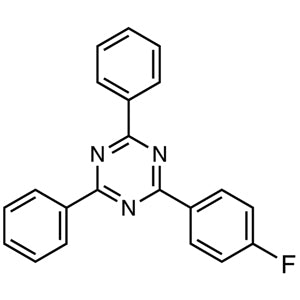
2-(4-Bromophenyl)-4,6-diphenyl-1,3,5-triazine is a chemical compound widely used in materials science research, particularly in the development of organic semiconductors. As a member of the triazine family, it provides a stable molecular framework that supports various material applications. This compound is essential in the synthesis of complex organic molecules and the design of materials with specific electronic properties. Its structural versatility makes it a valuable tool for scientists working on advanced material systems.
The compound’s molecular structure consists of three aromatic rings connected through nitrogen atoms, offering both chemical stability and reactivity. This unique structure enables it to interact effectively with a variety of functional groups, making it ideal for organic synthesis. Its reactivity and compatibility with different reagents enhance its utility in laboratory settings. The solid form of the compound also simplifies handling and processing, facilitating its use in experimental procedures.
In Indonesian laboratories, this compound is commonly used in material science research, especially in the study of molecular structures and electronic properties. Researchers rely on its stability and reactivity to develop new semiconductor materials and conduct advanced chemical experiments. Its availability in a solid form ensures ease of use, making it a preferred choice for both academic and industrial research applications.
TCI brochures (PDF)
- Building Blocks for Organic Semiconductor 2026-03-24 · p. 17
Related TCI products
- TCI T3308 890148-78-4 2,4,6-Tris(3-bromophenyl)-1,3,5-triazine
- TCI T3178 30363-03-2 2,4,6-Tris(4-bromophenyl)-1,3,5-triazine
- TCI B4939 80984-79-8 2-Bromo-4,6-diphenyl-1,3,5-triazine
- TCI B4894 864377-31-1 2-(3-Bromophenyl)-4,6-diphenyl-1,3,5-triazine
- TCI F1045 203450-08-2 2-(4-Fluorophenyl)-4,6-diphenyl-1,3,5-triazine
- TCI D5271 1219956-23-6 2,4-Diphenyl-6-[4-(4,4,5,5-tetramethyl-1,3,2-dioxaborolan-2-yl)phenyl]-1,3,5-triazine
- Organic Semiconductor Development: This compound is widely used in the synthesis of organic semiconductors due to its stable triazine core and ability to form complex molecular structures.
- Molecular Structure Analysis: Its aromatic ring system allows for detailed study of molecular interactions and electronic behavior in advanced material research.
- Functional Group Modification: The compound’s reactivity enables it to participate in various chemical reactions, making it suitable for functional group synthesis and modification.
- Electronic Material Fabrication: It serves as a building block in the creation of materials with tailored electronic properties for use in optoelectronic devices.
- Research in Material Science: Its versatility and chemical stability make it a key component in experimental studies aimed at developing new material systems.
| Brand | TCI |
|---|---|
| CAS number | 23449-08-3 |
| Molecular formula | — |
| Purity | — |
| Category | Materials Science > Material Building Blocks > Small Molecule Semiconductor Building Blocks |
| Pack sizes | Available in standard laboratory quantities |
| Physical form | Solid |
| Storage | Store in a cool, dry place away from direct sunlight |
This compound should be stored in a cool, dry environment, away from direct sunlight and moisture to maintain its chemical stability. It is recommended to use airtight containers to prevent exposure to air and humidity, which could affect its integrity. As a reactive chemical, it should be handled with appropriate laboratory safety measures, including the use of personal protective equipment. Storage should be in a well-ventilated area to minimize any potential risks associated with its chemical nature. Regular inspection of storage conditions is advised to ensure the material remains in optimal condition for use in research applications.
—
Produk Terkait
-
2,4,6-Tris(3-bromophenyl)-1,3,5-triazine TCI T3308
Regular price From Rp 1.776.600,00Regular priceRp 1.257.900,00Sale price From Rp 1.776.600,00 -
2,4,6-Tris(4-bromophenyl)-1,3,5-triazine TCI T3178
Regular price From Rp 955.500,00Regular priceRp 683.550,00Sale price From Rp 955.500,00 -
2-Bromo-4,6-diphenyl-1,3,5-triazine TCI B4939
Regular price From Rp 3.895.500,00Regular priceRp 2.739.450,00Sale price From Rp 3.895.500,00 -
2-(3-Bromophenyl)-4,6-diphenyl-1,3,5-triazine TCI B4894
Regular price From Rp 2.279.550,00Regular priceRp 1.609.650,00Sale price From Rp 2.279.550,00 -
2-(4-Fluorophenyl)-4,6-diphenyl-1,3,5-triazine TCI F1045
Regular price From Rp 637.350,00Regular priceRp 460.950,00Sale price From Rp 637.350,00 -
2,4-Diphenyl-6-[4-(4,4,5,5-tetramethyl-1,3,2-dioxaborolan-2-yl)phenyl]-1,3,5-triazine TCI D5271
Regular price From Rp 3.180.450,00Regular priceRp 2.239.650,00Sale price From Rp 3.180.450,00 -
2-(3,5-Dibromophenyl)-4,6-diphenyl-1,3,5-triazine TCI D4902
Regular price From Rp 1.405.950,00Regular priceRp 998.550,00Sale price From Rp 1.405.950,00 -
2-(4'-Chlorobiphenyl-3-yl)-4,6-diphenyl-1,3,5-triazine TCI C3164
Regular price From Rp 1.220.100,00Regular priceRp 868.350,00Sale price From Rp 1.220.100,00