2,4,6-Tris(4-bromophenyl)-1,3,5-triazine from TCI (product code T3178) is a star-shaped aromatic compound. Its core is a 1,3,5-triazine ring that carries three 4-bromophenyl groups arranged symmetrically around it. Laboratories use it as a building block for larger organic molecules and materials, especially small molecule semiconductors, optoelectronic materials, and porous frameworks. The three bromine atoms at the ends of its arms are reactive sites. Through coupling reactions, researchers can attach a wide range of functional groups at these positions.
Researchers choose this compound for two features: its three-fold (C3) symmetry and its electron-deficient triazine core. Together, these make it well suited to building materials with electron-accepting (acceptor) character. The aryl bromide groups react well in palladium-catalyzed cross-couplings such as Suzuki-Miyaura, Sonogashira, Heck, and Buchwald-Hartwig reactions, so three identical arms can be installed in a single synthetic step. The rigid aromatic triazine framework also provides the thermal and chemical stability that electronic materials and porous polymers require.
In Indonesia, this material is relevant to research groups working in materials chemistry, organic synthesis, and related fields at universities, research institutes, and industrial R&D laboratories. Typical projects include designing new organic semiconductors, studying optoelectronic behavior, and synthesizing porous framework materials for further characterization. Because it is a TCI reagent, it gives Indonesian laboratories a consistent starting material for multi-step synthesis and helps teams compare their results with work published by research groups elsewhere.
TCI brochures (PDF)
- Building Blocks for Organic Semiconductor 2026-03-24 · p. 17
Related TCI products
- TCI T3308 890148-78-4 2,4,6-Tris(3-bromophenyl)-1,3,5-triazine
- TCI B4927 23449-08-3 2-(4-Bromophenyl)-4,6-diphenyl-1,3,5-triazine
- TCI B4894 864377-31-1 2-(3-Bromophenyl)-4,6-diphenyl-1,3,5-triazine
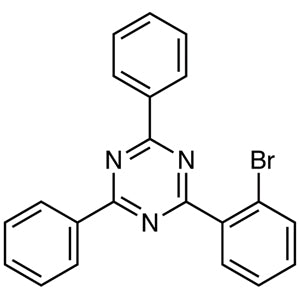
- TCI B5663 77989-15-2 2-(2-Bromophenyl)-4,6-diphenyl-1,3,5-triazine
- TCI T4341 2130745-76-3 4',4''',4'''''-(1,3,5-Triazine-2,4,6-triyl)tris[([1,1'-biphenyl]-4-amine)]
- TCI T4078 443922-06-3 4,4',4''-(1,3,5-Triazine-2,4,6-triyl)tribenzaldehyde
- Small molecule semiconductor synthesis: the symmetric triazine core and three reactive bromine sites let researchers build star-shaped semiconducting molecules with defined electron-accepting character.
- Optoelectronic material development: the electron-deficient triazine center works as an acceptor unit, so it suits the design of molecules for light-emitting and charge-transport studies.
- Porous framework and polymer construction: the rigid C3-symmetric geometry and three coupling points make it a natural node for building extended porous organic networks and frameworks.
- Palladium-catalyzed cross-coupling research: its aryl bromide groups react well in Suzuki-Miyaura, Sonogashira, Heck, and Buchwald-Hartwig couplings, which lets researchers install three identical arms in one step.
- Thermally stable material design: the rigid aromatic triazine framework provides the thermal and chemical stability that electronic materials and porous polymers need for further processing and testing.
| Brand | TCI (product code T3178) |
|---|---|
| CAS number | 30363-03-2 |
| Molecular formula | — |
| Purity | — |
| Category | Materials Science > Material Building Blocks > Small Molecule Semiconductor Building Blocks |
| Pack sizes | see the available options on the product page |
| Physical form | refer to the TCI product documentation |
| Storage | keep the container tightly closed in a cool, dry place and follow the TCI label and Safety Data Sheet (SDS) |
Store 2,4,6-Tris(4-bromophenyl)-1,3,5-triazine in its original, tightly sealed container in a cool, dry, well-ventilated area, away from direct sunlight, moisture, and incompatible substances such as strong oxidizing agents. Label containers clearly and reseal them promptly after each use to protect the reagent's quality. When handling the material, wear standard personal protective equipment, including a lab coat, safety glasses, and chemical-resistant gloves. Weigh and transfer the compound in a fume hood or ventilated enclosure to avoid inhaling dust, and avoid contact with skin and eyes. Always read the TCI Safety Data Sheet before use, and dispose of waste according to your institution's procedures and local regulations.
—
Produk Terkait
-
2,4,6-Tris(3-bromophenyl)-1,3,5-triazine TCI T3308
Regular price From Rp 1.776.600,00Regular priceRp 1.257.900,00Sale price From Rp 1.776.600,00 -
2-(4-Bromophenyl)-4,6-diphenyl-1,3,5-triazine TCI B4927
Regular price From Rp 2.093.700,00Regular priceRp 1.479.450,00Sale price From Rp 2.093.700,00 -
2-(3-Bromophenyl)-4,6-diphenyl-1,3,5-triazine TCI B4894
Regular price From Rp 2.279.550,00Regular priceRp 1.609.650,00Sale price From Rp 2.279.550,00 -
2-(2-Bromophenyl)-4,6-diphenyl-1,3,5-triazine TCI B5663
Regular price From Rp 1.908.900,00Regular priceRp 1.350.300,00Sale price From Rp 1.908.900,00 -
4',4''',4'''''-(1,3,5-Triazine-2,4,6-triyl)tris[([1,1'-biphenyl]-4-amine)] TCI T4341
Regular price From Rp 2.677.500,00Regular priceRp 1.887.900,00Sale price From Rp 2.677.500,00 -
4,4',4''-(1,3,5-Triazine-2,4,6-triyl)tribenzaldehyde TCI T4078
Regular price Rp 4.796.400,00Regular priceRp 3.369.450,00Sale price Rp 4.796.400,00 -
4,4',4''-(1,3,5-Triazine-2,4,6-triyl)trianiline TCI T3695
Regular price From Rp 4.504.500,00Regular priceRp 3.165.750,00Sale price From Rp 4.504.500,00 -
2,4-Bis(4-biphenylyl)-6-chloro-1,3,5-triazine TCI B4941
Regular price From Rp 717.150,00Regular priceRp 516.600,00Sale price From Rp 717.150,00