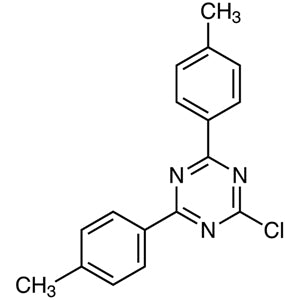
2,4-Bis(4-biphenylyl)-6-chloro-1,3,5-triazine is a specialized chemical compound used in semiconductor material research. This compound plays a crucial role in the development of advanced electronic materials due to its unique molecular structure. It is a key building block in the synthesis of materials that require precise electronic properties and stability under various conditions. Its presence in the laboratory supports innovation in both material science and electronic device fabrication.
The compound is favored for its chemical stability and resistance to unwanted reactions, making it reliable for repeated use in experimental processes. Its complex molecular structure provides distinctive reactivity and compatibility with a wide range of other compounds, enabling precise control over material synthesis. These properties make it an essential component in the creation of high-performance electronic materials. Additionally, its solubility in organic solvents simplifies handling and integration into laboratory workflows.
In Indonesian laboratories, this compound is widely used for research in semiconductor technology and energy materials. It is a vital resource for institutions and research groups focused on developing new materials with specific electronic and optical properties. Its application supports both academic and industrial research, contributing to advancements in optoelectronic and semiconductor technologies.
TCI brochures (PDF)
- Building Blocks for Organic Semiconductor 2026-03-24 · p. 17
Related TCI products
- TCI B4940 10202-45-6 2-(4-Biphenylyl)-4,6-dichloro-1,3,5-triazine
- TCI C3543 1459162-69-6 2-Chloro-4,6-bis(9,9-dimethyl-9H-fluoren-2-yl)-1,3,5-triazine
- TCI C3525 78941-32-9 2-Chloro-4,6-di(naphthalen-1-yl)-1,3,5-triazine
- TCI C3514 21902-34-1 2-Chloro-4,6-di-p-tolyl-1,3,5-triazine
- TCI C2703 3842-55-5 2-Chloro-4,6-diphenyl-1,3,5-triazine
- TCI B5804 253158-13-3 2,4-Bis[4-(tert-butyl)phenyl]-6-chloro-1,3,5-triazine
- Semiconductor material synthesis for advanced electronic devices due to its stable molecular structure and unique electronic properties.
- Development of optoelectronic components requiring precise control over conductivity and optical behavior.
- Research in energy materials, particularly in the design of high-performance photovoltaic and light-emitting materials.
- Creation of coating materials with enhanced durability and electrical conductivity for industrial applications.
- Support for academic research in material science, focusing on molecular engineering and functional material design.
| Brand | TCI |
|---|---|
| CAS number | 182918-13-4 |
| Molecular formula | — |
| Purity | — |
| Category | Materials Science > Material Building Blocks > Small Molecule Semiconductor Building Blocks |
| Pack sizes | Available in standard laboratory quantities as per supplier specifications |
| Physical form | Solid, crystalline appearance |
| Storage | Store in a cool, dry place away from direct sunlight and moisture |
This compound should be stored in a cool, dry environment, away from direct sunlight and moisture to maintain its chemical integrity. It is recommended to use sealed containers made of materials resistant to chemical interaction, such as glass or high-density polyethylene. Due to its complex molecular structure, it should be handled with care to prevent accidental exposure. In a laboratory setting, it is important to follow standard safety protocols, including proper ventilation and the use of personal protective equipment. Regular monitoring of storage conditions ensures the compound remains stable and suitable for use in research applications.
—
Produk Terkait
-
2-(4-Biphenylyl)-4,6-dichloro-1,3,5-triazine TCI B4940
Regular price From Rp 769.650,00Regular priceRp 553.350,00Sale price From Rp 769.650,00 -
2-Chloro-4,6-bis(9,9-dimethyl-9H-fluoren-2-yl)-1,3,5-triazine TCI C3543
Regular price From Rp 3.260.250,00Regular priceRp 2.295.300,00Sale price From Rp 3.260.250,00 -
2-Chloro-4,6-di(naphthalen-1-yl)-1,3,5-triazine TCI C3525
Regular price From Rp 1.776.600,00Regular priceRp 1.257.900,00Sale price From Rp 1.776.600,00 -
2-Chloro-4,6-di-p-tolyl-1,3,5-triazine TCI C3514
Regular price From Rp 2.252.250,00Regular priceRp 1.590.750,00Sale price From Rp 2.252.250,00 -
2-Chloro-4,6-diphenyl-1,3,5-triazine TCI C2703
Regular price From Rp 2.942.100,00Regular priceRp 2.072.700,00Sale price From Rp 2.942.100,00 -
2,4-Bis[4-(tert-butyl)phenyl]-6-chloro-1,3,5-triazine TCI B5804
Regular price From Rp 2.332.050,00Regular priceRp 1.646.400,00Sale price From Rp 2.332.050,00 -
2-([1,1'-Biphenyl]-3-yl)-4-chloro-6-phenyl-1,3,5-triazine TCI B5803
Regular price From Rp 769.650,00Regular priceRp 553.350,00Sale price From Rp 769.650,00 -
2-([1,1'-Biphenyl]-4-yl)-4-chloro-6-phenyl-1,3,5-triazine TCI B5792
Regular price From Rp 1.723.050,00Regular priceRp 1.220.100,00Sale price From Rp 1.723.050,00