

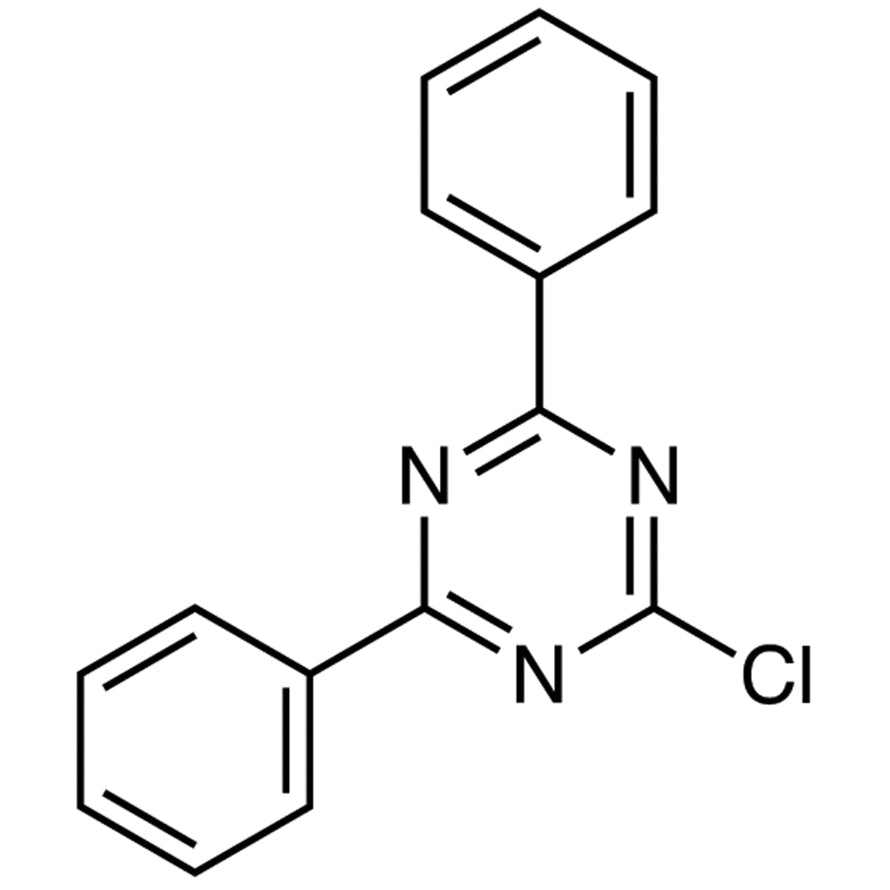
2-Chloro-4,6-diphenyl-1,3,5-triazine is a chemical compound widely used in scientific research, particularly in the fields of materials science and semiconductors. This compound serves as a fundamental building block in the synthesis of complex molecules with triazine structures. Its unique chemical composition allows researchers to create materials with tailored optical and electronic properties. In the laboratory, it plays a crucial role in the development of advanced materials, contributing to the innovation of new compounds with specific functionalities.
The compound is valued for its stable heterocyclic structure and its ability to react with various functional groups. These characteristics make it a preferred choice for organic synthesis, especially in applications requiring high reactivity. Its solubility in organic solvents further enhances its usability, simplifying the processing and handling in experimental settings. This versatility supports a wide range of chemical reactions and material development projects.
In Indonesian laboratories, 2-Chloro-4,6-diphenyl-1,3,5-triazine is commonly used in semiconductor material research, optical material development, and catalytic studies. Researchers from academic and industrial institutions rely on this compound to explore new material properties and advance technological applications in the field of chemistry and materials science.
TCI brochures (PDF)
- Building Blocks for Organic Semiconductor 2026-03-24 · p. 17
Related TCI products
- TCI B4939 80984-79-8 2-Bromo-4,6-diphenyl-1,3,5-triazine
- TCI B4927 23449-08-3 2-(4-Bromophenyl)-4,6-diphenyl-1,3,5-triazine
- TCI B4894 864377-31-1 2-(3-Bromophenyl)-4,6-diphenyl-1,3,5-triazine
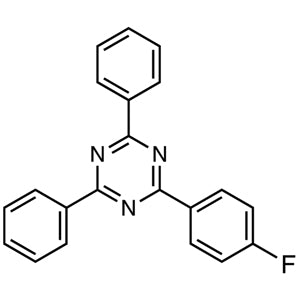
- TCI F1045 203450-08-2 2-(4-Fluorophenyl)-4,6-diphenyl-1,3,5-triazine
- TCI D5271 1219956-23-6 2,4-Diphenyl-6-[4-(4,4,5,5-tetramethyl-1,3,2-dioxaborolan-2-yl)phenyl]-1,3,5-triazine
- TCI D4902 1073062-59-5 2-(3,5-Dibromophenyl)-4,6-diphenyl-1,3,5-triazine
- Semiconductor material development due to its ability to form complex molecular structures essential for electronic devices.
- Optical material synthesis because of its stable heterocyclic framework that supports light-responsive properties.
- Catalytic research as a building block for creating reactive intermediates in chemical reactions.
- Organic synthesis applications due to its reactivity with various functional groups for compound modification.
- Advanced material design in research projects requiring tailored optical and electronic characteristics.
| Brand | TCI |
|---|---|
| CAS number | 3842-55-5 |
| Molecular formula | — |
| Purity | — |
| Category | Materials Science > Material Building Blocks > Small Molecule Semiconductor Building Blocks |
| Pack sizes | Available in standard laboratory quantities as per supplier specifications |
| Physical form | Solid, crystalline |
| Storage | Store in a cool, dry place away from direct sunlight and moisture |
This compound should be stored in a cool, dry environment, away from direct sunlight and moisture to maintain its chemical stability. It is recommended to use airtight containers made of glass or high-density polyethylene to prevent contamination and degradation. Due to its reactivity, it should be handled in a well-ventilated area, and appropriate personal protective equipment, such as gloves and safety goggles, should be worn. Avoid contact with incompatible substances, and ensure proper waste disposal in accordance with local regulations. Regular monitoring of storage conditions is advised to ensure the material remains suitable for use in laboratory applications.
—
Produk Terkait
-
2-Bromo-4,6-diphenyl-1,3,5-triazine TCI B4939
Regular price From Rp 3.843.000,00Regular price -
2-(4-Bromophenyl)-4,6-diphenyl-1,3,5-triazine TCI B4927
Regular price From Rp 2.041.200,00Regular price -
2-(3-Bromophenyl)-4,6-diphenyl-1,3,5-triazine TCI B4894
Regular price From Rp 2.227.050,00Regular price -
2-(4-Fluorophenyl)-4,6-diphenyl-1,3,5-triazine TCI F1045
Regular price From Rp 584.850,00Regular price -
2,4-Diphenyl-6-[4-(4,4,5,5-tetramethyl-1,3,2-dioxaborolan-2-yl)phenyl]-1,3,5-triazine TCI D5271
Regular price From Rp 3.127.950,00Regular price -
2-(3,5-Dibromophenyl)-4,6-diphenyl-1,3,5-triazine TCI D4902
Regular price From Rp 1.353.450,00Regular price -
2-(4'-Chlorobiphenyl-3-yl)-4,6-diphenyl-1,3,5-triazine TCI C3164
Regular price From Rp 1.167.600,00Regular price -
2-(3'-Chlorobiphenyl-4-yl)-4,6-diphenyl-1,3,5-triazine TCI C3163
Regular price From Rp 1.115.100,00Regular price


![2,4-Diphenyl-6-[4-(4,4,5,5-tetramethyl-1,3,2-dioxaborolan-2-yl)phenyl]-1,3,5-triazine (CAS 1219956-23-6) - TCI D5271 - AMI Scientific](http://amiscientific.com/cdn/shop/files/TCI2510D5271.jpg?v=1769142099&width=533)


