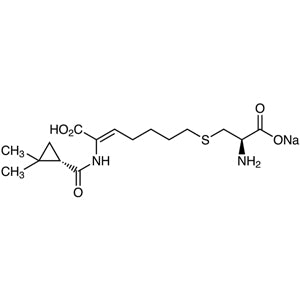
Cilastatin Sodium Salt (TCI C3547, CAS 81129-83-1) is a chemical compound widely used in pharmaceutical research and biochemical studies. It serves as a critical reagent in experimental settings, particularly in the development of drugs and the investigation of metabolic processes. This compound is essential for understanding enzyme activity and biochemical reactions, making it a valuable tool for researchers in life sciences. Its role extends to the study of pharmacokinetics and the interaction of drugs with biological systems.
The compound is known for its water solubility and chemical stability, which make it a preferred choice for various laboratory applications. As a sodium salt of cilastatin, it maintains its structural integrity under different experimental conditions, ensuring reliable results. Its ability to interact specifically with certain enzymes, such as acylase, enhances its utility in targeted biochemical studies. These properties contribute to its widespread use in both academic and industrial research environments.
In Indonesian laboratories, Cilastatin Sodium Salt is commonly used in pharmaceutical, biochemical, and medical research. It is frequently found in experiments related to drug effect studies, enzyme activity testing, and the development of new pharmaceutical compounds. Its reliability and availability make it an essential component in scientific research, supporting advancements in drug discovery and biochemical analysis.
TCI brochures (PDF)
- Pharmaceutical Ingredients for Research and Experimental Use 2026-03-09 · p. 43
- Pharmaceutical Research: Used to investigate drug metabolism and enzyme interactions, aiding in the development of new therapeutic agents.
- Biochemical Studies: Serves as a reagent for studying enzyme activity and biochemical pathways, supporting fundamental research in life sciences.
- Drug Discovery: Plays a key role in evaluating the pharmacological effects of compounds and their interactions with biological systems.
- Enzyme Kinetics Analysis: Facilitates the study of enzyme inhibition and activation, essential for understanding metabolic processes.
- Clinical Research: Applied in experiments that assess drug efficacy and safety, contributing to medical advancements and treatment strategies.
| Brand | TCI |
|---|---|
| CAS number | 81129-83-1 |
| Molecular formula | — |
| Purity | — |
| Category | Life Science > Biochemicals and Reagents > Pharmaceutical Research Reagents |
| Pack sizes | Available in various quantities as per standard laboratory requirements |
| Physical form | Sodium salt powder |
| Storage | Store in a cool, dry place away from moisture and direct sunlight |
Cilastatin Sodium Salt should be stored in a cool, dry environment to maintain its chemical stability and prevent degradation. It is recommended to keep the compound in a tightly sealed container to avoid moisture exposure, which could affect its solubility and purity. Suitable storage conditions include a controlled room temperature, typically between 15°C and 25°C, with low humidity levels. Laboratory personnel should handle the compound with care, using appropriate personal protective equipment such as gloves and safety goggles. It is important to ensure that the compound is stored away from incompatible substances to prevent any chemical reactions. Proper labeling of containers is essential for safe handling and to prevent accidental misuse in the laboratory setting.
—
Product Categories
Produk Terkait
-
Ibudilast TCI I0740
Regular price From Rp 1.908.900,00Regular price -
IvabradineHydrochloride TCI I0847
Regular price From Rp 4.611.600,00Regular price -
Carbazochrome TCI A0176
Regular price From Rp 2.227.050,00Regular price -
L-Adrenaline TCI A0173
Regular price Rp 1.298.850,00Regular price -
Zonisamide TCI Z0026
Regular price From Rp 2.147.250,00Regular price -
Xipamide TCI X0079
Regular price Rp 5.114.550,00Regular price -
Xylazine TCI X0069
Regular price Rp 1.908.900,00Regular price -
XylometazolineHydrochloride TCI X0063
Regular price From Rp 1.193.850,00Regular price