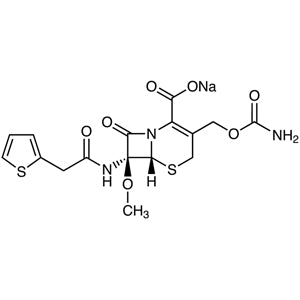
Cefoxitin is a β-lactam antibiotic from the cephamycin group, closely related in structure to the cephalosporins. Its defining feature is a methoxy group at the 7α position of the cephem nucleus, which gives it high resistance to many β-lactamase enzymes. In the laboratory, Cefoxitin is used as a biochemical and microbiological reagent. Typical uses include antimicrobial susceptibility testing, studies of bacterial resistance mechanisms, and biochemical research on penicillin-binding proteins and cell wall synthesis. This TCI product (C3598) is supplied for research use.
Like other β-lactam antibiotics, Cefoxitin works by inhibiting penicillin-binding proteins (PBPs), which build the peptidoglycan of the bacterial cell wall. Because it resists β-lactamase, researchers use it to tell different resistance mechanisms apart. In clinical microbiology, Cefoxitin is a well-known screening agent for detecting methicillin resistance in Staphylococcus aureus, which is governed by the mecA gene. Cefoxitin is also known to induce AmpC β-lactamase expression in a number of Gram-negative bacteria. For this reason it is often used in studies of how resistance is regulated, and it serves as a reference compound in many research settings.
For Indonesian laboratories, Cefoxitin is relevant to microbiology laboratories at universities, research institutes, and clinical and hospital laboratories that study antimicrobial resistance. It fits research groups that track resistant Staphylococcus and Gram-negative isolates, teaching laboratories that demonstrate how β-lactam antibiotics work, and biochemistry teams that study bacterial cell wall synthesis. A reagent from an established brand such as TCI helps these laboratories keep their work consistent and reproducible across experiments and over long research projects.
TCI brochures (PDF)
- Antimicrobials and Antitumor Agents for Research and Experimental Use 2025-04-24 · p. 3
- Pharmaceutical Ingredients for Research and Experimental Use 2026-03-09 · p. 3
- Antimicrobial susceptibility testing: Cefoxitin is a widely recognised β-lactam reference agent for testing how susceptible bacterial isolates are under controlled laboratory conditions.
- Methicillin-resistance screening in Staphylococcus aureus: Cefoxitin is a well-known screening agent for detecting mecA-mediated methicillin resistance in clinical and research microbiology.
- AmpC β-lactamase induction studies: Cefoxitin can induce AmpC β-lactamase expression in a number of Gram-negative bacteria, which makes it useful for studying how resistance is regulated.
- Distinguishing resistance mechanisms: Because the 7α-methoxy group makes Cefoxitin resistant to many β-lactamases, comparing it with other β-lactams helps separate enzyme-based resistance from other mechanisms.
- Penicillin-binding protein and cell wall research: Cefoxitin inhibits the penicillin-binding proteins that build peptidoglycan, so it suits biochemical studies of bacterial cell wall synthesis.
| Brand | TCI (product code C3598) |
|---|---|
| CAS number | 35607-66-0 |
| Molecular formula | — |
| Purity | — |
| Category | Life Science > Biochemicals and Reagents > Antibiotics |
| Pack sizes | please refer to the current product listing for available pack sizes |
| Physical form | — |
| Storage | follow the storage conditions on the product label and the Safety Data Sheet |
Store Cefoxitin in its original, tightly closed container, protected from moisture, heat, and direct light, and follow the storage temperature stated on the product label and Safety Data Sheet. Reclose the container promptly after each use so the reagent is not exposed to humidity for long. Prepare solutions with clean glassware or sterile plasticware suited to microbiological work, and label them clearly with the name and preparation date. Handle the material in line with good laboratory practice: wear gloves, a lab coat, and eye protection, avoid creating or breathing in dust, and avoid contact with skin and eyes. Because β-lactam antibiotics can cause allergic reactions in sensitive people, anyone with a known penicillin or cephalosporin allergy should take extra care. Dispose of waste and contaminated cultures according to institutional biosafety and chemical waste rules.
—
Product Categories
- Biochemicals and ReagentsAntibioticsAntibiotics (Chemical Structure Class)
- Biochemicals and ReagentsPharmaceutical Research Reagents (for Experimental Use)Antimicrobial Ingredients (for Research and Experimental Use)
- MicrobiologyAntibioticsAntibiotics (Chemical Structure Class)
- Pharmaceutical Development and Drug Discovery ResearchPharmaceutical Research Reagents (for Experimental Use)Antimicrobial Ingredients (for Research and Experimental Use)
- Pharmaceutical Development and Drug Discovery ResearchAntibioticsAntibiotics (Chemical Structure Class)
Produk Terkait
-
CefoxitinSodium TCI C3602
Regular price Rp 4.108.650,00Regular priceRp 2.888.550,00Sale price Rp 4.108.650,00 -
4-AminosalicylicAcid TCI A0420
Regular price From Rp 822.150,00Regular priceRp 590.100,00Sale price From Rp 822.150,00 -
Sodium4-AminosalicylateDihydrate TCI A0423
Regular price From Rp 928.200,00Regular priceRp 664.650,00Sale price From Rp 928.200,00 -
Wortmannin TCI W0007
Regular price Rp 11.632.950,00Regular priceRp 8.150.100,00Sale price Rp 11.632.950,00 -
ValganciclovirHydrochloride TCI V0158
Regular price From Rp 1.618.050,00Regular priceRp 1.146.600,00Sale price From Rp 1.618.050,00 -
ValnemulinHydrochloride TCI V0144
Regular price From Rp 4.982.250,00Regular priceRp 3.499.650,00Sale price From Rp 4.982.250,00 -
Sulfamerazine TCI U0176
Regular price From Rp 2.411.850,00Regular priceRp 1.702.050,00Sale price From Rp 2.411.850,00 -
SulfadiazineSodium TCI U0171
Regular price Rp 1.220.100,00Regular priceRp 868.350,00Sale price Rp 1.220.100,00