

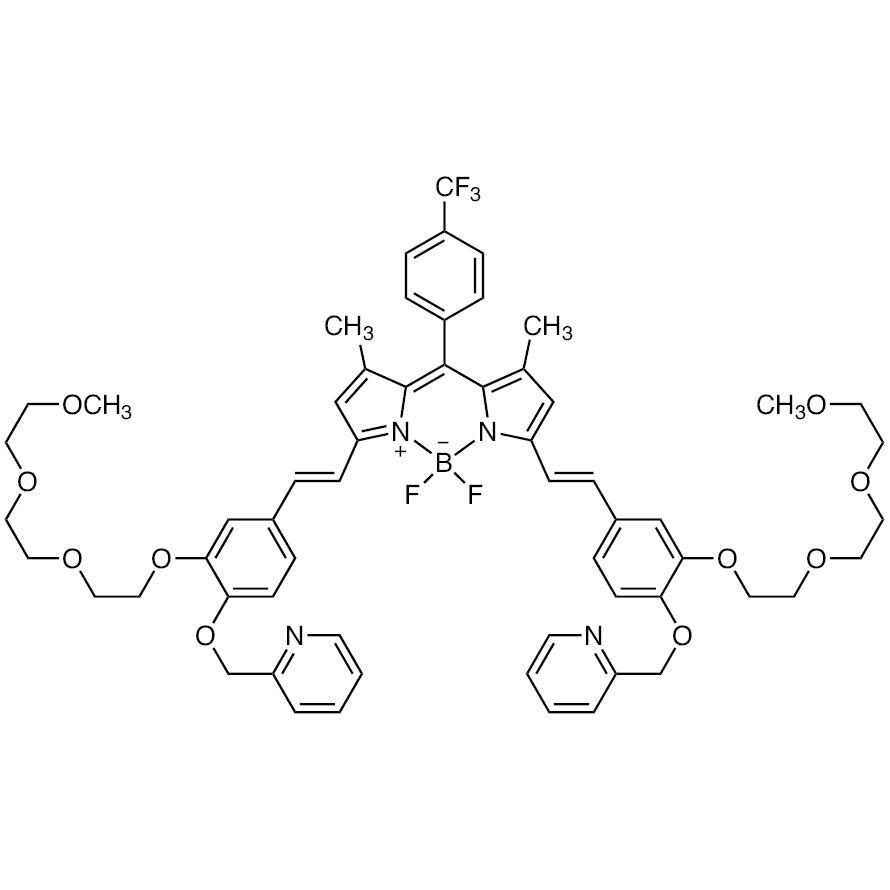
TCI C3662 CF-BI is a chemical compound classified under Dipyrromethene Dyes, a specialized category within the field of optical and photonic materials. This compound plays a crucial role in laboratory research, particularly in the development of materials with unique optical properties. Its ability to absorb and emit light efficiently makes it an essential component in studies involving fluorescence and light-responsive materials. In the context of materials science, TCI C3662 CF-BI is used to create advanced photonic materials that can interact with light in specific ways, enabling innovative applications in optical technology and analytical chemistry.
The compound is preferred due to its complex chemical structure, which provides both reactivity and stability under various experimental conditions. Its high efficiency in light absorption and emission allows for precise control in optical experiments, making it ideal for applications requiring high sensitivity and specificity. Additionally, its unique molecular configuration enables it to be tailored for different research needs, enhancing its versatility in both academic and industrial settings. These characteristics make TCI C3662 CF-BI a valuable resource for researchers working on advanced optical and photonic material development.
In Indonesian laboratories, TCI C3662 CF-BI is widely utilized in research related to photonics, optoelectronics, and analytical chemistry. It is particularly relevant for institutions focusing on material innovation and optical technology. Many universities and research centers in Indonesia rely on this compound to advance their studies in light-sensitive materials, contributing to the growth of scientific knowledge and technological development in the region.
- Photonic Material Development: TCI C3662 CF-BI is ideal for creating materials with unique optical properties, enabling the design of advanced photonic devices.
- Fluorescence Spectroscopy Studies: Its high light absorption and emission efficiency make it suitable for fluorescence-based analytical techniques.
- Optical Sensor Fabrication: The compound’s light-responsive nature allows it to be integrated into sensors for detecting specific environmental or chemical changes.
- Light-Responsive Material Research: Its ability to interact with light makes it valuable for studying materials that change properties under illumination.
- Analytical Chemistry Applications: The compound is used in experiments requiring precise optical measurements and light-based detection methods.
| Brand | TCI |
|---|---|
| CAS number | — |
| Molecular formula | — |
| Purity | — |
| Category | Materials Science > Photonic Materials and Optical Materials > Dipyrromethene Dyes |
| Pack sizes | As per supplier specifications |
| Physical form | — |
| Storage | Store in a cool, dry place away from light and moisture |
TCI C3662 CF-BI should be stored in a cool, dry environment, away from direct light and moisture to maintain its stability and effectiveness. It is recommended to use airtight containers to prevent contamination and degradation. In laboratory settings, proper ventilation should be ensured when handling the compound to minimize exposure. Always wear appropriate personal protective equipment, such as gloves and safety goggles, to ensure safe handling. The compound should be kept in a secure location, away from incompatible materials to prevent any potential chemical interactions. Proper storage practices are essential to preserve the compound’s integrity and ensure its usability in research applications.
—
Produk Terkait
-
5-Bromobenzoxazole TCI B5515
Regular price From Rp 1.696.800,00Regular price -
BMS-599626 TCI B5520
Regular price From Rp 3.525.900,00Regular price -
6-Bromobenzo[b]thiophene TCI B5523
Regular price Rp 3.392.550,00Regular price -
3-tert-Butyl4-Methyl(4R,5S)-2,2,5-Trimethyloxazolidine-3,4-dicarboxylate TCI B5538
Regular price Rp 2.969.400,00Regular price -
Biotin-PEG4-Azide TCI B5546
Regular price Rp 7.897.050,00Regular price -
Benzo[b]benzo[4,5]thieno[2,3-d]thiophene TCI B5551
Regular price From Rp 903.000,00Regular price -
2-Bromo-5-(4-hexylphenyl)thiophene TCI B5553
Regular price Rp 3.207.750,00Regular price -
Biotin-PEG4-Amine TCI B5560
Regular price From Rp 1.510.950,00Regular price


![6-Bromobenzo[b]thiophene (CAS 17347-32-9) - TCI B5523 - AMI Scientific](http://amiscientific.com/cdn/shop/files/TCI2510B5523.jpg?v=1767092466&width=533)


![Benzo[b]benzo[4,5]thieno[2,3-d]thiophene (CAS 248-70-4) - TCI B5551 - AMI Scientific](http://amiscientific.com/cdn/shop/files/TCI2510B5551.jpg?v=1768815817&width=533)

