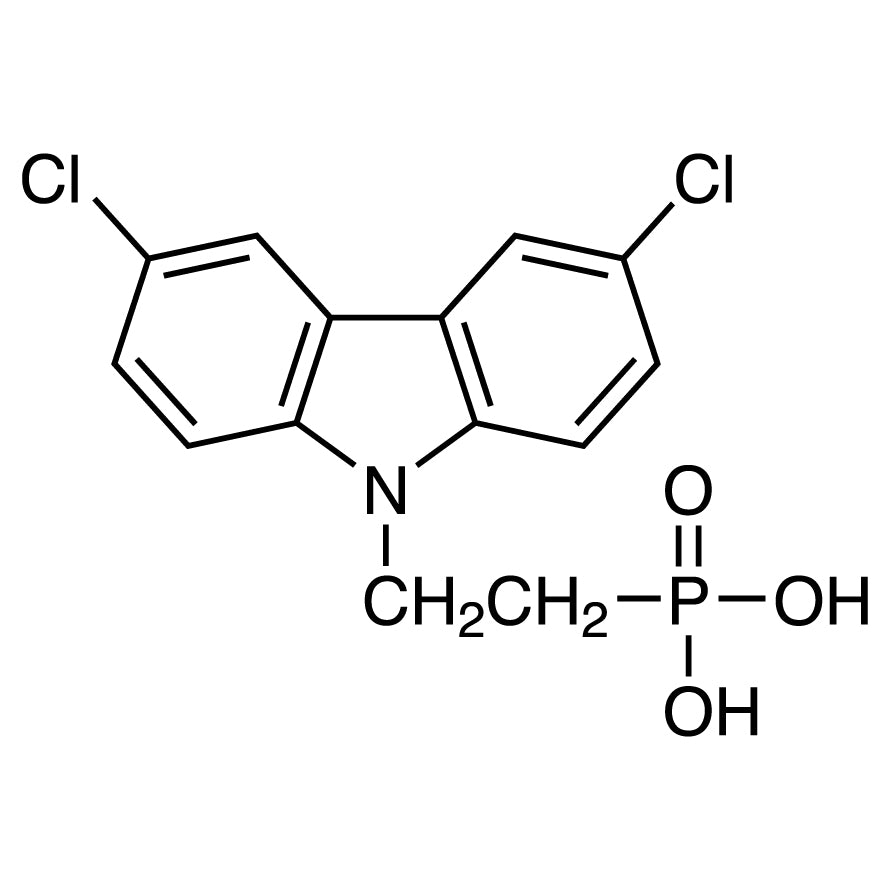
TCI C3914 Cl-2PACz is a chemical compound widely utilized in the research and development of perovskite solar cells (PSCs). As a key component in the active layer structure of PSCs, it functions as an electron transport material, facilitating efficient charge transfer within the cell. This material plays a crucial role in enhancing the overall performance of perovskite-based photovoltaic systems. Due to its unique chemical structure, it enables effective interaction with other perovskite layers, contributing to the stability and efficiency of the final device. Its application in laboratory settings is essential for advancing the field of renewable energy technologies.
The material is preferred for its excellent electron conductivity and chemical stability. These properties allow it to maintain performance over extended periods, reducing degradation during experimental testing. Its compatibility with various perovskite compositions makes it a versatile choice for researchers seeking to optimize device efficiency. Additionally, its chemical stability ensures that it remains effective under different experimental conditions, making it a reliable option for consistent results in laboratory studies.
In Indonesian laboratories, TCI C3914 Cl-2PACz is commonly used in scientific research focused on renewable energy and advanced materials. Researchers in the fields of energy technology and material science rely on this compound to develop high-performance perovskite solar cells. Its role in improving the efficiency and stability of these devices makes it an essential tool for innovation in sustainable energy solutions.
Advantages (TCI brochure)
- Forms hole extracting self-assembled monolayer (SAM) on ITO surfaces
- Improves performance and stability of organic photovoltaics (OPV)
TCI brochures (PDF)
- Hole-selective SAM Forming Agent Contributing to Improved Performance of OPVs Cl-2PACz 2024-01-26 · p. 1
- For Highly Efficient Solar Cells, Hole-Selective, Self-Assembled Monolayer (SAM)-Forming Agents 2024-09-02 · p. 1
- n-Type SAM Forming Agent Enabling Efficient Perovskite Solar Cell PANDI 2026-09-10 · p. 2
- SAM Forming Agent Enabling a Superwetting Layer for Uniform Perovskite Formation: MPA-CPA 2026-07-07 · p. 2
- SAM-Forming Agent for Efficient NBG-Type Perovskite Solar Cells: BrNH3-4PACz 2025-10-22 · p. 2
- Carbazoles 2025-06-27 · p. 4
Related TCI products
- TCI Z0037 14320-04-8 Zinc Phthalocyanine (purified by sublimation)
- TCI T3656 952431-34-4 N,N,N',N'-Tetra([1,1'-biphenyl]-4-yl)[1,1':4',1''-terphenyl]-4,4''-diamine
- TCI T3634 189363-47-1 2,2',7,7'-Tetrakis(diphenylamino)-9,9'-spirobi[9H-fluorene]
- TCI T3266 15546-43-7 N,N,N',N'-Tetraphenylbenzidine (purified by sublimation)
- TCI T2233 517-51-1 5,6,11,12-Tetraphenylnaphthacene (purified by sublimation)
- TCI T1812 15546-43-7 N,N,N',N'-Tetraphenylbenzidine
- Perovskite Solar Cell Fabrication: This material is ideal for constructing the active layer of PSCs due to its electron transport properties and compatibility with perovskite layers.
- Electronic Material Research: It is used in studies aimed at improving the efficiency and stability of perovskite-based photovoltaic systems.
- Material Stability Testing: Its chemical stability makes it suitable for experiments evaluating the long-term performance of perovskite materials.
- Renewable Energy Development: Researchers use it to develop and test new materials for sustainable energy applications.
- Thin Film Deposition Studies: Its chemical structure allows it to be integrated into thin film processes for creating efficient solar cell layers.
From the TCI brochure
- Hole-selective SAM forming agent for organic photovoltaics (OPV)
| Brand | TCI |
|---|---|
| CAS number | 1178-38-9 |
| Molecular formula | — |
| Purity | — |
| Category | Materials Science > Electronic Materials > Perovskite Solar Cell (PSC) Materials |
| Pack sizes | 1g, 5g, 25g |
| Physical form | Powder |
| Storage | Store in a cool, dry place away from light and moisture |
TCI C3914 Cl-2PACz should be stored in a cool, dry environment, away from direct light and moisture to maintain its chemical stability. It is recommended to use airtight containers to prevent exposure to air and humidity, which could affect its performance. In laboratory settings, it should be handled with care to avoid contamination and ensure safe usage. Proper labeling and storage conditions are essential to maintain the integrity of the material during experiments. Always ensure that the workspace is well-ventilated and that appropriate personal protective equipment is worn when handling this compound.
—
Produk Terkait
-
ZincPhthalocyanine(purifiedbysublimation) TCI Z0037
Regular price Rp 4.954.950,00Regular priceRp 3.480.750,00Sale price Rp 4.954.950,00 -
N,N,N',N'-Tetra([1,1'-biphenyl]-4-yl)[1,1':4',1''-terphenyl]-4,4''-diamine TCI T3656
Regular price Rp 4.001.550,00Regular priceRp 2.814.000,00Sale price Rp 4.001.550,00 -
2,2',7,7'-Tetrakis(diphenylamino)-9,9'-spirobi[9H-fluorene] TCI T3634
Regular price Rp 4.531.800,00Regular priceRp 3.184.650,00Sale price Rp 4.531.800,00 -
N,N,N',N'-Tetraphenylbenzidine(purifiedbysublimation) TCI T3266
Regular price Rp 2.173.500,00Regular priceRp 1.535.100,00Sale price Rp 2.173.500,00 -
5,6,11,12-Tetraphenylnaphthacene(purifiedbysublimation) TCI T2233
Regular price Rp 2.279.550,00Regular priceRp 1.593.900,00Sale price Rp 2.279.550,00 -
N,N,N',N'-Tetraphenylbenzidine TCI T1812
Regular price Rp 2.173.500,00Regular priceRp 1.535.100,00Sale price Rp 2.173.500,00 -
Bis-PCBM(mixtureofisomers) TCI B4576
Regular price Rp 6.545.700,00Regular priceRp 4.576.950,00Sale price Rp 6.545.700,00 -
Bathophenanthroline(purifiedbysublimation) TCI B2695
Regular price Rp 5.485.200,00Regular priceRp 3.851.400,00Sale price Rp 5.485.200,00

![952431-34-4 N,N,N',N'-Tetra([1,1'-biphenyl]-4-yl)[1,1':4',1''-terphenyl]-4,4''-diamine - AMI Scientific](http://amiscientific.com/cdn/shop/files/TCI2510T3656.jpg?v=1769143755&width=533)
![189363-47-1 2,2',7,7'-Tetrakis(diphenylamino)-9,9'-spirobi[9H-fluorene] - AMI Scientific](http://amiscientific.com/cdn/shop/files/TCI2510T3634.jpg?v=1768819793&width=533)