

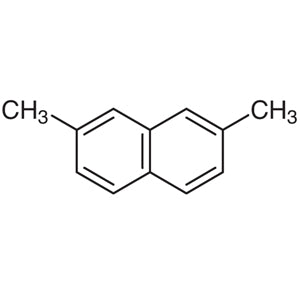
2,7-Dimethylnaphthalene is a chemical compound widely used in laboratory settings as a building block for various chemical reactions and molecular synthesis. This compound is derived from naphthalene, with two methyl groups attached at positions 2 and 7, enhancing its structural stability and reactivity. It plays a crucial role in the development of complex organic molecules, serving as an essential component in synthetic pathways. Its unique chemical properties make it a valuable tool for researchers working in organic chemistry and related fields.
The compound's molecular structure provides it with controlled reactivity, making it ideal for substitution and aromatic reactions. Its relatively high melting and boiling points facilitate efficient separation and purification processes in laboratory procedures. These physical properties, combined with its chemical versatility, make 2,7-Dimethylnaphthalene a preferred choice for both academic and industrial applications. Its stability under various reaction conditions further supports its use in a wide range of chemical experiments.
In Indonesian laboratories, 2,7-Dimethylnaphthalene is commonly used in organic chemistry research, particularly in the study of aromatic reactivity and the development of new compounds. It is also an important teaching material for students, helping them understand molecular structure and chemical reactivity. Its availability and reliability make it a staple in both educational and research environments across Indonesia.
- Aromatic Compound Synthesis: 2,7-Dimethylnaphthalene is ideal for synthesizing aromatic compounds due to its stable structure and reactivity, allowing for controlled chemical modifications.
- Organic Reaction Substrates: Its molecular framework supports various substitution and aromatic reactions, making it a versatile substrate in organic chemistry experiments.
- Teaching and Learning Materials: Used in educational settings to demonstrate molecular structure and reactivity, aiding students in understanding chemical behavior.
- Compound Development Research: Frequently employed in the development of new organic compounds, contributing to drug discovery and material science.
- Purification and Separation Processes: Its high melting and boiling points make it suitable for distillation and crystallization techniques in laboratory procedures.
| Brand | TCI |
|---|---|
| CAS number | 582-16-1 |
| Molecular formula | — |
| Purity | — |
| Category | Chemistry > Building Blocks > Non-Heterocyclic Building Blocks |
| Pack sizes | Available in various quantities as per supplier specifications |
| Physical form | Solid |
| Storage | Store in a cool, dry place away from direct sunlight |
2,7-Dimethylnaphthalene should be stored in a cool, dry environment to maintain its chemical integrity. It is recommended to use airtight containers to prevent exposure to moisture and air, which could affect its stability. Due to its solid form, it should be kept in a secure location away from heat sources and direct sunlight. In laboratory settings, it is important to handle the compound with care, using appropriate personal protective equipment. Proper labeling of storage containers is essential for safety and identification. Regular inspection of storage conditions ensures the compound remains in optimal condition for use in experiments.
—
Produk Terkait
-
1,4,5-Trimethylnaphthalene TCI T1711
Regular price Rp 2.889.600,00Regular price -
2,3,5-Trimethylnaphthalene TCI T0772
Regular price Rp 2.942.100,00Regular price -
2-Methylnaphthalene TCI M0372
Regular price From Rp 557.550,00Regular price -
1-Methylnaphthalene TCI M0371
Regular price From Rp 530.250,00Regular price -
2-Ethylnaphthalene TCI E0147
Regular price Rp 5.089.350,00Regular price -
1-Ethylnaphthalene TCI E0146
Regular price From Rp 2.279.550,00Regular price -
1,5-Dimethylnaphthalene TCI D2764
Regular price From Rp 1.644.300,00Regular price -
1,4-Dimethylnaphthalene TCI D1006
Regular price From Rp 3.287.550,00Regular price


