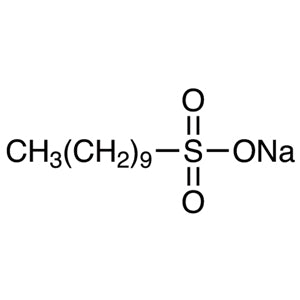
Sodium 1-Decanesulfonate is a chemical compound widely used in laboratory settings for its versatile applications in organic synthesis and chemical reactions involving sulfonate ions. This compound plays a key role in facilitating various chemical processes, including substitution reactions and esterification, where its sulfonate group contributes to the reactivity and stability of the reaction environment. It is a fundamental building block in the field of chemistry, particularly in the development of new compounds and the optimization of chemical pathways. Its presence in laboratory experiments is essential for achieving precise and reproducible results.
One of the key properties that make Sodium 1-Decanesulfonate a preferred choice is its solubility in both water and organic solvents. This dual solubility allows it to be used in a wide range of reaction conditions, making it adaptable to different experimental setups. Additionally, its stability under normal conditions ensures that it remains effective over time without degradation, which is crucial for long-term storage and repeated use. These characteristics contribute to its reliability and efficiency in laboratory applications.
In Indonesian laboratories, Sodium 1-Decanesulfonate is commonly used by researchers and students in higher education institutions and research organizations. It is an essential component of the chemical inventory required for both basic and advanced chemical experiments. Its availability and reliability make it a standard reagent in many laboratory workflows, supporting both teaching and research activities.
- Organic synthesis reactions benefit from Sodium 1-Decanesulfonate due to its ability to act as a sulfonate ion source, enhancing reaction efficiency and selectivity.
- Esterification processes often utilize this compound to facilitate the formation of ester bonds, improving the yield and purity of the final product.
- Substitution reactions in laboratory settings rely on its reactivity, allowing for the replacement of functional groups in complex molecules.
- Solubility in both aqueous and organic solvents makes it ideal for use in multi-phase reaction systems, enabling better mixing and reaction control.
- It is frequently employed in the preparation of surfactants and detergents, where its sulfonate group provides surface-active properties for various applications.
| Brand | TCI |
|---|---|
| CAS number | 13419-61-9 |
| Molecular formula | — |
| Purity | — |
| Category | Chemistry > Building Blocks > Non-Heterocyclic Building Blocks |
| Pack sizes | Available in various quantities as per standard laboratory supply options |
| Physical form | Solid powder |
| Storage | Store in a cool, dry place away from direct sunlight and moisture |
Sodium 1-Decanesulfonate should be stored in a cool, dry environment to maintain its chemical integrity and prevent degradation. It is recommended to keep it in airtight containers to avoid exposure to moisture and contaminants. Due to its hygroscopic nature, it is important to ensure that the storage area is well-ventilated and free from sources of heat or direct sunlight. When handling the compound, laboratory personnel should wear appropriate personal protective equipment, including gloves and safety goggles, to minimize exposure. Proper labeling of containers is essential to ensure safe handling and prevent accidental use in inappropriate applications. Regular inspection of storage conditions is advised to maintain the quality and usability of the compound over time.
—
Produk Terkait
-
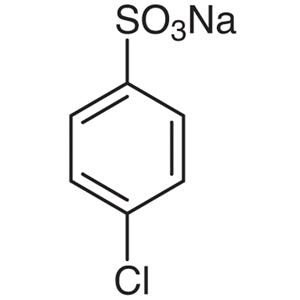
Sodium4-Chlorobenzenesulfonate TCI C0127
Regular price Rp 2.016.000,00Regular price -
Sodium2-Chlorotoluene-4-sulfonate TCI C0298
Regular price Rp 610.050,00Regular price -
4-ChlorobenzenesulfonicAcid TCI C0606
Regular price Rp 3.896.550,00Regular price -
ChloromethylsulfonylChloride TCI C0924
Regular price Rp 1.565.550,00Regular price -
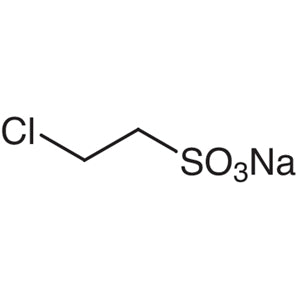
Sodium2-Chloroethanesulfonate(ca.13%inWater) TCI C1110
Regular price From Rp 637.350,00Regular price -
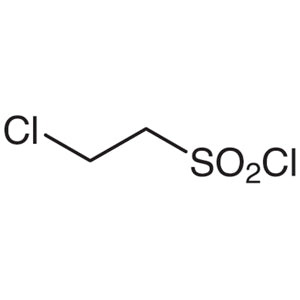
2-ChloroethanesulfonylChloride TCI C1142
Regular price From Rp 1.193.850,00Regular price -
2-Chloro-4-(trifluoromethyl)benzenesulfonylChloride TCI C1790
Regular price From Rp 1.087.800,00Regular price -
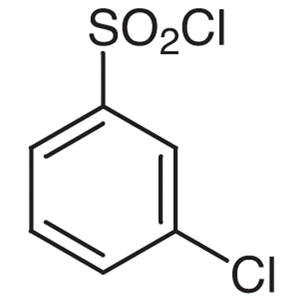
3-ChlorobenzenesulfonylChloride TCI C1791
Regular price From Rp 664.650,00Regular price