TCI D1280 2,6-Dimethylcyclohexanone (mixture of isomers) is a six-membered cyclic ketone carrying two methyl groups at both alpha positions relative to the carbonyl group, and is supplied as a mixture of cis and trans isomers. As a non-heterocyclic building block, this compound frequently serves as a starting material in the design of target molecules that require a symmetrically substituted cyclohexanone framework. Chemists use it to form new carbon-carbon bonds, carry out functional group transformations, and prepare intermediates that are developed further into bioactive compounds or fragrance materials within organic synthesis research programs.
The most distinctive feature of this compound is the double steric hindrance surrounding the carbonyl group created by the two flanking methyl substituents. This condition makes its carbonyl far more shielded than that of ordinary cyclohexanone, so the compound becomes a highly useful model for studying the influence of steric effects on the rate and direction of nucleophilic addition reactions. The symmetrical substitution pattern also simplifies the interpretation of NMR spectra, which makes it well suited to teaching work and to structural characterization research where clear, readable signal sets are an advantage.
In Indonesian laboratories, this material is typically found in university organic chemistry research groups, synthesis laboratories, and institutional research centers that build target molecules step by step. It is used in method development work, in postgraduate research projects, and in instructional laboratories where students learn how substitution patterns govern reactivity. Because it is supplied as an organic liquid, it fits routine bench handling with standard glassware, syringes, and fume hood practice already established in most laboratories.
Related TCI products
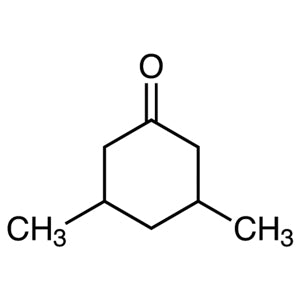
- TCI D1282 2320-30-1 3,5-Dimethylcyclohexanone (mixture of isomers)
- TCI D1281 5465-09-8 3,4-Dimethylcyclohexanone (mixture of isomers)
- TCI D1279 932-51-4 2,5-Dimethylcyclohexanone (mixture of isomers)
- TCI T4002 42594-17-2 Tricyclo[5210~2,6~]decanedimethanol Diacrylate (mixture of isomers) (stabilized with MEHQ)
- TCI T2701 6809-52-5 Teprenone [mixture of (5E,9E,13E)- and (5Z,9E,13E)- isomers]
- TCI B3371 14765-30-1 2-sec-Butylcyclohexanone (mixture of isomers)
- Organic synthesis building block work: the substituted cyclohexanone framework serves as a starting scaffold for constructing more complex target molecules in multi-step synthetic routes.
- Carbon-carbon bond formation studies: chemists use the reactive carbonyl centre to build new carbon-carbon bonds and extend molecular skeletons during synthetic route development in the laboratory.
- Steric effect investigations: the two flanking methyl groups shield the carbonyl strongly, making this compound a model substrate for examining how hindrance controls nucleophilic addition rates.
- Intermediate preparation for bioactive compounds and fragrance materials: the compound is converted into intermediates that research programs develop further toward bioactive or aroma chemistry targets.
- NMR characterization and teaching exercises: the symmetrical substitution pattern simplifies spectral interpretation, so it suits structure determination practice and instructional spectroscopy sessions for students.
| Brand | TCI |
|---|---|
| CAS number | 2816-57-1 |
| Molecular formula | — |
| Purity | — |
| Category | Chemistry > Building Blocks > Non-Heterocyclic Building Blocks |
| Pack sizes | available in the packaging options offered by the supplier for this catalogue item |
| Physical form | organic liquid, supplied as a mixture of cis and trans isomers |
| Storage | keep in a tightly closed original container in a cool, well-ventilated chemical store |
- Chemical name: 2,6-Dimethylcyclohexanone (mixture of isomers)
Store the product in its original tightly closed container in a cool, dry and well-ventilated chemical storage area, kept away from heat, open flame, and direct sunlight. Use containers that are compatible with organic liquids and keep them sealed when not in use to limit evaporation and moisture uptake. Handle and transfer the material inside a fume hood, using appropriate personal protective equipment such as safety glasses, chemical-resistant gloves, and a laboratory coat. Avoid contact with skin and eyes and avoid inhaling vapours. Keep the compound separated from strong oxidizing agents and other incompatible chemicals, label all working aliquots clearly, and consult the manufacturer safety data sheet before use and before disposal of residues or contaminated materials.
—
Produk Terkait
-
3,5-Dimethylcyclohexanone(mixtureofisomers) TCI D1282
Regular price From Rp 3.340.050,00Regular price -
3,4-Dimethylcyclohexanone(mixtureofisomers) TCI D1281
Regular price Rp 4.743.900,00Regular price -
2,5-Dimethylcyclohexanone(mixtureofisomers) TCI D1279
Regular price From Rp 4.240.950,00Regular price -
Tricyclo[5210~2,6~]decanedimethanolDiacrylate(mixtureofisomers)(stabilizedwithMEHQ) TCI T4002
Regular price From Rp 1.273.650,00Regular price -
Teprenone[mixtureof(5E,9E,13E)-and(5Z,9E,13E)-isomers] TCI T2701
Regular price From Rp 2.147.250,00Regular price -
2-sec-Butylcyclohexanone(mixtureofisomers) TCI B3371
Regular price Rp 1.060.500,00Regular price -
DiisononylAdipate(mixtureofbranchedchainisomers) TCI A1387
Regular price From Rp 584.850,00Regular price -
TetrapropenylsuccinicAnhydride(mixtureofbranchedchainisomers) TCI T0170
Regular price From Rp 505.050,00Regular price


![42594-17-2 Tricyclo[5.2.1.0~2,6~]decanedimethanol Diacrylate (mixture of isomers) (stabilized with MEHQ) - AMI Scientific](http://amiscientific.com/cdn/shop/files/TCI2510T4002.jpg?v=1767144579&width=533)
![6809-52-5 Teprenone [mixture of (5E,9E,13E)- and (5Z,9E,13E)- isomers] - AMI Scientific](http://amiscientific.com/cdn/shop/files/TCI2510T2701.jpg?v=1767143256&width=533)