

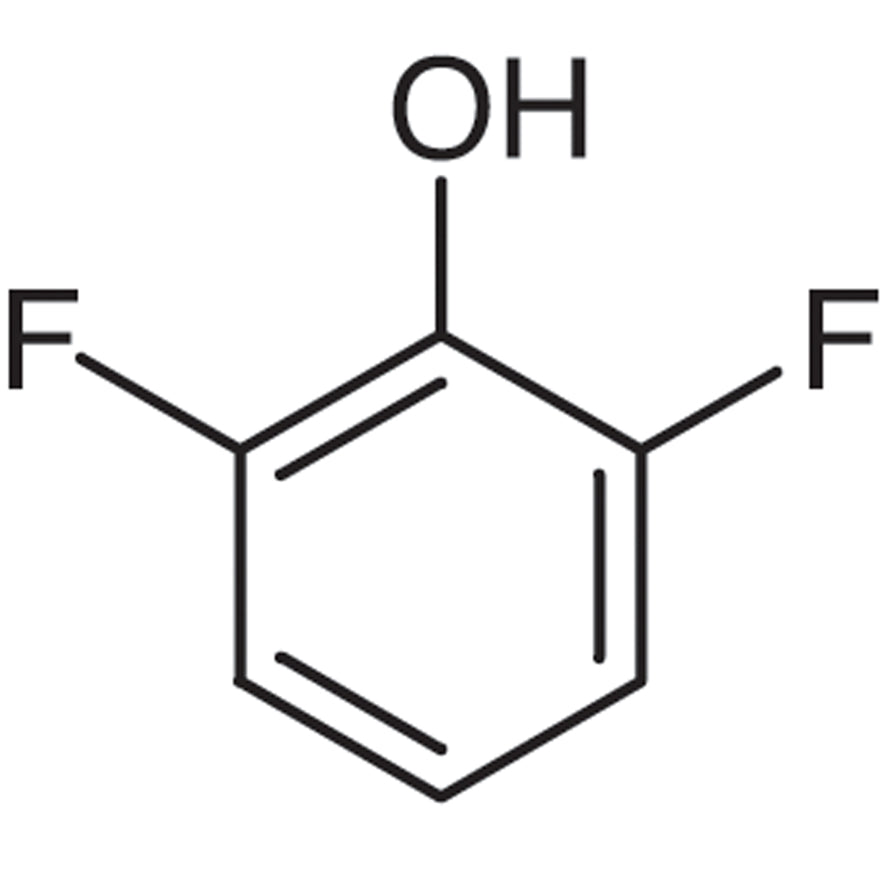
2,6-Difluorophenol is a chemical compound classified under fluorinated building blocks, commonly used as a foundational material in the synthesis of complex organic compounds. This compound features a phenol structure with two fluorine atoms at positions 2 and 6, which significantly influence its chemical properties and reactivity. In laboratory settings, it serves as a versatile precursor for the development of various compounds, including pharmaceuticals, industrial chemicals, and specialized organic materials. Its unique molecular structure enables it to participate in a wide range of chemical reactions, making it a valuable tool for researchers seeking to create compounds with specific functional properties.
The presence of fluorine atoms imparts high polarity and moderate reactivity to 2,6-Difluorophenol, which makes it an attractive choice for substitution reactions and other synthetic processes. The combination of the phenolic group and fluorine enhances its chemical versatility, allowing it to be tailored for specific applications. Its stability under controlled conditions further supports its use in a variety of experimental setups. These properties make it a preferred compound for scientists working in both academic and industrial research environments.
In Indonesian laboratories, 2,6-Difluorophenol is widely utilized in chemical research, particularly in pharmaceutical and organic chemistry fields. Local researchers frequently employ this compound to develop new substances with medical or industrial applications. Its availability in the local market facilitates faster research progress and supports the advancement of scientific innovation in the region.
TCI brochures (PDF)
- Fluorination Reagents, Fluorinated Building Blocks 2026-03-18 · p. 30
Related TCI products
- TCI T3756 132123-45-6 3,4,5-Trifluorophenyl trans,trans-4'-Propylbicyclohexyl-4-carboxylate
- TCI T3129 113798-74-6 2,3,6-Trifluorophenol
- TCI T2407 209995-38-0 2,4,5-Trifluorophenylacetic Acid
- TCI T2299 99627-05-1 3,4,5-Trifluorophenol
- TCI T1785 13089-11-7 Methyl Trifluoropyruvate
- TCI T1713 2516-99-6 3,3,3-Trifluoropropionic Acid
- Pharmaceutical Research: Used in the synthesis of drug compounds due to its reactivity and structural versatility.
- Organic Chemistry Synthesis: Serves as a building block for creating complex organic molecules with specific functional groups.
- Industrial Chemical Development: Applied in the production of specialized chemicals requiring fluorinated structures.
- Material Science Innovation: Utilized in the creation of advanced materials with tailored chemical properties.
- Environmental Chemistry Studies: Employed in the analysis of fluorinated compounds and their environmental impact.
| Brand | TCI |
|---|---|
| CAS number | 28177-48-2 |
| Molecular formula | — |
| Purity | — |
| Category | Chemistry > Building Blocks > Fluorinated Building Blocks |
| Pack sizes | Available in various quantities as per standard laboratory supply |
| Physical form | Solid, crystalline appearance |
| Storage | Store in a cool, dry place away from light and moisture |
2,6-Difluorophenol should be stored in a cool, dry environment to maintain its chemical integrity. It is recommended to keep it in a sealed container to prevent exposure to moisture and air. The compound is sensitive to light, so storage in a dark location is advisable. Suitable containers include glass or high-density polyethylene vessels to ensure chemical stability. In laboratory settings, it should be handled with appropriate personal protective equipment to ensure safety. Regular monitoring of storage conditions is essential to maintain the compound's quality and effectiveness for research purposes.
—
Produk Terkait
-
3,4,5-Trifluorophenyltrans,trans-4'-Propylbicyclohexyl-4-carboxylate TCI T3756
Regular price From Rp 1.431.150,00Regular price -
2,3,6-Trifluorophenol TCI T3129
Regular price From Rp 955.500,00Regular price -
2,4,5-TrifluorophenylaceticAcid TCI T2407
Regular price Rp 1.193.850,00Regular price -
3,4,5-Trifluorophenol TCI T2299
Regular price From Rp 1.220.100,00Regular price -
MethylTrifluoropyruvate TCI T1785
Regular price From Rp 584.850,00Regular price -
3,3,3-TrifluoropropionicAcid TCI T1713
Regular price From Rp 1.115.100,00Regular price -
2,3,4-Trifluorophenol TCI T1616
Regular price From Rp 875.700,00Regular price -
EthylTrifluoropyruvate TCI T1434
Regular price Rp 1.298.850,00Regular price


