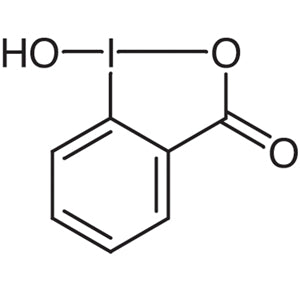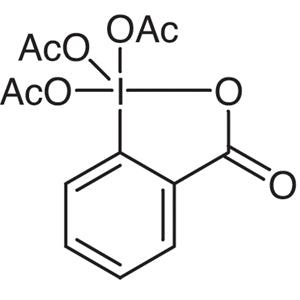
TCI D2045 Dess-Martin Periodinane is an oxidizing reagent belonging to the hypervalent iodine class of compounds, and it is one of the most widely recognized oxidants in synthetic organic chemistry. Its primary function is to oxidize primary alcohols to aldehydes and secondary alcohols to ketones cleanly, rapidly, and under very mild conditions. The reagent has become a standard choice in many laboratories because it stops the oxidation precisely at the aldehyde stage without allowing the reaction to proceed on to the carboxylic acid — an outcome that is difficult to achieve with many other oxidants, particularly on complex, densely functionalized molecules.
The advantages that lead chemists to select this reagent lie in its selectivity and the gentleness of its reaction conditions. Oxidations generally proceed at room temperature in dichloromethane, require no strongly acidic medium, and typically leave double bonds, protecting groups, and stereogenic centers prone to epimerization untouched. The reagent also contains no heavy metals such as chromium, so waste handling is more straightforward and the risk of metal toxicity is reduced. Its solid form makes weighing convenient and allows the number of equivalents to be controlled accurately during reaction setup.
In Indonesian laboratories, Dess-Martin Periodinane is typically used in synthetic organic chemistry research groups at universities and in research institutes where alcohol-to-carbonyl conversions must be carried out on valuable or sensitive intermediates. It suits work on multi-step syntheses of natural products and pharmaceutical intermediates, where a clean, mild, and selective oxidation step is needed. As an important note, this reagent belongs to the category of materials that must be handled with appropriate care.
Advantages (TCI brochure)
- Oxidizes primary and secondary alcohols to aldehydes and ketones
- Mild reaction conditions
- Wide generality of reactive substrates
- Lower environmental impact than chromate(VI) compounds
- Easy treatment after the reaction
TCI brochures (PDF)
- Hypervalent Iodine Compounds 2025-06-12 · p. 5
- Oxidizing Agents 2025-06-11 · p. 3
Related TCI products
- TCI D4477 87413-09-0 Dess-Martin Periodinane (8-12% in Dichloromethane)
- TCI I0791 61717-82-6 2-Iodoxybenzoic Acid (stabilized with Benzoic Acid + Isophthalic Acid)
- TCI A3839 3030894-95-9 1-Amino-1lambda3-benzo[d][1,2]iodaoxol-3(1H)-one
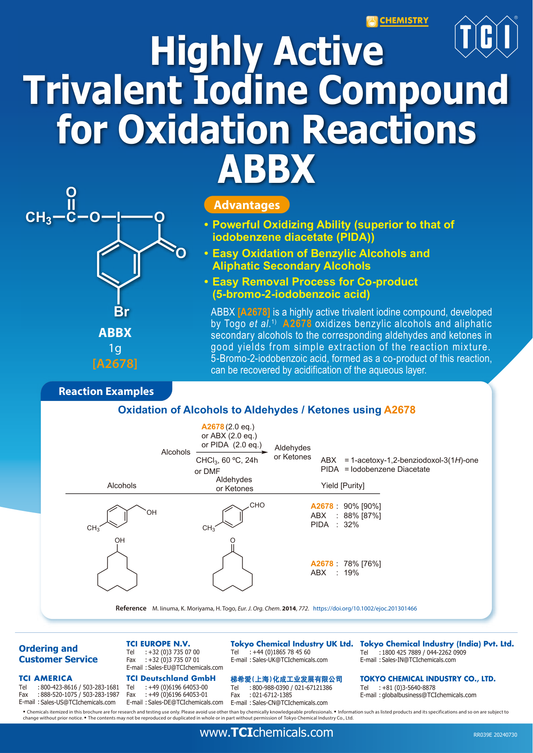
- TCI A2678 1580548-81-7 1-Acetoxy-5-bromo-1,2-benziodoxol-3(1H)-one
- TCI P1415 36290-94-5 Poly[4-(diacetoxyiodo)styrene]
- TCI I0073 304-91-6 2-Iodosobenzoic Acid
- Oxidation of primary alcohols to aldehydes — the reaction stops cleanly at the aldehyde stage without over-oxidation to the carboxylic acid, which is difficult with many conventional oxidants.
- Oxidation of secondary alcohols to ketones — proceeds rapidly at room temperature in dichloromethane, giving clean conversion without requiring a strongly acidic reaction medium.
- Multi-step synthesis of complex, densely functionalized molecules — the reagent's high selectivity allows a single hydroxyl group to be oxidized while other functional groups remain intact.
- Synthesis involving epimerization-sensitive substrates — the mild, non-acidic conditions generally leave stereogenic centers unaffected, preserving the stereochemical integrity of valuable intermediates.
- Chromium-free oxidation workflows — because the reagent contains no heavy metals, laboratories can avoid metal toxicity risks and simplify the treatment of their chemical waste streams.
From the TCI brochure
- Oxidation of alcohols
| Brand | TCI |
|---|---|
| CAS number | 87413-09-0 |
| Molecular formula | — |
| Purity | — |
| Category | Chemistry > Synthetic Reagents > Hypervalent Iodine Compounds [Synthetic Reagents] |
| Pack sizes | — |
| Physical form | Solid, which facilitates accurate weighing and control of reaction equivalents |
| Storage | Store according to the conditions stated on the manufacturer's label and safety data sheet |
- Product Code: D2045
Store the reagent in its original tightly closed container in a cool, dry, and well-ventilated area, following the storage conditions given on the manufacturer's label and safety data sheet. Keep containers protected from moisture, heat, and sources of ignition, and keep them separated from incompatible materials, particularly reducing agents and readily oxidizable organic substances. This is a material that must be handled with appropriate care: weigh and transfer it in a fume hood, wear gloves, safety glasses, and a laboratory coat, avoid mechanical shock and friction, and dispose of residues and reaction waste through the laboratory's established chemical waste procedures. Always consult the current safety data sheet before use.
—
Produk Terkait
-
Dess-MartinPeriodinane(8-12%inDichloromethane) TCI D4477
Regular price Rp 2.174.550,00Regular price -
2-IodoxybenzoicAcid(stabilizedwithBenzoicAcid+IsophthalicAcid) TCI I0791
Regular price From Rp 1.829.100,00Regular price -
1-Amino-1lambda3-benzo[d][1,2]iodaoxol-3(1H)-one TCI A3839
Regular price Rp 2.889.600,00Regular price -
1-Acetoxy-5-bromo-1,2-benziodoxol-3(1H)-one TCI A2678
Regular price Rp 2.862.300,00Regular price -
Poly[4-(diacetoxyiodo)styrene] TCI P1415
Regular price From Rp 4.399.500,00Regular price -
2-IodosobenzoicAcid TCI I0073
Regular price From Rp 1.936.200,00Regular price

![3030894-95-9 1-Amino-1lambda3-benzo[d][1,2]iodaoxol-3(1H)-one - AMI Scientific](http://amiscientific.com/cdn/shop/files/TCI2510A3839.jpg?v=1767084815&width=533)

![36290-94-5 Poly[4-(diacetoxyiodo)styrene] - AMI Scientific](http://amiscientific.com/cdn/shop/files/TCI2510P1415.jpg?v=1767134851&width=533)