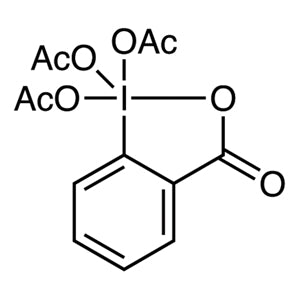
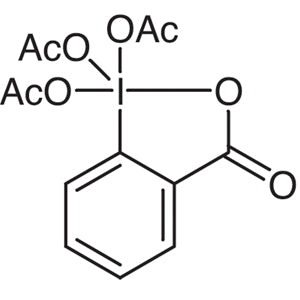
2-Iodosobenzoic Acid (TCI I0073) is a synthetic reagent widely used in organic chemistry for its versatile reactivity in substitution and oxidation reactions. This compound plays a crucial role in the synthesis of aromatic and heterocyclic compounds, where its iodine functionality enables selective transformations under controlled conditions. Its importance lies in its ability to act as both an oxidizing and substituting agent, making it a valuable tool in the development of complex molecular structures. Due to its high reactivity, it is frequently employed in research settings where precise chemical control is required.
The compound exhibits high polarity, allowing it to dissolve readily in organic solvents such as ethyl acetate and chloroform. This solubility facilitates efficient separation and purification of reaction products, which is essential in laboratory workflows. Additionally, its chemical properties can be fine-tuned by adjusting reaction parameters such as temperature and concentration, offering flexibility in experimental design. These characteristics make it a preferred choice for chemists seeking reliable and effective reagents.
In Indonesian laboratories, 2-Iodosobenzoic Acid is commonly used in organic synthesis research. It is particularly favored for its role in creating complex organic molecules, especially in the development of pharmaceutical and agrochemical compounds. Its availability and performance make it a standard reagent in academic and industrial research settings across the country.
TCI brochures (PDF)
- Hypervalent Iodine Compounds 2025-06-12 · p. 5
- Oxidizing Agents 2025-06-11 · p. 7
Related TCI products
- TCI I0791 61717-82-6 2-Iodoxybenzoic Acid (stabilized with Benzoic Acid + Isophthalic Acid)
- TCI A3839 3030894-95-9 1-Amino-1lambda3-benzo[d][1,2]iodaoxol-3(1H)-one
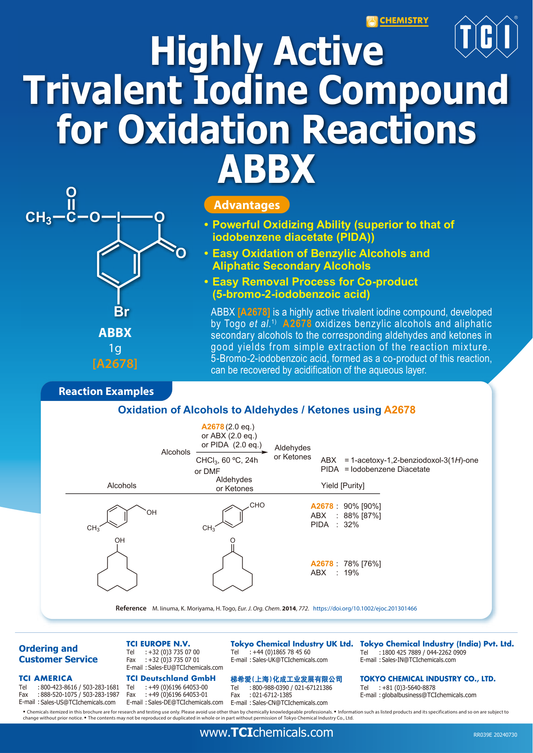
- TCI A2678 1580548-81-7 1-Acetoxy-5-bromo-1,2-benziodoxol-3(1H)-one
- TCI P1415 36290-94-5 Poly[4-(diacetoxyiodo)styrene]
- TCI D4477 87413-09-0 Dess-Martin Periodinane (8-12% in Dichloromethane)
- TCI D2045 87413-09-0 Dess-Martin Periodinane
- Organic synthesis reactions benefit from 2-Iodosobenzoic Acid due to its ability to facilitate iodine-mediated substitution and oxidation processes.
- It is ideal for the preparation of aromatic and heterocyclic compounds, where controlled iodination is required.
- The compound supports the development of complex molecular structures by enabling selective functional group transformations.
- Its solubility in organic solvents makes it suitable for purification and isolation steps in multi-step synthesis protocols.
- It is used in research involving oxidative coupling reactions, where iodine acts as a key reagent for bond formation.
| Brand | TCI |
|---|---|
| CAS number | 304-91-6 |
| Molecular formula | — |
| Purity | — |
| Category | Chemistry > Synthetic Reagents > Hypervalent Iodine Compounds |
| Pack sizes | Available in various quantities as per standard laboratory supply |
| Physical form | Solid |
| Storage | Store in a cool, dry place away from light and incompatible materials |
2-Iodosobenzoic Acid should be stored in a cool, dry environment, away from direct sunlight and sources of heat. It is recommended to keep the compound in a sealed container to prevent moisture absorption and maintain its chemical integrity. Due to its reactivity, it should be handled in a well-ventilated area, preferably under a fume hood, to minimize exposure. Avoid contact with incompatible substances such as strong reducing agents or reactive metals. Always use appropriate personal protective equipment, including gloves and safety goggles, when handling this material. Proper storage and handling ensure the compound remains effective and safe for use in laboratory applications.
—
Produk Terkait
-
2-IodoxybenzoicAcid(stabilizedwithBenzoicAcid+IsophthalicAcid) TCI I0791
Regular price From Rp 1.829.100,00Regular price -
1-Amino-1lambda3-benzo[d][1,2]iodaoxol-3(1H)-one TCI A3839
Regular price Rp 2.889.600,00Regular price -
1-Acetoxy-5-bromo-1,2-benziodoxol-3(1H)-one TCI A2678
Regular price Rp 2.862.300,00Regular price -
Poly[4-(diacetoxyiodo)styrene] TCI P1415
Regular price From Rp 4.399.500,00Regular price -
Dess-MartinPeriodinane(8-12%inDichloromethane) TCI D4477
Regular price Rp 2.174.550,00Regular price -
Dess-MartinPeriodinane TCI D2045
Regular price From Rp 1.565.550,00Regular price

![3030894-95-9 1-Amino-1lambda3-benzo[d][1,2]iodaoxol-3(1H)-one - AMI Scientific](http://amiscientific.com/cdn/shop/files/TCI2510A3839.jpg?v=1767084815&width=533)

![36290-94-5 Poly[4-(diacetoxyiodo)styrene] - AMI Scientific](http://amiscientific.com/cdn/shop/files/TCI2510P1415.jpg?v=1767134851&width=533)