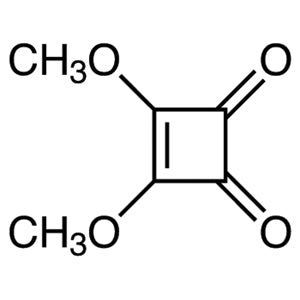
TCI D2099 3,4-Dimethoxy-3-cyclobutene-1,2-dione, more commonly known as dimethyl squarate, is the dimethyl ester of squaric acid built around a four-membered cyclobutenedione core. In the laboratory, this compound serves as a key building block for constructing squaramide and squaraine frameworks. The strained yet distinctly aromatic four-membered ring gives the molecule its unusual reactivity: both methoxy groups act as leaving groups that can be displaced stepwise by nucleophiles, allowing researchers to install two different substituents on a single core in a controlled, sequential manner.
The property that makes this reagent so widely chosen is precisely that stepwise substitution behaviour. Reaction with one equivalent of an amine at room temperature generally delivers the squaric acid monoamide, and addition of a second amine under more forcing conditions produces the unsymmetrical squaramide. The squaramide framework itself is highly valued because it is a strong and conformationally rigid dual hydrogen-bond donor, which makes it a backbone for organocatalysts and anion receptors, as well as a bioisostere of the urea group and of carboxylate groups in medicinal chemistry.
As an easily weighed solid, this reagent is practical to handle in Indonesian laboratories. It is typically used in university and institutional research groups working on organic synthesis, supramolecular chemistry, organocatalysis, and medicinal chemistry, where small quantities are weighed out on an analytical balance for bench-scale reactions. It is classified under Chemistry > Building Blocks > Non-Heterocyclic Building Blocks, and is generally purchased in research-scale quantities that suit method development, thesis projects, and exploratory synthetic work rather than production use.
Related TCI products
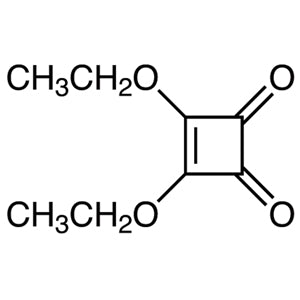
- TCI D3253 5231-87-8 3,4-Diethoxy-3-cyclobutene-1,2-dione
- TCI D2207 61699-62-5 3,4-Diisopropoxy-3-cyclobutene-1,2-dione
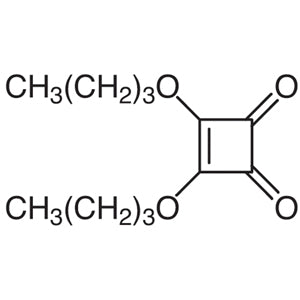
- TCI D2203 2892-62-8 3,4-Dibutoxy-3-cyclobutene-1,2-dione
- TCI D1399 2892-51-5 3,4-Dihydroxy-3-cyclobutene-1,2-dione
- TCI H1578 39604-68-7 2'-Hydroxy-4',6'-dimethoxy-2-(4-methoxyphenyl)acetophenone
- TCI H1577 39604-66-5 2'-Hydroxy-4',6'-dimethoxy-2-phenylacetophenone
- Unsymmetrical squaramide synthesis — the two methoxy groups are displaced sequentially by different amines, giving controlled access to non-identical N,N'-substituted squaramides in two clean steps.
- Organocatalyst preparation — squaramides derived from this reagent are rigid dual hydrogen-bond donors, making them effective scaffolds for bifunctional organocatalysts used in asymmetric transformations.
- Anion receptor and supramolecular host construction — the strong, directional double hydrogen-bond donor motif built from this core binds anionic guests, supporting molecular recognition studies.
- Squaraine dye and chromophore research — the cyclobutenedione core is the central unit of squaraine frameworks, so this ester serves as the entry point for such conjugated systems.
- Medicinal chemistry bioisostere work — the squaramide unit substitutes for urea and carboxylate groups, letting researchers modify hydrogen-bonding and acidity profiles of candidate structures.
| Brand | TCI |
|---|---|
| CAS number | 5222-73-1 |
| Molecular formula | — |
| Purity | — |
| Category | Chemistry > Building Blocks > Non-Heterocyclic Building Blocks |
| Pack sizes | available in research-scale quantities; please contact AMI Scientific for the pack sizes currently offered |
| Physical form | solid, easily weighed on an analytical balance |
| Storage | — |
- Chemical name: 3,4-Dimethoxy-3-cyclobutene-1,2-dione (dimethyl squarate)
Store the container tightly closed in a cool, dry place away from direct sunlight, heat sources, and moisture, and follow the storage conditions stated on the manufacturer's label and Safety Data Sheet. Keep the material in its original tightly sealed glass or manufacturer-supplied container, and reseal promptly after each use to limit exposure to atmospheric moisture. Weigh and transfer the solid inside a fume hood or well-ventilated area, using a clean dry spatula to avoid contamination. Wear safety glasses, gloves, and a laboratory coat, avoid inhaling dust, and keep the compound separated from strong nucleophiles, amines, and strong bases. Consult the Safety Data Sheet before first use and dispose of residues through approved chemical waste channels.
—
Produk Terkait
-
3,4-Diethoxy-3-cyclobutene-1,2-dione TCI D3253
Regular price From Rp 2.016.000,00Regular price -
3,4-Diisopropoxy-3-cyclobutene-1,2-dione TCI D2207
Regular price From Rp 3.048.150,00Regular price -
3,4-Dibutoxy-3-cyclobutene-1,2-dione TCI D2203
Regular price From Rp 2.254.350,00Regular price -
3,4-Dihydroxy-3-cyclobutene-1,2-dione TCI D1399
Regular price From Rp 1.458.450,00Regular price -
2'-Hydroxy-4',6'-dimethoxy-2-(4-methoxyphenyl)acetophenone TCI H1578
Regular price From Rp 1.776.600,00Regular price -
2'-Hydroxy-4',6'-dimethoxy-2-phenylacetophenone TCI H1577
Regular price From Rp 1.326.150,00Regular price -
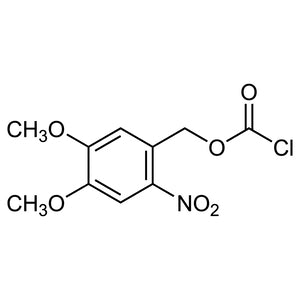
4,5-Dimethoxy-2-nitrobenzylCarbonochloridate TCI D6396
Regular price From Rp 1.378.650,00Regular price -
6,7-Dimethoxy-3,4-dihydronaphthalen-1(2H)-one TCI D6363
Regular price Rp 2.359.350,00Regular price