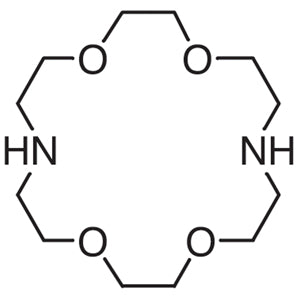
4,13-Diaza-18-crown-6-ether is a synthetic reagent widely used in chemical synthesis and complexation studies. It is a macrocyclic compound that plays a crucial role in laboratory settings by facilitating the binding of metal ions through its unique molecular structure. This compound is particularly valuable in organic synthesis, where it serves as a ligand for metal ion complexation. Its ability to selectively bind specific ions makes it an essential tool for researchers working on coordination chemistry and analytical methods.
The compound is known for its excellent solubility in organic solvents such as ethyl acetate and ethanol, which enhances its usability in a variety of experimental conditions. Its stability under normal laboratory conditions ensures that it remains effective for repeated use without significant degradation. This reliability makes it a preferred choice for both academic and industrial research. Additionally, its chemical inertness and predictable behavior contribute to its widespread application in laboratory protocols.
In Indonesian laboratories, 4,13-Diaza-18-crown-6-ether is commonly used in pure and applied chemical research. It is a staple in educational institutions and research centers, supporting experiments related to metal ion complexation, organic synthesis, and analytical chemistry. Its versatility and effectiveness make it an essential component in the chemical toolkit of Indonesian scientists and students.
Related TCI products
- Metal ion complexation studies - This compound is ideal for investigating the binding interactions between metal ions and organic ligands due to its high affinity and selectivity.
- Organic synthesis reactions - It is frequently used as a chelating agent to stabilize metal catalysts and improve reaction efficiency in synthetic processes.
- Analytical chemistry techniques - Its ability to selectively bind metal ions makes it useful in ion-exchange chromatography and spectroscopic analysis.
- Coordination chemistry research - It serves as a model ligand for studying the structure and properties of metal complexes in various environments.
- Educational laboratory experiments - It is commonly used in teaching labs to demonstrate complexation reactions and the role of macrocyclic compounds in chemical processes.
| Brand | TCI |
|---|---|
| CAS number | 23978-55-4 |
| Molecular formula | — |
| Purity | — |
| Category | Chemistry > Synthetic Reagents > Chelation/Complexation Compounds |
| Pack sizes | Available in various quantities as per standard laboratory supply |
| Physical form | Solid or powder, depending on the specific product variant |
| Storage | Store in a cool, dry place away from moisture and direct sunlight |
This compound should be stored in a cool, dry environment to maintain its stability and effectiveness. It is recommended to keep it in airtight containers to prevent moisture absorption, which could affect its performance. Due to its chemical nature, it should be handled with care, using appropriate personal protective equipment such as gloves and safety goggles. It is not classified as hazardous under standard laboratory conditions, but general safety protocols should still be followed. The compound is stable under normal laboratory conditions and does not require special refrigeration or controlled atmosphere storage. Proper labeling and storage practices ensure safe handling and long-term usability in laboratory settings.
—
Produk Terkait
-
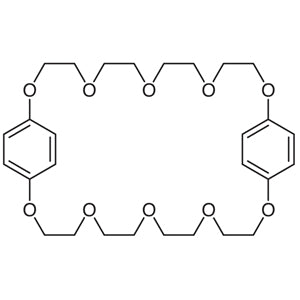
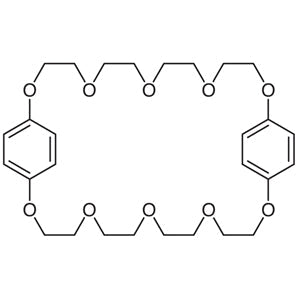
Bis(1,4-phenylene)-34-crown10-Ether TCI B2245
Regular price Rp 12.587.400,00Regular price -
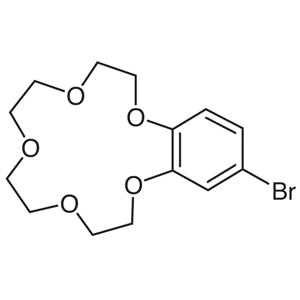
4'-Bromobenzo-15-crown5-Ether TCI B2189
Regular price From Rp 5.194.350,00Regular price -
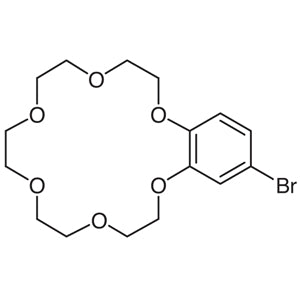
4'-Bromobenzo-18-crown6-Ether TCI B2181
Regular price From Rp 5.089.350,00Regular price -
Benzo-18-crown6-Ether TCI B1539
Regular price From Rp 1.538.250,00Regular price -
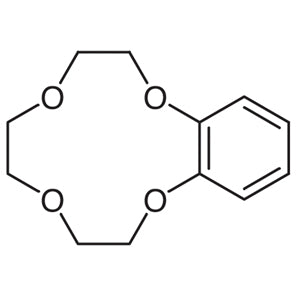
Benzo-12-crown4-Ether TCI B1249
Regular price From Rp 2.439.150,00Regular price -
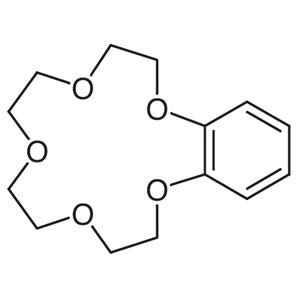
Benzo-15-crown5-Ether TCI B1154
Regular price From Rp 1.724.100,00Regular price -
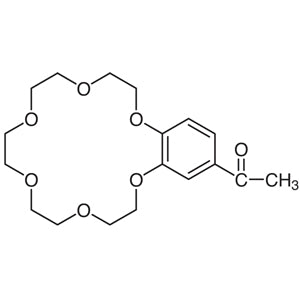
4'-Acetylbenzo-18-crown6-Ether TCI A1604
Regular price Rp 9.461.550,00Regular price -
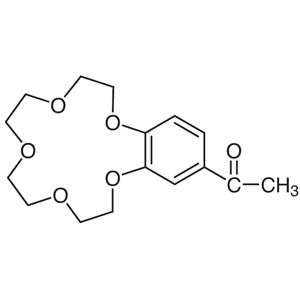
4'-Acetylbenzo-15-crown5-Ether TCI A1603
Regular price Rp 3.578.400,00Regular price