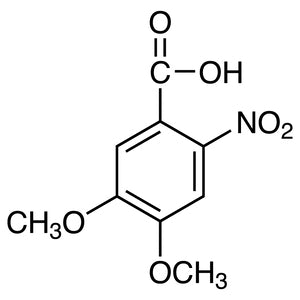
TCI D2628 4,5-Dimethoxy-2-nitrobenzoic Acid is a substituted benzoic acid that carries two adjacent methoxy groups together with a single nitro group positioned ortho to the carboxylic acid function. This substitution pattern is widely recognised in chemistry as the nitroveratryl framework, the structural motif that underpins a broad family of light-sensitive protecting groups. In the laboratory, the compound serves as a starting material for the preparation of photolabile reagents, caged compounds, and synthetic intermediates leading to alkaloids and heterocyclic structures that require an oxygen-rich aromatic ring.
The properties that make this building block a frequent choice are the light sensitivity of its nitroaromatic framework and the versatility of its functional groups. Combining a nitro group with two electron-donating methoxy substituents produces a system that can be cleaved in a controlled manner when irradiated at a suitable wavelength, so that any molecule attached to it may be released precisely at the time and place the researcher intends. The carboxylic acid group is readily activated into esters or amides for coupling a target molecule, while the nitro group can also be reduced to an amine when a different synthetic route is required.
In Indonesian laboratories, this material is typically used in university and institutional research groups working on organic synthesis, photochemistry, and the preparation of functional molecular probes. It suits benchtop-scale synthetic work where a defined, well-characterised aromatic building block is needed as a reliable point of departure, and it is equally applicable in method development and postgraduate research projects that build multi-step routes toward more complex oxygenated aromatic and heterocyclic targets.
Related TCI products
- Photolabile protecting group synthesis: the nitroveratryl framework is the established basis for light-removable protecting groups, so this acid provides direct access to such reagents without additional ring construction.
- Caged compound preparation: the carboxylic acid is easily converted into esters or amides, allowing a bioactive or reporter molecule to be attached and then released on irradiation.
- Alkaloid synthesis intermediates: the oxygen-rich aromatic ring with two adjacent methoxy groups matches the substitution pattern required in many alkaloid skeletons built in the laboratory.
- Heterocyclic building block work: reduction of the nitro group to an amine opens routes into nitrogen heterocycles, giving one reagent two distinct synthetic directions.
- Photochemistry and wavelength-controlled release studies: the controlled cleavage of the nitroaromatic system under defined irradiation makes the compound useful for investigating spatial and temporal control of chemical reactions.
| Brand | TCI (Tokyo Chemical Industry) |
|---|---|
| CAS number | 4998-07-6 |
| Molecular formula | — |
| Purity | — |
| Category | Chemistry > Building Blocks > Non-Heterocyclic Building Blocks |
| Pack sizes | available in the standard TCI catalogue pack sizes for this product code; please confirm the required quantity when ordering |
| Physical form | — |
| Storage | store in a tightly closed container, protected from light, in accordance with the manufacturer's product documentation |
- Product code: D2628
Keep the container tightly closed and store it in a cool, dry, well-ventilated place away from light, since the nitroaromatic framework is deliberately light sensitive and unnecessary exposure should be avoided. Retain the material in its original manufacturer packaging or in an amber glass container with a chemically resistant closure, and label any transfers clearly. Handle the solid in a fume hood, using gloves, safety glasses, and a laboratory coat, and avoid generating or inhaling dust during weighing. Keep the compound separate from strong oxidising and reducing agents, and always consult the manufacturer's safety data sheet before use and before disposal of residues.
—
Produk Terkait
-
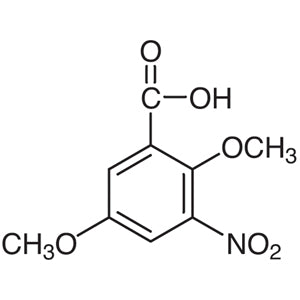
2,5-Dimethoxy-3-nitrobenzoicAcid TCI D2949
Regular price Rp 3.949.050,00Regular price -
3-Bromo-4-nitrobenzoicAcid TCI B4786
Regular price From Rp 1.618.050,00Regular price -
2-Bromo-5-nitrobenzoicAcid TCI B3841
Regular price From Rp 1.565.550,00Regular price -
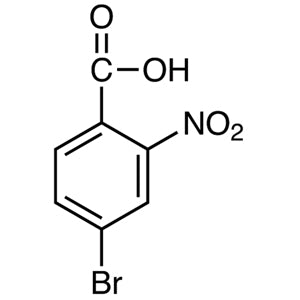
4-Bromo-2-nitrobenzoicAcid TCI B3810
Regular price From Rp 1.298.850,00Regular price -
4-Bromo-3-nitrobenzoicAcid TCI B3689
Regular price Rp 1.829.100,00Regular price -
2-Bromo-4-nitrobenzoicAcid TCI B3607
Regular price From Rp 903.000,00Regular price -
3-Bromo-5-nitrobenzoicAcid TCI B3370
Regular price From Rp 955.500,00Regular price -
2-Bromo-3-nitrobenzoicAcid TCI B3322
Regular price From Rp 3.817.800,00Regular price