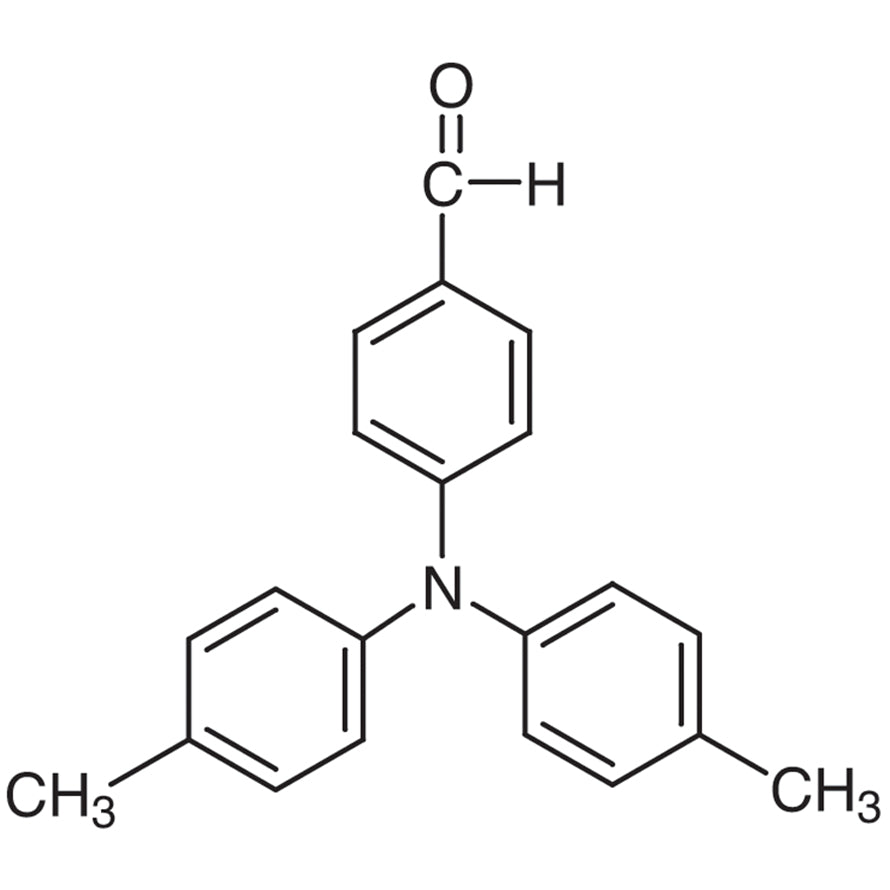
4-(Di-p-tolylamino)benzaldehyde from TCI is a small molecule building block for organic semiconductors that combines a methyl-substituted triphenylamine unit, acting as the electron donor, with a benzaldehyde group serving as a reactive coupling point. The triphenylamine framework is widely recognised in organic electronics because its nitrogen centre is electron rich, its propeller-like geometry suppresses aggregate stacking, and it provides good hole-transport behaviour. The aldehyde group in the para position allows the molecule to be joined to electron-accepting units through simple condensation chemistry, making it a favoured starting material in the design of donor–π–acceptor chromophores.
The characteristic that makes this compound so frequently selected is the balance it strikes between ease of synthesis and the quality of the optoelectronic properties obtained. The two methyl groups on the tolyl rings improve solubility in common organic solvents and strengthen the electron-donating character compared with unsubstituted triphenylamine, so the HOMO energy level of the derivatives prepared from it can be shifted in a controlled manner. Its aldehyde functionality is compatible with the Knoevenagel reaction, condensation with rhodanine or cyanoacetic acid, the Wittig reaction and Horner–Wadsworth type couplings, giving synthetic chemists a broad and dependable set of routes to work with.
In Indonesian laboratories, this building block is typically encountered in university and institutional research groups working on organic photovoltaics, dye-sensitised solar cells, and organic light-emitting or hole-transport materials. It is generally purchased in research-scale quantities for multi-step synthetic work, where a reliable donor fragment shortens the route to a target chromophore. Because it is supplied by TCI as a catalogue reagent, it also suits teaching and method-development settings in which consistent, well-defined starting materials are needed for reproducible results.
TCI brochures (PDF)
- Building Blocks for Organic Semiconductor 2026-03-24 · p. 31
Related TCI products
- TCI B4905 89115-20-8 4-[Bis(4-methoxyphenyl)amino]benzaldehyde
- TCI D2172 4181-05-9 4-(N,N-Diphenylamino)benzaldehyde
- TCI T3007 72811-73-5 4-(m-Tolylamino)pyridine-3-sulfonamide
- TCI B4682 119586-44-6 4,4'-Bis[4-(di-p-tolylamino)styryl]biphenyl
- TCI B2080 55035-43-3 1,4-Bis[4-(di-p-tolylamino)styryl]benzene
- TCI M2572 86672-58-4 6-Methyl-2-(p-tolylamino)-4H-3,1-benzoxazin-4-one
- Donor–π–acceptor chromophore synthesis: the para-aldehyde provides a direct condensation handle for attaching acceptor fragments while the triarylamine end supplies the electron-donating half of the push–pull system.
- Dye-sensitised solar cell dye preparation: condensation with cyanoacetic acid or rhodanine derivatives converts the aldehyde into an anchoring acceptor group, producing complete sensitiser structures from a single donor precursor.
- Hole-transport material development: the electron-rich triphenylamine core with its propeller geometry supports hole transport and discourages aggregate stacking, which is desirable in charge-transport layers.
- Knoevenagel and Wittig coupling chemistry: the reactive benzaldehyde group participates readily in Knoevenagel condensations, Wittig olefinations and Horner–Wadsworth type reactions used to extend conjugated backbones.
- HOMO level tuning studies: the two methyl substituents strengthen electron donation relative to plain triphenylamine, letting researchers shift the HOMO energy of derivative series in a controlled and comparable way.
| Brand | TCI |
|---|---|
| CAS number | 42906-19-4 |
| Molecular formula | — |
| Purity | — |
| Category | Materials Science > Material Building Blocks > Small Molecule Semiconductor Building Blocks |
| Pack sizes | available in standard TCI research-scale catalogue pack sizes; please confirm the size required when ordering |
| Physical form | — |
| Storage | store in a tightly closed container in a cool, dry, well-ventilated place away from light and moisture |
- Product code: D2737
Store the material in its original tightly closed container in a cool, dry and well-ventilated area, protected from direct light and moisture, and keep it away from strong oxidising agents and ignition sources. Amber glass bottles or the supplier's original packaging are suitable containers; reseal promptly after each use to limit exposure to air and humidity. Handle in a fume hood using gloves, safety glasses and a laboratory coat, and weigh out portions with clean, dry spatulas to avoid contamination of the bulk material. Allow refrigerated containers to warm to room temperature before opening to prevent condensation. Always consult the manufacturer's safety data sheet before use, and dispose of residues and contaminated materials in accordance with local chemical waste regulations.
—
Produk Terkait
-
4-[Bis(4-methoxyphenyl)amino]benzaldehyde TCI B4905
Regular price Rp 3.710.700,00Regular price -
4-(N,N-Diphenylamino)benzaldehyde TCI D2172
Regular price From Rp 1.724.100,00Regular price -
4-(m-Tolylamino)pyridine-3-sulfonamide TCI T3007
Regular price Rp 2.332.050,00Regular price -
4,4'-Bis[4-(di-p-tolylamino)styryl]biphenyl TCI B4682
Regular price Rp 3.710.700,00Regular price -
1,4-Bis[4-(di-p-tolylamino)styryl]benzene TCI B2080
Regular price Rp 7.897.050,00Regular price -
6-Methyl-2-(p-tolylamino)-4H-3,1-benzoxazin-4-one TCI M2572
Regular price From Rp 1.936.200,00Regular price -
4-(1,2,2-Triphenylvinyl)benzaldehyde TCI T4136
Regular price Rp 3.790.500,00Regular price -
4-(9H-Carbazol-9-yl)benzaldehyde TCI C3481
Regular price From Rp 3.155.250,00Regular price
![89115-20-8 4-[Bis(4-methoxyphenyl)amino]benzaldehyde - AMI Scientific](http://amiscientific.com/cdn/shop/files/TCI2510B4905.jpg?v=1768359979&width=533)


![119586-44-6 4,4'-Bis[4-(di-p-tolylamino)styryl]biphenyl - AMI Scientific](http://amiscientific.com/cdn/shop/files/TCI2510B4682.jpg?v=1771059000&width=533)
![55035-43-3 1,4-Bis[4-(di-p-tolylamino)styryl]benzene - AMI Scientific](http://amiscientific.com/cdn/shop/files/TCI2510B2080.jpg?v=1768815299&width=533)