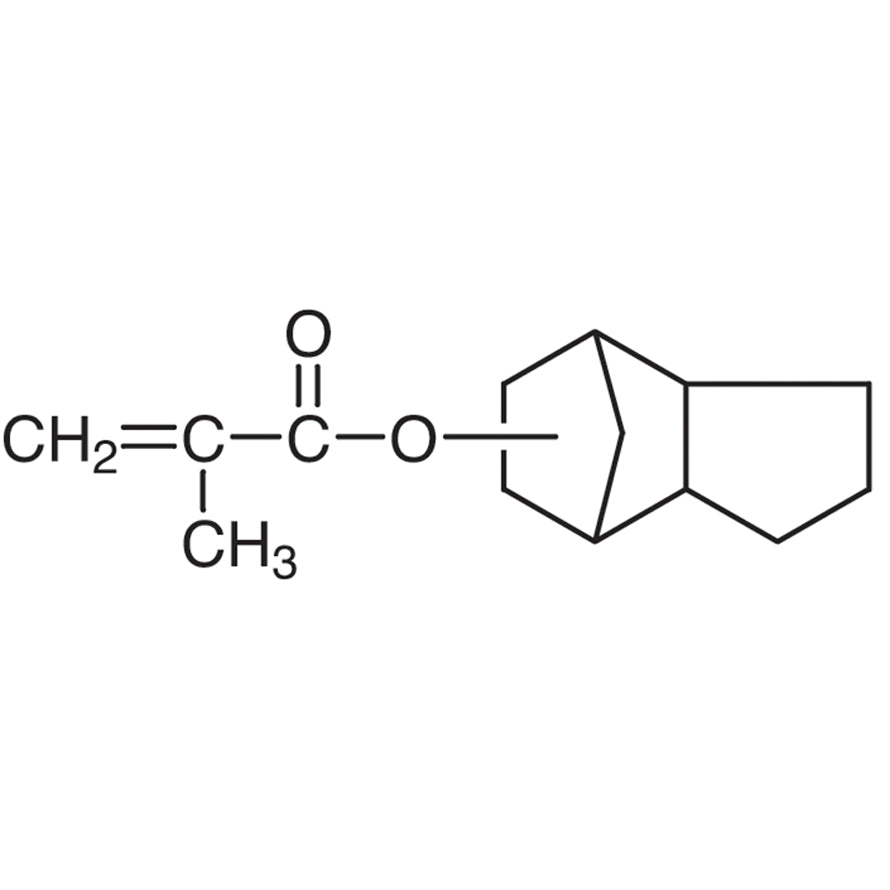
Dicyclopentanyl Methacrylate (DCMA) is a key chemical compound widely used in materials science and polymer chemistry. As a monomer, it plays a crucial role in the synthesis of polymers with excellent mechanical and thermal properties. Its ability to form high-strength materials with environmental resistance makes it indispensable in various chemical and industrial applications. In the laboratory, DCMA is a fundamental component in the development of new materials, thermoplastics, and composites. Its chemical structure provides stability and reactivity, enabling efficient polymerization reactions.
DCMA is preferred for its stable chemical structure and favorable reactivity, which contribute to efficient polymerization processes. The addition of a stabilizer, such as MEHQ (methyl ethyl glycol hydroquinone), enhances its stability under certain conditions, ensuring consistent performance in experimental settings. These characteristics make DCMA a reliable choice for laboratories requiring precision and reproducibility in their experiments. Its chemical stability and reactivity also support a wide range of research applications in material science.
In Indonesian laboratories, DCMA is extensively used in chemical, engineering, and environmental research. Its role in developing innovative materials makes it a highly sought-after reagent. It is commonly found in academic and industrial research settings where polymer synthesis and material characterization are essential. The compound's versatility and performance make it a valuable asset in advancing scientific research and development in Indonesia.
- Polymer synthesis for creating high-performance thermoplastics and composites due to its excellent mechanical and thermal properties.
- Material development research where stable and reactive monomers are essential for producing advanced polymers.
- Environmental testing applications where DCMA is used to study the behavior of chemical compounds under various conditions.
- Chemical engineering experiments requiring reliable monomers for polymerization reactions and material characterization.
- Composite material research where DCMA contributes to the formation of durable and high-strength composite structures.
| Brand | TCI |
|---|---|
| CAS number | 34759-34-7 |
| Molecular formula | — |
| Purity | — |
| Category | Materials Science > Polymer/Macromolecule Reagents > Monomers |
| Pack sizes | Available in standard laboratory quantities |
| Physical form | Liquid |
| Storage | Store in a cool, dark place away from direct sunlight and moisture |
DCMA should be stored in a cool, dark place, away from direct sunlight and moisture to maintain its chemical stability. It is recommended to use sealed containers made of inert materials such as glass or polyethylene to prevent contamination and degradation. Proper ventilation is essential when handling the compound to minimize exposure to vapors. Laboratory personnel should wear appropriate personal protective equipment, including gloves and safety goggles, to ensure safe handling. Avoid contact with skin and eyes, and ensure that spill containment procedures are in place for accidental exposure. Regular monitoring of storage conditions is advised to maintain the integrity and safety of the material.
—
Produk Terkait
-
DicyclopentanylAcrylate(stabilizedwithMEHQ) TCI D3380
Regular price From Rp 823.200,00Regular price -
2-[(3r,5r,7r)-Adamantan-1-yl]propan-2-ylMethacrylate(stabilizedwithMEHQ) TCI A3633
Regular price From Rp 2.016.000,00Regular price -
1-IsopropylcyclopentylMethacrylate(stabilizedwithMEHQ) TCI M3676
Regular price Rp 2.068.500,00Regular price -
1-MethylcyclopentylMethacrylate(stabilizedwithMEHQ) TCI M3228
Regular price Rp 1.378.650,00Regular price -
1-AdamantylMethacrylate(stabilizedwithMEHQ) TCI M1526
Regular price From Rp 2.757.300,00Regular price -
tert-ButylMethacrylateMonomer(stabilizedwithMEHQ) TCI M0326
Regular price From Rp 505.050,00Regular price -
IsobornylMethacrylate(stabilizedwithMEHQ) TCI I0617
Regular price Rp 557.550,00Regular price -
1-EthylcyclohexylMethacrylate(stabilizedwithMEHQ) TCI E1407
Regular price From Rp 1.140.300,00Regular price
![279218-76-7 2-[(3r,5r,7r)-Adamantan-1-yl]propan-2-yl Methacrylate (stabilized with MEHQ) - AMI Scientific](http://amiscientific.com/cdn/shop/files/TCI_32d370de-36a6-41a6-85d3-a19ab470bf3f.png?v=1766990810&width=533)
![279218-76-7 2-[(3r,5r,7r)-Adamantan-1-yl]propan-2-yl Methacrylate (stabilized with MEHQ) - AMI Scientific](http://amiscientific.com/cdn/shop/files/TCI2510A3633.jpg?v=1768815042&width=533)