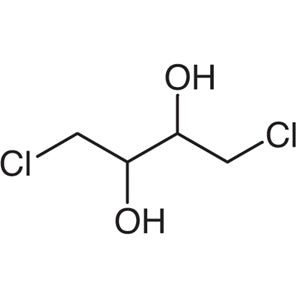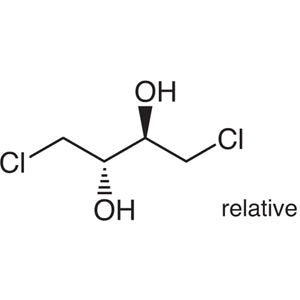
TCI D3409 meso-1,4-Dichloro-2,3-butanediol is a four-carbon compound bearing two chlorine atoms at the ends of the chain and two hydroxyl groups on the central carbons, with a meso configuration that gives the molecule an internal plane of symmetry. As a building block, this compound provides four functional points at once within a small framework, making it an efficient starting material for constructing three- to seven-membered rings as well as difunctional chains in targeted organic synthesis.
Its principal characteristics are its defined stereochemistry and its ability to be converted into a bis-epoxide. Treatment with base drives the hydroxyl groups to attack the chlorine-bearing carbons intramolecularly, producing a diepoxide whose configuration can be predicted from the starting material. The meso configuration ensures that both sides of the molecule are equivalent, so reaction outcomes are more uniform and easier to purify than mixtures of diastereomers. Both hydroxyl groups can also be protected as an acetonide or as ethers, opening routes to selective substitution at the chloride ends only.
Being a solid at room temperature, the material is easy to weigh accurately at the millimole scale, which suits the working scale of most synthetic benches. Research laboratories in Indonesia use this compound as a compact, stereochemically defined starting point for building rings and difunctional chains, particularly where a predictable diepoxide intermediate or a selectively protected diol is required in a multi-step synthetic route.
- Bis-epoxide preparation: base treatment promotes intramolecular attack of the hydroxyl groups on the chlorine-bearing carbons, yielding a diepoxide whose configuration follows predictably from the starting material.
- Ring construction in targeted synthesis: the four functional points within a compact four-carbon frame make this an efficient starting material for building three- to seven-membered rings.
- Difunctional chain assembly: the two terminal chlorides and two central hydroxyls allow both ends of the molecule to be elaborated when constructing doubly functionalised chains.
- Selective end-group substitution: protecting both hydroxyl groups as an acetonide or as ethers opens routes in which only the chloride termini undergo subsequent substitution chemistry.
- Stereochemically controlled routes: the meso configuration makes both halves of the molecule equivalent, giving more uniform reaction outcomes and simpler purification than diastereomeric mixtures.
| Brand | TCI |
|---|---|
| CAS number | 7268-35-1 |
| Molecular formula | — |
| Purity | — |
| Category | Chemistry > Building Blocks > Non-Heterocyclic Building Blocks |
| Pack sizes | available in the pack sizes listed on the product page |
| Physical form | solid at room temperature |
| Storage | keep in a tightly closed container in a cool, dry place away from moisture |
Store the compound in a tightly closed original container in a cool, dry, well-ventilated area, protected from moisture and away from heat sources and incompatible materials such as strong bases, which promote the intramolecular reaction of the hydroxyl and chloride groups. Amber glass or the supplier's original packaging is suitable; keep the container sealed between uses to avoid moisture uptake that could compromise accurate weighing. Handle in a fume hood with laboratory coat, safety glasses, and chemically resistant gloves. Weigh solids carefully to limit dust generation, return the container to storage promptly after dispensing, and follow the supplier's safety data sheet together with institutional procedures for waste disposal.
—
Produk Terkait
-
DL-1,4-Dichloro-2,3-butanediol TCI D3423
Regular price From Rp 3.922.800,00Regular price -
4-Benzyloxy-1,3-butanediol TCI B3326
Regular price From Rp 2.386.650,00Regular price -
1,4-ButanediolMonomethylEther TCI B2402
Regular price From Rp 2.359.350,00Regular price -
1,2-Butanediol TCI B0804
Regular price From Rp 505.050,00Regular price -
2,3-Butanediol(mixtureofstereoisomers) TCI B0681
Regular price From Rp 717.150,00Regular price -
1,4-Butanediol TCI B0680
Regular price From Rp 477.750,00Regular price -
1,3-Butanediol TCI B0679
Regular price From Rp 505.050,00Regular price -
2,2,4,4-Tetramethyl-1,3-cyclobutanediol(mixtureofisomers) TCI T0145
Regular price From Rp 2.227.050,00Regular price