TCI D3568 2,3-Dichlorobenzenesulfonyl Chloride is a sulfonylation reagent from TCI that belongs to the family of non-heterocyclic building blocks. The compound is a benzenesulfonyl chloride derivative carrying two neighbouring chlorine atoms at positions 2 and 3 of the aromatic ring. Its role in the laboratory is to serve as a supplier of aryl sulfonyl fragments, meaning it is a reagent that transfers a sulfonyl unit onto amines, alcohols, or other nucleophiles to form sulfonamides and sulfonate esters, motifs that appear as important structural elements in many active molecules and functional materials designed by researchers.
The property that makes this reagent a preferred choice is its highly electrophilic sulfonyl chloride group, which reacts rapidly with amines under mild conditions, usually requiring nothing more than an acid-scavenging base such as pyridine or triethylamine. The 2,3-dichloro substitution pattern contributes an electron-withdrawing effect that increases the reactivity of the sulfonyl group while at the same time introducing steric hindrance at the ortho position, producing products with a characteristic conformation. Both chlorine atoms also remain available as points for further modification through nucleophilic aromatic substitution or transition-metal coupling reactions, making the compound a versatile framework for elaboration.
In Indonesian laboratories, this reagent is typically used in university and institutional synthetic chemistry groups, in medicinal chemistry and materials research programmes, and in analytical work where derivatisation is required. It is normally handled in small quantities at the bench inside a fume hood, weighed under dry conditions, and consumed over the course of a synthetic campaign. Research teams generally keep it as part of a stocked collection of sulfonylating agents so that sulfonamide and sulfonate ester targets can be prepared without waiting on external procurement.
Related TCI products
- TCI D4222 6579-54-0 2,6-Dichlorobenzenesulfonyl Chloride
- TCI D4037 16271-33-3 2,4-Dichlorobenzenesulfonyl Chloride
- TCI D3503 705-21-5 3,5-Dichlorobenzenesulfonyl Chloride
- TCI D2244 5402-73-3 2,5-Dichlorobenzenesulfonyl Chloride
- TCI T2035 51527-73-2 2,4,6-Trichlorobenzenesulfonyl Chloride
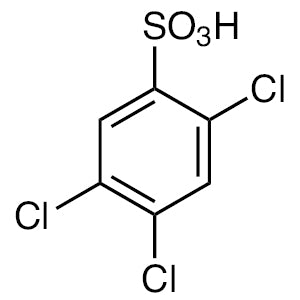
- TCI B0248 6378-25-2 2,4,5-Trichlorobenzenesulfonic Acid
- Sulfonamide synthesis: the electrophilic sulfonyl chloride group couples directly with primary and secondary amines under mild basic conditions to install the aryl sulfonyl unit cleanly.
- Sulfonate ester preparation: alcohols and phenols can be converted into sulfonate esters with this reagent, giving activated intermediates useful for subsequent displacement chemistry.
- Medicinal chemistry building block work: the sulfonamide motif it delivers is a recurring feature of biologically active molecules, so the reagent supports analogue design and structure-activity exploration.
- Functional materials research: transferring an electron-poor dichlorinated aryl sulfonyl fragment onto a substrate allows researchers to tune the electronic character of designed functional materials.
- Sequential functionalisation strategies: the two retained chlorine atoms serve as handles for nucleophilic aromatic substitution or transition-metal coupling, enabling multi-step elaboration from a single starting framework.
| Brand | TCI (Tokyo Chemical Industry) |
|---|---|
| CAS number | 82417-45-6 |
| Molecular formula | — |
| Purity | — |
| Category | Chemistry > Building Blocks > Non-Heterocyclic Building Blocks |
| Pack sizes | available in standard TCI research-scale packaging; please confirm the exact pack size when ordering |
| Physical form | — |
| Storage | keep in a tightly closed container under dry conditions, away from moisture |
- Chemical name: 2,3-Dichlorobenzenesulfonyl Chloride
- Catalogue code: D3568
Store the reagent in its original tightly closed container in a cool, dry, well-ventilated area, kept clearly separated from water, aqueous solutions, alcohols, amines, and strong bases. Because sulfonyl chlorides are moisture sensitive and hydrolyse to release acidic by-products, containers should be resealed promptly after use and, where possible, handled under a dry inert atmosphere. Weighing and transfer are best carried out inside a fume hood using dry glassware or other compatible, corrosion-resistant labware. Wear safety glasses, chemical-resistant gloves, and a laboratory coat, avoid inhaling dust or vapour, and keep the working area free of standing moisture. Dispose of residues and rinses as chemical waste following the institution's own laboratory waste procedures, and consult the manufacturer's safety data sheet before first use.
—
Produk Terkait
-
2,6-DichlorobenzenesulfonylChloride TCI D4222
Regular price From Rp 505.050,00Regular price -
2,4-DichlorobenzenesulfonylChloride TCI D4037
Regular price From Rp 1.035.300,00Regular price -
3,5-DichlorobenzenesulfonylChloride TCI D3503
Regular price From Rp 1.273.650,00Regular price -
2,5-DichlorobenzenesulfonylChloride TCI D2244
Regular price Rp 2.174.550,00Regular price -
2,4,6-TrichlorobenzenesulfonylChloride TCI T2035
Regular price From Rp 2.016.000,00Regular price -
2,4,5-TrichlorobenzenesulfonicAcid TCI B0248
Regular price From Rp 2.147.250,00Regular price -
2,4,5-TrichlorobenzenesulfonylChloride TCI B0247
Regular price From Rp 2.439.150,00Regular price -
Potassium2,4,5-Trichlorobenzenesulfonate TCI T0628
Regular price Rp 2.359.350,00Regular price