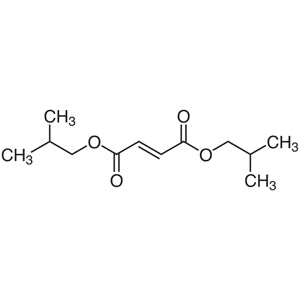
TCI D3915 Diisobutyl Fumarate is the diisobutyl ester of fumaric acid, classified as a non-heterocyclic building block featuring a carbon–carbon double bond conjugated to two ester groups. In the laboratory, this compound is widely used as a monomer and co-monomer in polymer research, as well as a Michael acceptor and dienophile in organic synthesis. Its role is important for researchers who need a branched fumarate group to tune the mechanical properties, solubility, and transition temperature of the resulting final products.
The characteristics that make it a preferred choice are the trans geometry of the fumarate framework, which delivers reactivity patterns and chain arrangements different from those of its maleate isomer, together with the branched isobutyl groups that increase hydrophobic character and influence polymer chain rigidity. The electron-deficient double bond makes the molecule reactive toward nucleophiles and radicals, so it is well suited to radical copolymerization as well as addition reactions. The consistent reagent quality of TCI materials helps polymer researchers obtain product characteristics that can be reproduced from experiment to experiment.
In Indonesian laboratories, this compound is used in polymer and materials research at universities and research institutions, where reproducible monomer quality is essential for comparing results across experimental runs. Groups working on ester-functional monomers rely on it when a branched fumarate unit is required in a synthesis or copolymerization scheme, and its behaviour as a Michael acceptor and dienophile also supports teaching and method-development work in organic synthesis laboratories.
Related TCI products
- Radical copolymerization studies — the electron-deficient double bond reacts readily with radical species, making this fumarate ester a dependable co-monomer for controlled copolymer preparation.
- Polymer property tuning — the branched isobutyl groups let researchers adjust chain rigidity, hydrophobic character, solubility, and transition temperature of the final polymer product.
- Michael addition chemistry — as a Michael acceptor, the conjugated double bond accepts nucleophiles cleanly, supporting the construction of extended ester-functional molecular frameworks.
- Diels–Alder and cycloaddition work — its dienophile character makes it suitable for addition reactions with dienes in organic synthesis and method-development studies.
- Materials research and reproducibility comparisons — consistent TCI reagent quality allows monomer-related results to be reproduced reliably between separate experimental runs and research groups.
| Brand | TCI (Tokyo Chemical Industry) |
|---|---|
| CAS number | 7283-69-4 |
| Molecular formula | — |
| Purity | — |
| Category | Chemistry > Building Blocks > Non-Heterocyclic Building Blocks |
| Pack sizes | available in standard TCI research packaging; please confirm the size options when ordering |
| Physical form | — |
| Storage | keep in the original tightly closed container in a cool, dry, well-ventilated place |
- Catalogue code: D3915
Store the material in its original tightly closed container in a cool, dry, well-ventilated area, away from heat, ignition sources, and direct sunlight, and keep it separated from strong oxidizing agents, strong bases, and nucleophilic reagents. Use chemically compatible glass or manufacturer-supplied containers, and close them promptly after dispensing to limit moisture pickup and vapour release. Handle in a fume hood using safety glasses, chemically resistant gloves, and a laboratory coat. Because the compound is a reactive monomer, avoid conditions that could promote unintended polymerization, label all working aliquots clearly, and follow the manufacturer's safety data sheet together with your institution's chemical waste procedures for disposal.
—
Produk Terkait
-
DiisobutylPerylenedicarboxylate(mixtureofregioisomers) TCI P1197
Regular price Rp 2.386.650,00Regular price -
DiethylDiisobutylmalonate TCI D2280
Regular price Rp 2.942.100,00Regular price -
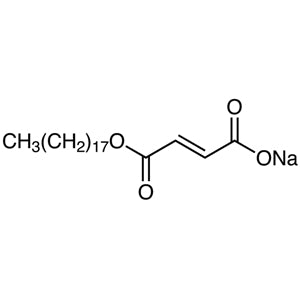
SodiumStearylFumarate TCI S0879
Regular price From Rp 1.246.350,00Regular price -
MonomethylFumarate TCI M2413
Regular price From Rp 1.961.400,00Regular price -
MonoisopropylFumarate TCI M1784
Regular price Rp 4.213.650,00Regular price -
MonoethylFumarate TCI F0359
Regular price Rp 1.908.900,00Regular price -
SodiumHydrogenFumarate TCI F0071
Regular price From Rp 875.700,00Regular price -
DisodiumFumarate TCI F0070
Regular price From Rp 610.050,00Regular price