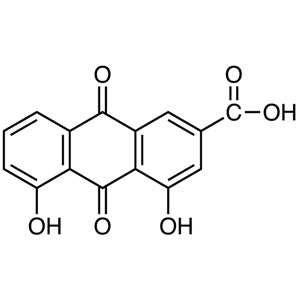
TCI D3986 4,5-Dihydroxyanthraquinone-2-carboxylic Acid (CAS 478-43-3), widely known among researchers as rhein, is a hydroxylated anthraquinone derivative that carries a carboxylic acid group on its tricyclic framework. In the laboratory this material plays a dual role: it serves as a non-heterocyclic building block for organic synthesis, and at the same time it functions as a reference compound in natural product research, particularly in studies of secondary metabolites of the anthraquinone class that are commonly found in plants of the Polygonaceae and Fabaceae families. Its presence helps researchers establish the identity of isolated compounds with greater confidence.
The characteristic that makes this material a frequent choice is its combination of functional groups that is rich yet still manageable: two phenolic hydroxyl groups that are weakly acidic and capable of forming intramolecular hydrogen bonds with the quinone carbonyl groups, plus a single carboxylic acid group that provides a clear derivatisation point for both esterification and amidation. The anthraquinone framework supplies a strongly conjugated chromophore system, so the compound is easily monitored with a UV-Vis detector in HPLC as well as by spectrophotometric scanning. This makes it convenient to track through reaction sequences and analytical workflows alike.
In Indonesian laboratories, this profile fits the work routinely carried out in university natural product groups, pharmacy and pharmacognosy laboratories, and chemical synthesis laboratories. It is used as a comparison standard when confirming anthraquinone metabolites isolated from local plant material, and as a starting scaffold when researchers need to prepare derivatives around the anthraquinone core. Because it is detected readily by common UV-Vis instrumentation, it integrates well with the analytical equipment already available in most institutional laboratories.
TCI brochures (PDF)
- Phytochemicals 2025-12-17 · p. 13
- Natural product reference compound — used as a comparison marker so anthraquinone metabolites isolated from Polygonaceae and Fabaceae plant material can be identified with greater confidence.
- Non-heterocyclic building block for organic synthesis — the intact anthraquinone framework serves as a starting scaffold for researchers preparing structurally related target compounds.
- Carboxyl-directed derivatisation chemistry — the single carboxylic acid group provides a clear and well-defined point of attachment for esterification and amidation reactions.
- HPLC method development and analysis — the strongly conjugated anthraquinone chromophore is readily monitored with a UV-Vis detector, making the compound convenient for chromatographic work.
- UV-Vis spectrophotometric studies — the same conjugated chromophore system allows straightforward spectrophotometric scanning, supporting characterisation work and routine verification of isolated fractions.
| Brand | TCI |
|---|---|
| CAS number | 478-43-3 |
| Molecular formula | — |
| Purity | — |
| Category | Chemistry > Building Blocks > Non-Heterocyclic Building Blocks |
| Pack sizes | available in standard TCI research-scale packaging; please refer to the current catalogue listing for available options |
| Physical form | — |
| Storage | store according to the storage conditions stated on the product label and in the accompanying documentation |
- Chemical name: 4,5-Dihydroxyanthraquinone-2-carboxylic Acid (also known as rhein)
- Product code: D3986
Store the container tightly closed in a cool, dry, well-ventilated place, away from direct sunlight and sources of heat or ignition, and follow the specific storage conditions indicated on the product label and Safety Data Sheet. Keep the material in its original supplier container, or in a chemically compatible, clearly labelled amber glass container if transfer is necessary, since the conjugated chromophore makes light protection sensible. Handle in a fume hood using standard personal protective equipment — safety goggles, gloves, and a laboratory coat — and avoid the generation and inhalation of dust when weighing the solid. Wash hands thoroughly after handling, keep the container closed when not in use, and dispose of residues and contaminated materials in accordance with applicable laboratory and institutional waste procedures. Always consult the Safety Data Sheet before first use.
—
Product Categories
- Biochemicals and ReagentsCrude Medicine Ingredients for Research and Experimental Use
- Cell BiologyCancer ResearchAntitumor Agents for Research
- Cell BiologyCancer ResearchChemopreventive Agents [Cancer Research]
- Cell BiologyNutrition ResearchPhytochemicals
- Pharmaceutical Development and Drug Discovery ResearchCrude Medicine Ingredients for Research and Experimental Use
Produk Terkait
-
trans-FerulicAcid TCI H0267
Regular price From Rp 1.881.600,00Regular price -
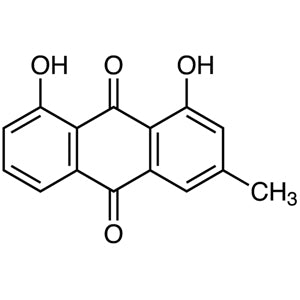
ChrysophanicAcid TCI C2505
Regular price Rp 4.611.600,00Regular price -
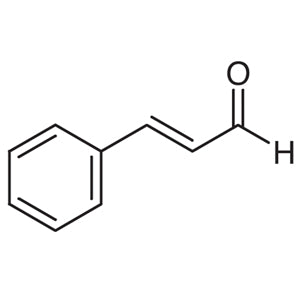
trans-Cinnamaldehyde TCI C0352
Regular price From Rp 477.750,00Regular price -
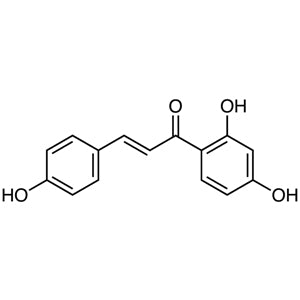
Isoliquiritigenin TCI I0822
Regular price From Rp 1.035.300,00Regular price -
Tetrahydrocurcumin TCI T3587
Regular price From Rp 2.386.650,00Regular price -
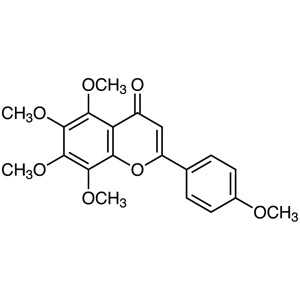
Tangeretin TCI T2708
Regular price From Rp 5.619.600,00Regular price -
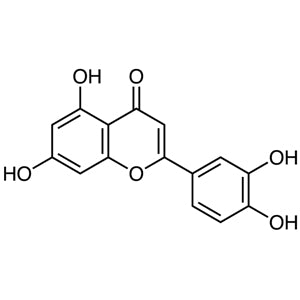
3',4',5,7-Tetrahydroxyflavone TCI T2682
Regular price From Rp 1.565.550,00Regular price -
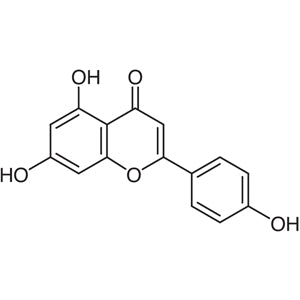
Apigenin TCI A1514
Regular price Rp 5.778.150,00Regular price