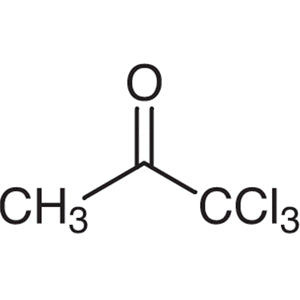
TCI D4004 3,3-Dibromo-1,1,1-trifluoroacetone (CAS 431-67-4) is a fluorinated ketone that carries a trifluoromethyl group on one side of the carbonyl and a dibrominated carbon on the other. This arrangement makes it a highly useful fluorinated building block in the organic synthesis laboratory, particularly for introducing trifluoromethyl groups into heterocyclic frameworks. The carbon bearing the two bromine atoms acts as an electrophilic centre and as a double leaving group, which makes the compound a classic reaction partner for bivalent nucleophiles in the construction of five-membered CF3-substituted rings.
The properties that lead chemists to select this reagent are the combination of electrophilic reactivity and the electronic influence of the trifluoromethyl group. The strongly electron-withdrawing CF3 group increases the electrophilicity of the carbonyl and makes the adjacent carbon more responsive to nucleophilic attack, while the two bromine atoms allow sequential substitution that terminates in ring closure. In target molecules, the trifluoromethyl group is known to improve metabolic stability, lipophilicity, and receptor binding strength, which is why it is so widely sought in the design of active pharmaceutical ingredients and agrochemicals.
In Indonesian laboratories, this material is typically used in university and institutional synthetic chemistry groups, in medicinal chemistry and agrochemical discovery programmes, and in process development work where fluorinated heterocycles are prepared on a research scale. Its liquid form makes it convenient to dispense and transfer for small-scale reaction screening, and it is generally handled inside a fume hood as part of routine multi-step synthesis and method-development workflows.
Related TCI products
- Synthesis of CF3-substituted heterocycles: the dibrominated carbon provides two leaving groups, so bivalent nucleophiles can substitute sequentially and close a five-membered ring in one operation.
- Trifluoromethyl group installation in medicinal chemistry: the intact CF3 unit is carried directly into the product framework, improving metabolic stability, lipophilicity, and receptor binding strength of candidate molecules.
- Agrochemical discovery research: fluorinated heterocyclic cores derived from this ketone are widely pursued in active-ingredient design, making it a practical starting point for analogue series.
- Electrophilic substitution and alkylation studies: the electron-withdrawing CF3 group raises carbonyl electrophilicity, so the adjacent carbon reacts readily with nucleophiles under mild laboratory conditions.
- Building-block libraries for multi-step organic synthesis: as a bifunctional fluorinated intermediate, it lets research groups diversify scaffolds without separate fluorination steps or specialised fluorinating reagents.
| Brand | TCI |
|---|---|
| CAS number | 431-67-4 |
| Molecular formula | — |
| Purity | — |
| Category | Chemistry > Building Blocks > Fluorinated Building Blocks |
| Pack sizes | available in standard TCI research and laboratory pack sizes; please confirm the required size when ordering |
| Physical form | liquid |
| Storage | store in a tightly closed container in a cool, well-ventilated area away from incompatible materials |
- Chemical name: 3,3-Dibromo-1,1,1-trifluoroacetone
Store the container tightly closed in a cool, dry, and well-ventilated place, away from heat, ignition sources, and incompatible chemicals such as strong bases and strong oxidising agents. Keep the material in its original manufacturer-supplied glass bottle or another container known to be compatible with brominated and fluorinated organic liquids, and reseal it immediately after each use to limit vapour release and moisture uptake. Because this is a reactive halogenated ketone, all transfers and reaction set-ups should be carried out in a functioning fume hood while wearing safety glasses, a laboratory coat, and chemically resistant gloves. Avoid inhaling vapours and any contact with skin or eyes, use only clean and dry glassware and syringes when dispensing, and collect residues as halogenated organic chemical waste in accordance with your institution's laboratory waste procedures. Always consult the manufacturer's safety data sheet before use.
—
Produk Terkait
-
1-Bromo-3,3,3-trifluoroacetone TCI B1240
Regular price From Rp 928.200,00Regular price -
HexafluoroacetoneHydrate TCI H0425
Regular price From Rp 769.650,00Regular price -
2,6-Dibromo-4-fluorophenol TCI D3531
Regular price From Rp 1.220.100,00Regular price -
2,6-Dibromo-4-fluoroaniline TCI D2570
Regular price Rp 7.526.400,00Regular price -
1,2-Dibromo-1-chloro-1,2,2-trifluoroethane TCI D2220
Regular price Rp 2.466.450,00Regular price -
Fluoroacetonitrile TCI F0665
Regular price Rp 3.896.550,00Regular price -
1,1,1-Trichloroacetone TCI T1376
Regular price Rp 5.194.350,00Regular price -
1-Acetoxy-3-chloroacetone TCI A1232
Regular price From Rp 2.782.500,00Regular price