

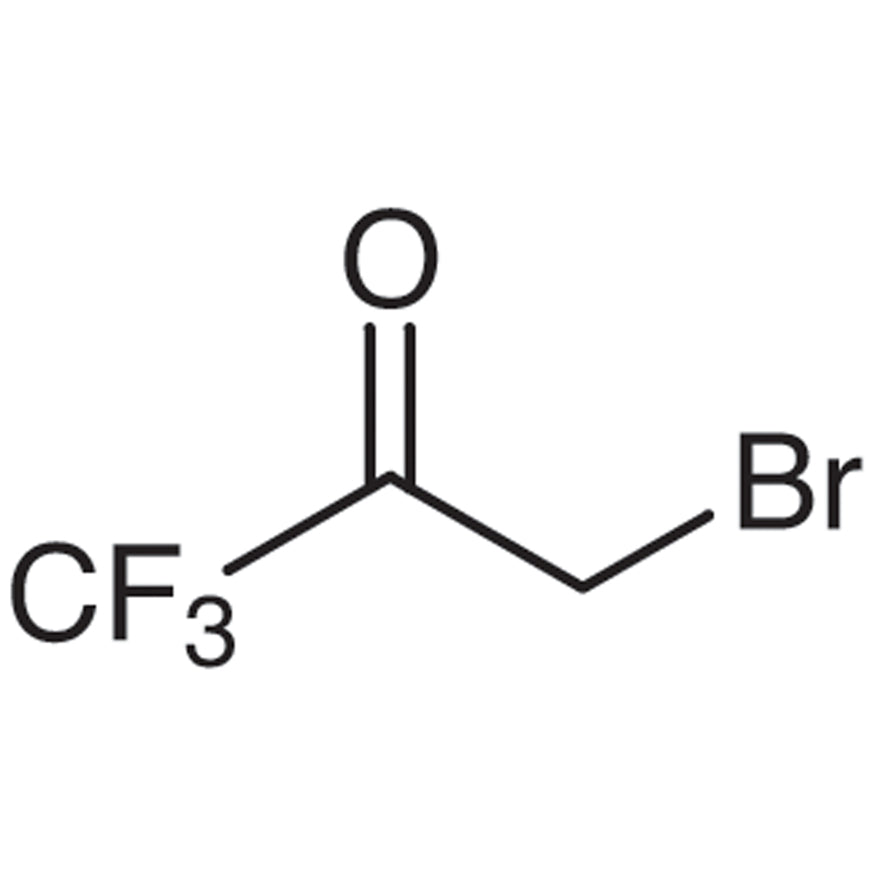
1-Bromo-3,3,3-trifluoroacetone is a chemical compound widely used in organic reactions, particularly in the synthesis of fluorinated compounds. Its unique molecular structure, featuring three fluorine atoms attached to a carbon atom, gives it distinct properties that set it apart from standard carbon-based compounds. This compound plays a crucial role in laboratory settings as a building block for creating organofluorine compounds, which are essential in various scientific fields. Due to its reactivity and stability, it is a valuable tool for researchers aiming to develop new materials or pharmaceuticals.
The presence of fluorine atoms significantly enhances the chemical properties of this compound. Fluorine increases the solubility, thermal stability, and biological activity of the resulting compounds. These characteristics make it a preferred choice for researchers working on drug development, material science, and analytical chemistry. Its ability to modify the properties of other molecules makes it a versatile reagent in synthetic chemistry, enabling the creation of compounds with tailored functionalities.
In Indonesian laboratories, this compound is commonly used in research focused on organic chemistry, pharmaceuticals, and materials science. It is a key reagent in academic and industrial research settings, supporting experiments that require precise chemical modifications. Its widespread application in both educational and research institutions highlights its importance in advancing scientific knowledge and innovation in Indonesia.
TCI brochures (PDF)
- Fluorous Chemistry 2025-01-21 · p. 6
- Fluorination Reagents, Fluorinated Building Blocks 2026-03-18 · p. 51
Related TCI products
- TCI D4004 431-67-4 3,3-Dibromo-1,1,1-trifluoroacetone
- TCI H0425 10057-27-9 Hexafluoroacetone Hydrate
- TCI F0665 503-20-8 Fluoroacetonitrile
- TCI T2747 383-53-9 2-Bromo-4'-(trifluoromethyl)acetophenone
- TCI T2147 64115-88-4 1-Bromo-2-(trifluoromethoxy)benzene
- TCI B5363 149947-15-9 3-Bromo-2-fluorobenzaldehyde
- Organic synthesis applications benefit from this compound’s ability to introduce fluorine atoms into complex molecular structures, enhancing the reactivity and stability of the final products.
- Pharmaceutical research utilizes it to develop new drugs with improved bioavailability and therapeutic effects due to the unique properties of fluorinated compounds.
- Material science applications rely on its role in creating fluorinated polymers and coatings with enhanced durability and chemical resistance.
- Analytical chemistry experiments use it as a standard reference compound for studying fluorine-containing substances and their behavior in different environments.
- Environmental studies incorporate it to investigate the fate and behavior of fluorinated compounds in ecosystems and their impact on ecological systems.
| Brand | TCI |
|---|---|
| CAS number | 431-35-6 |
| Molecular formula | — |
| Purity | — |
| Category | Chemistry > Building Blocks > Fluorinated Building Blocks |
| Pack sizes | Available in various sizes as per supplier specifications |
| Physical form | Liquid |
| Storage | Store in a cool, dry place away from light and incompatible materials |
This compound should be stored in a cool, dry environment, away from direct sunlight and sources of heat. It is recommended to use airtight containers made of materials compatible with its chemical properties, such as glass or high-density polyethylene. Due to its reactivity, it should be handled in a well-ventilated area, preferably under a fume hood. Personal protective equipment, including gloves, goggles, and lab coats, should be worn at all times to ensure safety. Avoid contact with skin and eyes, and ensure proper disposal of any waste in accordance with local regulations.
—
Produk Terkait
-
3,3-Dibromo-1,1,1-trifluoroacetone TCI D4004
Regular price From Rp 900.900,00Regular priceRp 645.750,00Sale price From Rp 900.900,00 -
HexafluoroacetoneHydrate TCI H0425
Regular price From Rp 822.150,00Regular priceRp 590.100,00Sale price From Rp 822.150,00 -
Fluoroacetonitrile TCI F0665
Regular price Rp 3.949.050,00Regular priceRp 2.777.250,00Sale price Rp 3.949.050,00 -
2-Bromo-4'-(trifluoromethyl)acetophenone TCI T2747
Regular price From Rp 1.618.050,00Regular priceRp 1.146.600,00Sale price From Rp 1.618.050,00 -
1-Bromo-2-(trifluoromethoxy)benzene TCI T2147
Regular price From Rp 637.350,00Regular priceRp 445.200,00Sale price From Rp 637.350,00 -
3-Bromo-2-fluorobenzaldehyde TCI B5363
Regular price From Rp 1.590.750,00Regular priceRp 1.111.950,00Sale price From Rp 1.590.750,00 -
5-Bromo-2-chloro-4-fluoroanisole TCI B5354
Regular price From Rp 664.650,00Regular priceRp 464.100,00Sale price From Rp 664.650,00 -
2-Bromo-4-(trifluoromethyl)benzoicAcid TCI B5334
Regular price From Rp 1.431.150,00Regular priceRp 1.016.400,00Sale price From Rp 1.431.150,00


