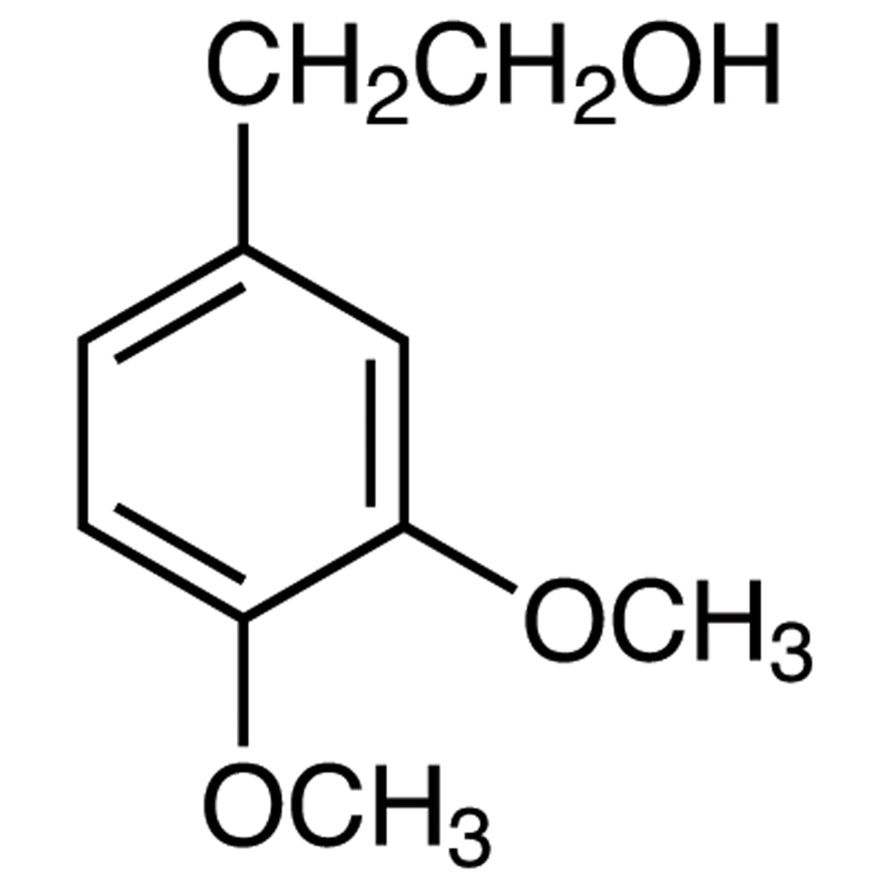
TCI D4107, 2-(3,4-Dimethoxyphenyl)ethanol with CAS number 7417-21-2, also known as homoveratryl alcohol, is an aromatic primary alcohol carrying two methoxy groups at positions 3 and 4 of the benzene ring. In the laboratory, this compound serves as an important building block that links a reactive hydroxyl group to an electron-rich veratrole framework. Its hydroxyl group can be oxidized, esterified, etherified, or converted into a leaving group for further substitution, which is why this compound frequently appears at the early stages of many synthetic routes toward complex target molecules.
The property that makes this material a preferred choice is its high transformation flexibility combined with an activated aromatic ring, so that cyclization reactions toward isoquinoline systems proceed with good yields. The 3,4-dimethoxyphenethyl framework is a recurring motif in many bioactive compounds and natural products, making this compound an efficient entry point toward structural analogues. Because it is a liquid at room temperature, it is easy to transfer and measure out, and it dissolves well in common organic solvents, giving synthetic chemists a convenient and versatile starting material for multi-step work.
In Indonesian laboratories, this building block is typically used in synthetic organic chemistry research at universities and research institutes, as well as in method development work where a substituted phenethyl alcohol scaffold is required. Its liquid form supports straightforward handling during routine dispensing and reaction setup, while its solubility in common organic solvents fits the solvent systems already available in most local laboratories. Long-term storage does require protection from air and light to preserve the material's colour.
- Isoquinoline synthesis: the electron-rich activated aromatic ring supports cyclization reactions toward isoquinoline ring systems, allowing these transformations to proceed with good yields.
- Building-block chemistry for complex targets: the reactive primary hydroxyl group makes this compound a frequent starting point at the early stages of multi-step synthetic routes.
- Preparation of structural analogues: the recurring 3,4-dimethoxyphenethyl motif found in many bioactive compounds provides an efficient entry point for making related analogues.
- Functional group transformation studies: the hydroxyl group can be oxidized, esterified, etherified, or converted into a leaving group for further substitution chemistry.
- Natural-product-oriented research: because the dimethoxyphenethyl framework recurs in numerous natural products, this material suits synthetic work directed at natural product scaffolds.
| Brand | TCI |
|---|---|
| CAS number | 7417-21-2 |
| Molecular formula | — |
| Purity | — |
| Category | Chemistry > Building Blocks > Non-Heterocyclic Building Blocks |
| Pack sizes | please refer to the available packaging options for this catalogue item |
| Physical form | liquid at room temperature; soluble in common organic solvents |
| Storage | protect from air and light for long-term storage |
- Chemical name: 2-(3,4-Dimethoxyphenyl)ethanol, also known as homoveratryl alcohol
Store this material in a tightly closed container and keep it protected from air and light during long-term storage, since exposure can affect the colour of the liquid. Amber glass bottles or the original supplier container with a well-sealed closure are suitable for keeping the material in good condition. Because the product is a liquid at room temperature, transfer and dispensing should be carried out carefully to avoid spills. Handle it in a fume hood, wear standard laboratory personal protective equipment including gloves, safety glasses, and a laboratory coat, and keep the container closed when not in use. Always consult the manufacturer's safety data sheet before handling.
—
Produk Terkait
-
1-(3,4-Dimethoxyphenyl)ethanol TCI D6124
Regular price Rp 4.849.950,00Regular price -
Methyl2-(3,4-Dimethoxyphenyl)acetate TCI M3431
Regular price From Rp 2.439.150,00Regular price -
2-(Benzyloxy)ethanol TCI B0426
Regular price From Rp 557.550,00Regular price -
1-(2-Naphthyl)ethanol TCI N0788
Regular price From Rp 1.936.200,00Regular price -
2-(1-Naphthyl)ethanol TCI N0575
Regular price From Rp 1.326.150,00Regular price -
2-(4-Nitrophenyl)ethanol TCI N0569
Regular price From Rp 1.353.450,00Regular price -
1-(1-Naphthyl)ethanol TCI N0395
Regular price From Rp 2.016.000,00Regular price -
1-(3-Methoxyphenyl)ethanol TCI M3577
Regular price From Rp 2.571.450,00Regular price