

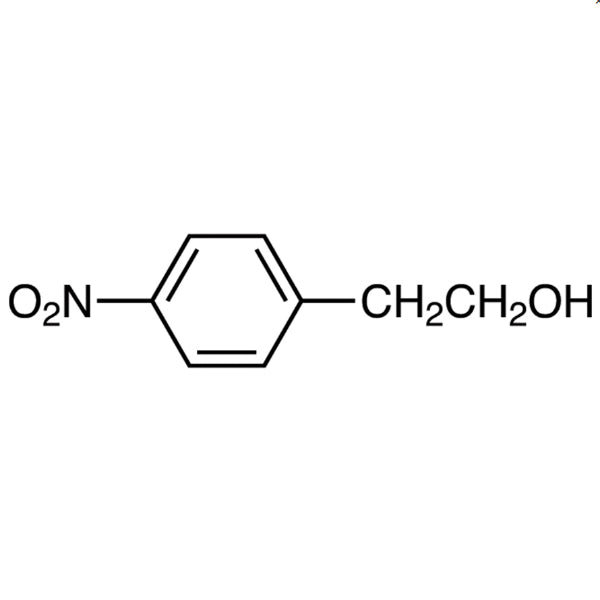
2-(4-Nitrophenyl)ethanol is a chemical compound widely used in various laboratory reactions. It serves as a fundamental building block in organic synthesis, playing a crucial role in the development of more complex molecules. Its simple molecular structure is essential for creating heterocyclic and aromatic compounds, making it a versatile reagent in chemical research. This compound is commonly utilized in the initial stages of synthesis processes, such as drug development, industrial chemical production, and the creation of organic compounds with broad applications. Its chemical stability and reactivity make it a valuable tool in laboratory settings.
The compound's molecular structure contains both a nitro group and a hydroxyl group, contributing to its high reactivity. These functional groups enable it to participate in substitution and reduction reactions, making it ideal for a wide range of synthetic pathways. Its reactivity and availability in various packaging options make it a preferred choice for researchers seeking reliable and effective chemical building blocks. The ease of handling and its compatibility with multiple reagents further enhance its utility in laboratory environments.
In Indonesian laboratories, 2-(4-Nitrophenyl)ethanol is frequently used in organic chemistry research, particularly in universities and research institutions focused on synthesis. Its role in creating complex molecules and its availability in different packaging sizes support its use in both academic and industrial research settings. This compound is an essential component in the study of chemical reactions and the development of new materials and pharmaceuticals.
- Organic synthesis is a key application where this compound is used to build complex molecules due to its reactivity and structural versatility.
- Drug development benefits from its role in creating pharmaceutical compounds through various synthetic pathways.
- Industrial chemical production relies on this compound for the synthesis of a wide range of organic materials.
- Research in heterocyclic compounds often utilizes this building block for its ability to form stable and functional molecular structures.
- Educational institutions use this compound in teaching and experimental settings to demonstrate fundamental chemical reactions and synthesis techniques.
| Brand | TCI |
|---|---|
| CAS number | 100-27-6 |
| Molecular formula | — |
| Purity | — |
| Category | Chemistry > Building Blocks > Non-Heterocyclic Building Blocks |
| Pack sizes | Available in various sizes to suit different experimental needs |
| Physical form | Liquid |
| Storage | Store in a cool, dry place away from direct sunlight |
This compound should be stored in a cool, dry place away from direct sunlight to maintain its stability and reactivity. It is recommended to use airtight containers to prevent exposure to moisture and air, which can affect its chemical integrity. Due to its reactive nature, it should be handled with appropriate safety measures, such as wearing gloves and safety goggles. It is important to ensure proper ventilation when working with this compound to minimize inhalation risks. Storage conditions should be controlled to avoid temperature fluctuations that could impact its performance in laboratory applications. General laboratory precautions include keeping it away from incompatible substances and following standard safety protocols for chemical handling.
—
Produk Terkait
-
1-(2-Nitrophenyl)ethanol TCI N1132
Regular price From Rp 1.881.600,00Regular price -
2-(Benzyloxy)ethanol TCI B0426
Regular price From Rp 557.550,00Regular price -
1-(2-Naphthyl)ethanol TCI N0788
Regular price From Rp 1.936.200,00Regular price -
2-(1-Naphthyl)ethanol TCI N0575
Regular price From Rp 1.326.150,00Regular price -
1-(1-Naphthyl)ethanol TCI N0395
Regular price From Rp 2.016.000,00Regular price -
1-(3-Methoxyphenyl)ethanol TCI M3577
Regular price From Rp 2.571.450,00Regular price -
2-(p-Tolyl)ethanol TCI M2298
Regular price From Rp 2.121.000,00Regular price -
2-(m-Tolyl)ethanol TCI M1376
Regular price From Rp 3.155.250,00Regular price


