

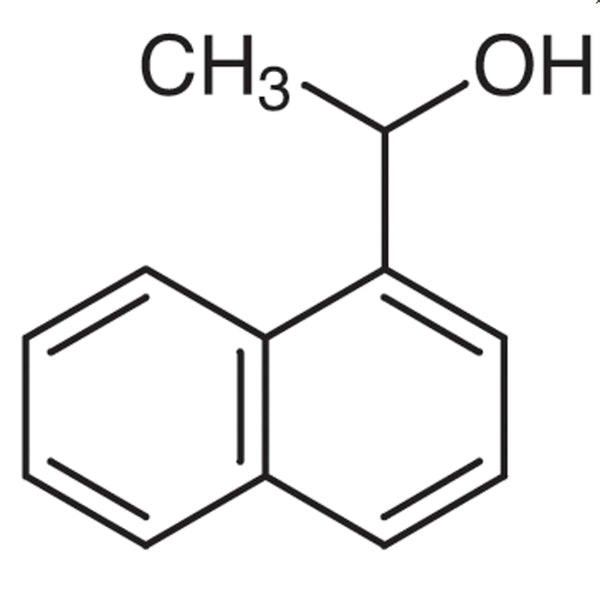
1-(1-Naphthyl)ethanol is a chemical compound widely used in laboratory settings for the synthesis of complex molecules. It serves as a key building block in organic chemistry, particularly in the creation of aromatic compounds. This material is commonly found in chemical laboratories as a foundational reagent that supports the development of more intricate molecular structures. Its role extends beyond mere participation in reactions; it often functions as an intermediate, facilitating the formation of new compounds through controlled chemical transformations.
The chemical properties of 1-(1-Naphthyl)ethanol make it a preferred choice for researchers. Its molecular structure, consisting of an ethanol chain and a naphthyl group, provides specific polarity and solubility characteristics. These properties enable it to interact effectively with various reagents under controlled conditions. The stability of the compound ensures consistent performance in laboratory experiments, making it a reliable component in synthetic processes. Its predictable behavior and compatibility with a range of solvents and reagents further enhance its utility in chemical research.
In Indonesian laboratories, 1-(1-Naphthyl)ethanol is a staple in organic chemistry and complex compound synthesis. It is frequently used in university and research institutions, where its ability to contribute to the development of new compounds is highly valued. Its applications span across fields such as pharmaceuticals and material science, where the creation of novel substances is essential. The compound’s versatility and reliability make it a go-to choice for researchers aiming to advance their work in chemical synthesis.
- Aromatic Compound Synthesis: This compound is ideal for creating complex aromatic structures due to its stable molecular framework and reactivity.
- Organic Chemistry Research: It supports the development of new organic molecules, making it essential for academic and industrial research.
- Pharmaceutical Development: Its role in synthesizing bioactive compounds makes it valuable in drug discovery and formulation.
- Material Science Innovation: It contributes to the creation of advanced materials by participating in polymer and functional compound synthesis.
- Intermediate Reagent Use: It functions as a key intermediate in multi-step synthetic pathways, enabling the production of specialized chemical products.
| Brand | TCI |
|---|---|
| CAS number | 1517-72-2 |
| Molecular formula | — |
| Purity | — |
| Category | Chemistry > Building Blocks > Non-Heterocyclic Building Blocks |
| Pack sizes | Available in standard laboratory quantities |
| Physical form | Liquid |
| Storage | Store in a cool, dry place away from light and incompatible substances |
This compound should be stored in a cool, dry environment, away from direct sunlight and sources of heat. It is recommended to keep it in a tightly sealed container to prevent evaporation and contamination. Due to its chemical nature, it should be stored separately from strong oxidizers and incompatible materials. In laboratory settings, proper ventilation is essential when handling this compound to minimize exposure. Always use appropriate personal protective equipment, such as gloves and safety goggles, to ensure safe handling. The compound is generally stable under normal storage conditions but should be handled with care to maintain its integrity and effectiveness.
—
Produk Terkait
-
1-(2-Naphthyl)ethanol TCI N0788
Regular price From Rp 1.936.200,00Regular price -
2-(1-Naphthyl)ethanol TCI N0575
Regular price From Rp 1.326.150,00Regular price -
2-(Benzyloxy)ethanol TCI B0426
Regular price From Rp 557.550,00Regular price -
2-(4-Nitrophenyl)ethanol TCI N0569
Regular price From Rp 1.353.450,00Regular price -
1-(3-Methoxyphenyl)ethanol TCI M3577
Regular price From Rp 2.571.450,00Regular price -
2-(p-Tolyl)ethanol TCI M2298
Regular price From Rp 2.121.000,00Regular price -
2-(m-Tolyl)ethanol TCI M1376
Regular price From Rp 3.155.250,00Regular price -
2-(o-Tolyl)ethanol TCI M1375
Regular price From Rp 2.677.500,00Regular price


