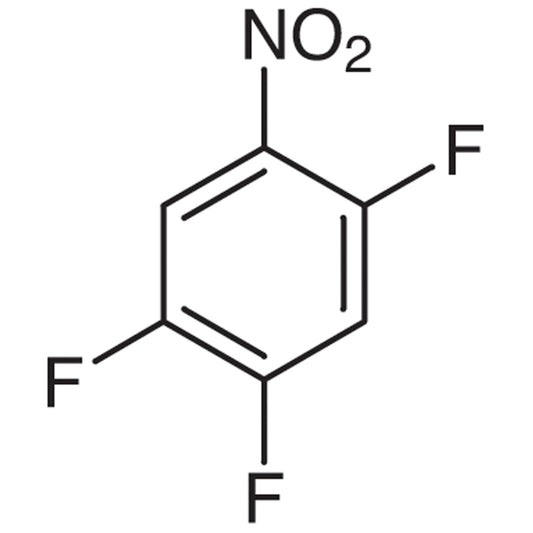
TCI D4123 2,6-Difluoronitrobenzene is a fluorinated aromatic compound bearing a nitro group with two fluorine atoms at both ortho positions. The combination of a strongly electron-withdrawing nitro group and fluorine atoms acting as leaving groups makes this compound one of the most reliable substrates for nucleophilic aromatic substitution reactions in the organic chemistry laboratory. Its role is that of a synthetic starting material that allows amine, alkoxy, or thio groups to be installed directly onto the benzene ring, a transformation that is normally difficult to achieve on ordinary aromatics without a metal catalyst.
The property that makes this material a preferred choice is its dual activation toward both fluorine positions. The nitro group at the ortho position stabilises the Meisenheimer intermediate so that nucleophilic attack proceeds rapidly, even at moderate temperatures and without expensive catalysts. Because the two fluorine atoms are symmetrically equivalent, the first substitution can be controlled simply by adjusting the amount of nucleophile, leaving one fluorine available for a subsequent step. After that, the nitro group can be reduced to an amine, opening cyclisation routes toward benzimidazoles, benzoxazoles, and benzothiazoles.
Its liquid form at room temperature makes handling straightforward in Indonesian laboratories, since the material can be measured volumetrically or by mass with a syringe or pipette without a dissolution step beforehand. This suits the working practice of university research groups, pharmaceutical development laboratories, and agrochemical laboratories that build heterocyclic scaffolds in stages, where a single reagent needs to serve several routes on a small to medium reaction scale.
TCI brochures (PDF)
- Fluorination Reagents, Fluorinated Building Blocks 2026-03-18 · p. 31
- Nucleophilic aromatic substitution studies: the ortho nitro group activates both fluorine positions so amines, alcohols, and thiols displace fluoride reliably without a metal catalyst.
- Sequential difunctionalisation of a benzene ring: the two equivalent fluorines allow a controlled mono-substitution first, keeping the second position open for a different nucleophile later.
- Benzimidazole synthesis: substitution with an amine followed by reduction of the nitro group delivers the ortho-diamine relationship required for ring closure to the heterocycle.
- Benzoxazole and benzothiazole preparation: alkoxy or thio substitution installs the oxygen or sulfur partner, and nitro reduction then supplies the amine needed for cyclisation.
- Pharmaceutical and agrochemical building block work: the compound serves as an early-stage intermediate for constructing fluorinated aromatic and heterocyclic cores in discovery-scale routes.
| Brand | TCI |
|---|---|
| CAS number | 19064-24-5 |
| Molecular formula | — |
| Purity | — |
| Category | Chemistry > Building Blocks > Fluorinated Building Blocks |
| Pack sizes | available in the standard TCI catalogue pack sizes; please confirm the pack size when ordering |
| Physical form | liquid at room temperature |
| Storage | keep in a tightly closed container, protected from light and moisture, in a cool and well-ventilated area |
- Catalogue Number: D4123
Store the material in its original tightly closed container in a cool, dry, and well-ventilated place, away from heat sources, direct sunlight, and incompatible materials such as strong bases and strong reducing agents. Amber glass bottles or the manufacturer's original packaging are suitable, and containers should be resealed immediately after each withdrawal to limit moisture uptake and vapour release. All handling, transfer, and reaction set-up should be carried out inside a fume hood, using nitrile gloves, safety goggles, and a laboratory coat. Because the compound is a liquid, transfer it with a syringe or pipette rather than by pouring to reduce the risk of spillage and skin contact. Collect halogenated organic waste separately, and consult the manufacturer's Safety Data Sheet before first use.
—
Produk Terkait
-
4-Bromo-2,5-difluoronitrobenzene TCI B3926
Regular price From Rp 1.538.250,00Regular price -
3,5-Difluoronitrobenzene TCI D3426
Regular price From Rp 3.048.150,00Regular price -
3,4-Difluoronitrobenzene TCI D1926
Regular price From Rp 1.193.850,00Regular price -
2,5-Difluoronitrobenzene TCI D1700
Regular price Rp 1.696.800,00Regular price -
2,4-Difluoronitrobenzene TCI D1636
Regular price From Rp 769.650,00Regular price -
3,4,5-Trifluoronitrobenzene TCI T2357
Regular price From Rp 875.700,00Regular price -
2,4,6-Trifluoronitrobenzene TCI T1681
Regular price From Rp 1.696.800,00Regular price -
2,4,5-Trifluoronitrobenzene TCI T1589
Regular price From Rp 1.008.000,00Regular price