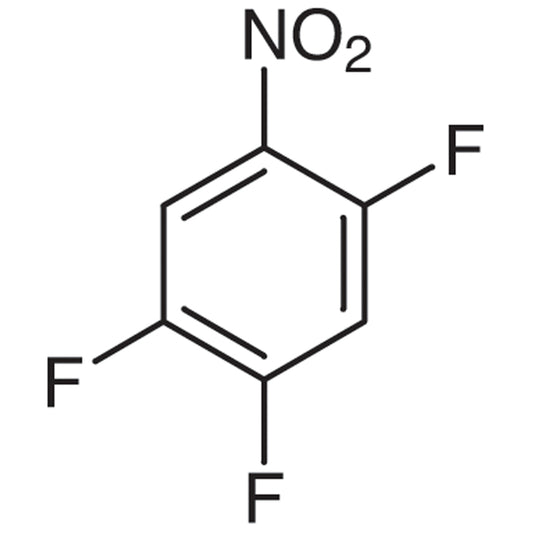
4-Bromo-2,5-difluoronitrobenzene is a chemical compound widely used as a building block in the synthesis of complex organic molecules. This versatile reagent plays a crucial role in laboratory settings where the development of new compounds is required. Its unique molecular structure, featuring a combination of nitro, bromo, and fluoro groups, makes it an essential tool for chemists working on a variety of synthetic pathways. Due to its reactivity and functional group diversity, it is frequently employed in research aimed at creating compounds with specific biological or industrial applications.
The compound’s fluorinated groups contribute to its high polarity and reactivity, making it ideal for substitution and electrophilic reactions. The presence of both nitro and bromo groups further enhances its utility by allowing for the formation of a wide range of chemically functional derivatives. These properties make it a preferred choice for researchers looking to explore new synthetic strategies or modify existing molecular structures with precision. Its stability under controlled conditions also ensures that it remains a reliable and consistent reagent for long-term use.
In Indonesian laboratories, 4-Bromo-2,5-difluoronitrobenzene is commonly used in organic chemistry research, particularly in pharmaceutical and industrial chemical development. Its role in creating compounds with specific biological activities makes it a valuable resource for scientists working on drug discovery and chemical synthesis projects. Its availability and chemical properties make it a standard component in many research laboratories across Indonesia.
TCI brochures (PDF)
- Fluorination Reagents, Fluorinated Building Blocks 2026-03-18 · p. 32
- Organic synthesis applications benefit from its reactivity and functional group diversity, enabling the creation of complex molecules with specific biological or industrial properties.
- Pharmaceutical research utilizes this compound to develop compounds with targeted biological activities, such as drugs or therapeutic agents.
- Industrial chemical development leverages its unique structure to create specialized chemical products with enhanced functional properties.
- Structural modification studies take advantage of its fluorinated and brominated groups to explore new synthetic pathways and molecular transformations.
- Analytical chemistry applications use it as a reference standard for identifying and characterizing similar fluorinated and nitro-containing compounds.
| Brand | TCI |
|---|---|
| CAS number | 167415-27-2 |
| Molecular formula | — |
| Purity | — |
| Category | Chemistry > Building Blocks > Fluorinated Building Blocks |
| Pack sizes | Available in various quantities as per supplier specifications |
| Physical form | Liquid or solid, depending on the specific product variant |
| Storage | Store in a cool, dry, and well-ventilated area away from light and incompatible materials |
This compound should be stored in a cool, dry, and well-ventilated area, away from direct sunlight and sources of heat. It is recommended to use airtight containers made of materials compatible with its chemical properties, such as glass or high-density polyethylene. Due to its reactivity and potential for interaction with other substances, it should be kept separate from strong oxidizers, acids, and bases. Proper personal protective equipment, including gloves, goggles, and a lab coat, should be worn when handling this material to ensure safety. Regular monitoring of storage conditions is advised to maintain its stability and effectiveness for laboratory use.
—
Produk Terkait
-
2,6-Difluoronitrobenzene TCI D4123
Regular price From Rp 1.485.750,00Regular priceRp 1.038.450,00Sale price From Rp 1.485.750,00 -
3,5-Difluoronitrobenzene TCI D3426
Regular price From Rp 3.048.150,00Regular priceRp 2.131.500,00Sale price From Rp 3.048.150,00 -
3,4-Difluoronitrobenzene TCI D1926
Regular price From Rp 1.193.850,00Regular priceRp 834.750,00Sale price From Rp 1.193.850,00 -
2,5-Difluoronitrobenzene TCI D1700
Regular price Rp 1.696.800,00Regular priceRp 1.186.500,00Sale price Rp 1.696.800,00 -
2,4-Difluoronitrobenzene TCI D1636
Regular price From Rp 769.650,00Regular priceRp 537.600,00Sale price From Rp 769.650,00 -
3,4,5-Trifluoronitrobenzene TCI T2357
Regular price From Rp 875.700,00Regular priceRp 612.150,00Sale price From Rp 875.700,00 -
2,4,6-Trifluoronitrobenzene TCI T1681
Regular price From Rp 1.696.800,00Regular priceRp 1.186.500,00Sale price From Rp 1.696.800,00 -
2,4,5-Trifluoronitrobenzene TCI T1589
Regular price From Rp 1.008.000,00Regular priceRp 704.550,00Sale price From Rp 1.008.000,00