

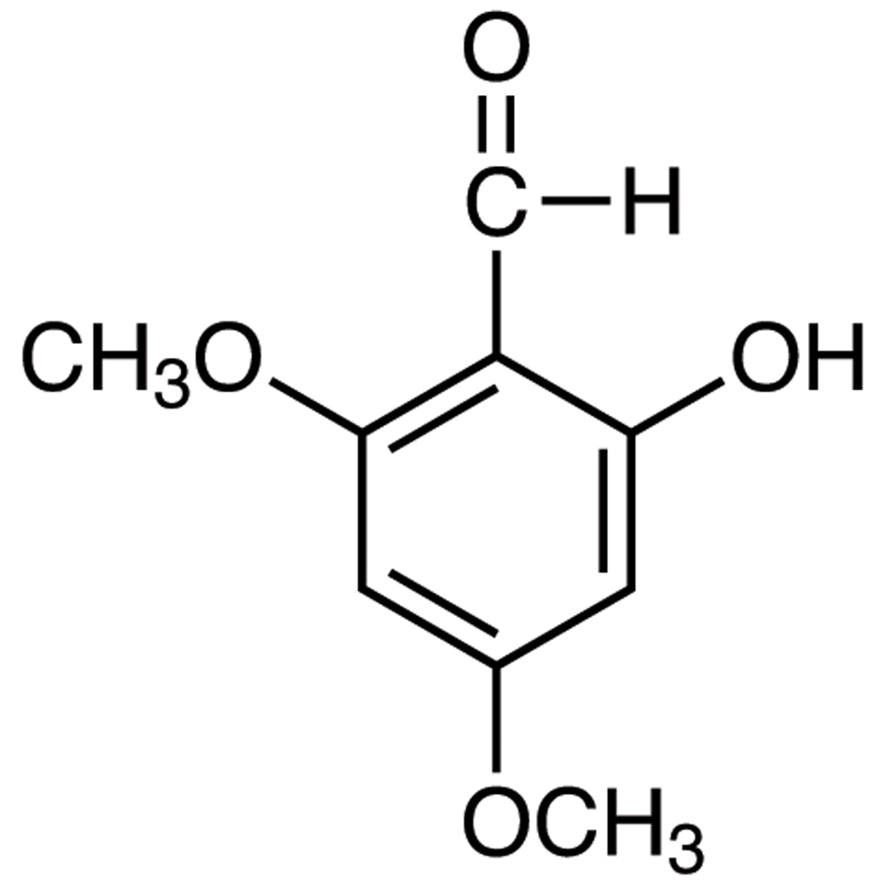
TCI D4165 4,6-Dimethoxysalicylaldehyde is a salicylaldehyde derivative that carries a phenolic hydroxyl group adjacent to an aldehyde group, together with two methoxy groups at positions 4 and 6 of the aromatic ring. As a non-heterocyclic building block, this compound offers three reactive points within a single molecule, which makes it particularly valuable for the synthesis of oxygen-rich molecules such as coumarins, chromones, chalcones, and a range of flavonoid-like frameworks. Having it on hand removes several preparatory steps that would otherwise be required to install a methoxy substitution pattern on a phenolic ring.
The property that makes this material a preferred choice is its distinctive electronic combination: the two methoxy groups donate electrons into the aromatic ring and thereby increase reactivity toward electrophilic aromatic substitution, while the neighbouring hydroxyl and aldehyde pair forms an intramolecular hydrogen bond and at the same time acts as an effective chelation site for metal ions. This arrangement also leaves the compound ready to enter Schiff base condensation reactions, aldol condensations, and cyclisations that build six-membered rings fused to the aromatic core. Its substitution pattern resembles motifs that appear widely across naturally occurring oxygenated aromatic compounds.
In Indonesian laboratories, this building block is typically used in synthetic organic chemistry groups at universities and research institutes, in natural product and phytochemistry work where flavonoid-type or coumarin-type scaffolds are being assembled, and in coordination chemistry projects that require Schiff base ligands. It is also drawn upon by industrial and contract research laboratories preparing intermediates on a small scale, where a ready-made methoxylated salicylaldehyde shortens a multi-step route considerably.
- Coumarin and chromone synthesis — the adjacent hydroxyl and aldehyde groups allow direct cyclisation into six-membered oxygenated rings fused to the aromatic core.
- Chalcone and flavonoid-like scaffold preparation — the aldehyde group condenses readily with ketones, while the methoxy substitution pattern already matches many oxygenated natural product motifs.
- Schiff base ligand preparation — the aldehyde reacts with primary amines and the neighbouring phenolic hydroxyl completes an effective chelating pocket for metal ions.
- Coordination and metal complex chemistry — the ortho hydroxyl–aldehyde arrangement provides a defined chelation site, making the compound suitable for building metal complexes for structural or catalytic study.
- Electrophilic aromatic substitution studies — the two electron-donating methoxy groups activate the ring, so this substrate serves well in teaching and research work on ring reactivity and regioselectivity.
| Brand | TCI (Tokyo Chemical Industry) |
|---|---|
| CAS number | 708-76-9 |
| Molecular formula | — |
| Purity | — |
| Category | Chemistry > Building Blocks > Non-Heterocyclic Building Blocks |
| Pack sizes | available in standard TCI research-scale pack sizes; please confirm the size required when ordering |
| Physical form | — |
| Storage | store in a cool, dry place in a tightly closed container, protected from light |
- Catalogue number: D4165
Store the container tightly closed in a cool, dry, and well-ventilated area, away from direct sunlight and from sources of heat or ignition. Amber glass bottles or the original manufacturer packaging are suitable, since phenolic aldehydes are generally sensitive to light and to prolonged air exposure. Handle the material in a fume hood, and wear a laboratory coat, safety glasses, and chemical-resistant gloves. Avoid generating dust, avoid contact with skin and eyes, and keep the compound separate from strong oxidising agents and strong bases. Always consult the manufacturer's Safety Data Sheet before use, and dispose of residues in accordance with your institution's chemical waste procedures.
—
Produk Terkait
-
5-Allyl-3-methoxysalicylaldehyde TCI A2104
Regular price From Rp 928.200,00Regular price -
Salicylaldehyde TCI S0275
Regular price From Rp 584.850,00Regular price -
Salicylaldehyde TCI S0004
Regular price From Rp 689.850,00Regular price -
3-Ethoxysalicylaldehyde TCI E0253
Regular price Rp 875.700,00Regular price -
Methyl5-Allyl-3-methoxysalicylate TCI M2204
Regular price Rp 1.749.300,00Regular price -
Methyl3-Methoxysalicylate TCI M2167
Regular price From Rp 769.650,00Regular price -
Methyl5-Methoxysalicylate TCI M2127
Regular price Rp 1.988.700,00Regular price -
6-MethoxysalicylicAcid TCI M1941
Regular price From Rp 505.050,00Regular price


