

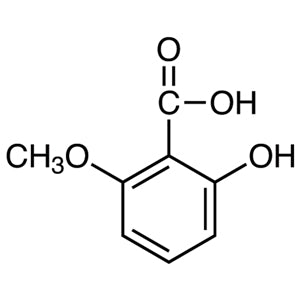
6-Methoxysalicylic Acid is a chemical compound widely used as a building block in the synthesis of organic compounds. It plays a crucial role in laboratory settings where structural modifications of molecules are required, particularly in the development of aromatic and heterocyclic compounds. This compound is essential for creating more complex chemical structures, which are fundamental in various scientific fields such as pharmaceutical research, industrial chemistry, and bioactive compound development. Its versatility and reactivity make it a valuable resource for chemists aiming to explore new synthetic pathways.
The compound’s molecular structure includes both hydroxyl and methoxy groups, which contribute to its reactivity in a range of chemical reactions, including esterification, hydrolysis, and substitution. These functional groups allow it to participate in diverse chemical transformations, making it a flexible tool in synthetic chemistry. Its availability in solid form and solubility in organic solvents enhance its practicality for laboratory use. This combination of stability and reactivity ensures that it remains a reliable choice for researchers seeking to manipulate molecular structures.
In Indonesian laboratories, 6-Methoxysalicylic Acid is commonly used in chemical research, especially in pharmaceutical, material science, and analytical chemistry applications. Its accessibility and broad range of uses make it a popular choice for advanced research and product development. Researchers in Indonesia rely on this compound for its consistent performance and adaptability in various experimental conditions.
Related TCI products
- Pharmaceutical research utilizes 6-Methoxysalicylic Acid for the synthesis of bioactive compounds due to its structural versatility and reactivity.
- Material science applications benefit from its ability to participate in chemical modifications, aiding in the creation of new polymers and functional materials.
- Analytical chemistry uses this compound as a reference standard for identifying and quantifying similar organic compounds in complex mixtures.
- Organic synthesis relies on its functional groups for catalytic and structural transformations, supporting the development of novel chemical entities.
- Environmental studies employ it as a model compound to study degradation pathways and reactivity in different chemical environments.
| Brand | TCI |
|---|---|
| CAS number | 3147-64-6 |
| Molecular formula | — |
| Purity | — |
| Category | Chemistry > Building Blocks > Non-Heterocyclic Building Blocks |
| Pack sizes | Available in various quantities as per standard laboratory supply |
| Physical form | Solid |
| Storage | Store in a cool, dry place away from moisture and direct sunlight |
6-Methoxysalicylic Acid should be stored in a cool, dry environment to maintain its chemical stability and prevent degradation. It is recommended to keep it in a sealed container to minimize exposure to moisture and air, which could affect its reactivity. While it is not highly toxic, standard laboratory safety practices should be followed when handling this compound, including the use of personal protective equipment such as gloves and safety goggles. It is important to ensure that the storage area is well-ventilated to avoid any potential accumulation of vapors. Proper labeling of containers is essential to prevent accidental misuse. The compound should not be stored near incompatible materials, such as strong acids or bases, to avoid any chemical reactions that could compromise its integrity.
—
Produk Terkait
-
4-MethoxysalicylicAcid TCI M1795
Regular price From Rp 903.000,00Regular price -
5-MethoxysalicylicAcid TCI M1254
Regular price From Rp 980.700,00Regular price -
3-MethoxysalicylicAcid TCI M1153
Regular price From Rp 477.750,00Regular price -
5-Allyl-3-methoxysalicylaldehyde TCI A2104
Regular price From Rp 928.200,00Regular price -
Methyl5-Allyl-3-methoxysalicylate TCI M2204
Regular price Rp 1.749.300,00Regular price -
Methyl3-Methoxysalicylate TCI M2167
Regular price From Rp 769.650,00Regular price -
Methyl5-Methoxysalicylate TCI M2127
Regular price Rp 1.988.700,00Regular price -
Methyl4-Methoxysalicylate TCI M1797
Regular price From Rp 717.150,00Regular price


