

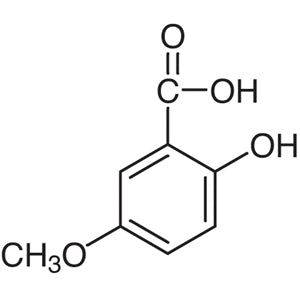
5-Methoxysalicylic Acid is a chemical compound widely used in laboratory settings for the synthesis of complex molecules. As a building block in organic chemistry, it plays a crucial role in the development of both heterocyclic and non-heterocyclic compounds. Its simple molecular structure provides a versatile platform for various chemical reactions, including esterification, hydrolysis, and substitution. This compound is particularly valued for its ability to react with different functional groups, enabling the creation of more intricate chemical structures.
One of the key properties that make 5-Methoxysalicylic Acid a preferred choice is its stability under controlled laboratory conditions. It is readily available in international markets and is known for its consistent quality and reliability. Its chemical reactivity and compatibility with a wide range of reagents make it a go-to material for chemists working on diverse synthetic pathways. Additionally, its predictable behavior in different reaction environments enhances its utility in both research and educational settings.
In Indonesian laboratories, 5-Methoxysalicylic Acid is commonly used in chemical synthesis, particularly in the development of pharmaceutical compounds, industrial chemicals, and environmental research. It is also integral to academic training, where it helps students gain hands-on experience in synthetic techniques and compound characterization. Its presence in both research and educational contexts underscores its importance in the scientific community.
Related TCI products
- Drug synthesis applications benefit from 5-Methoxysalicylic Acid due to its reactivity and compatibility with various functional groups, enabling the creation of complex pharmaceutical compounds.
- Industrial chemical production relies on this compound for its role in synthesizing a wide range of organic materials, contributing to the development of new chemical products.
- Environmental research utilizes this compound in the study of chemical degradation processes and the synthesis of compounds for pollution control and remediation.
- Educational institutions use it to teach students about synthetic chemistry, offering practical experience in compound preparation and analysis techniques.
- Research laboratories incorporate it into their workflows for the development of novel compounds, leveraging its versatility in chemical reactions and structural modifications.
| Brand | TCI |
|---|---|
| CAS number | 2612-02-4 |
| Molecular formula | — |
| Purity | — |
| Category | Chemistry > Building Blocks > Non-Heterocyclic Building Blocks |
| Pack sizes | Available in various quantities as per supplier standards |
| Physical form | Solid |
| Storage | Store in a cool, dry place away from direct sunlight |
5-Methoxysalicylic Acid should be stored in a cool, dry environment to maintain its chemical integrity and prevent degradation. It is recommended to keep the compound in a tightly sealed container to minimize exposure to moisture and air. While it is generally stable under normal laboratory conditions, it should be handled with care to avoid contamination. Appropriate personal protective equipment, such as gloves and safety goggles, should be worn when handling this material. It is not classified as hazardous under standard laboratory conditions, but standard safety protocols should still be followed to ensure safe usage and storage.
—
Produk Terkait
-
6-MethoxysalicylicAcid TCI M1941
Regular price From Rp 505.050,00Regular price -
4-MethoxysalicylicAcid TCI M1795
Regular price From Rp 903.000,00Regular price -
3-MethoxysalicylicAcid TCI M1153
Regular price From Rp 477.750,00Regular price -
5-Allyl-3-methoxysalicylaldehyde TCI A2104
Regular price From Rp 928.200,00Regular price -
Methyl5-Allyl-3-methoxysalicylate TCI M2204
Regular price Rp 1.749.300,00Regular price -
Methyl3-Methoxysalicylate TCI M2167
Regular price From Rp 769.650,00Regular price -
Methyl5-Methoxysalicylate TCI M2127
Regular price Rp 1.988.700,00Regular price -
Methyl4-Methoxysalicylate TCI M1797
Regular price From Rp 717.150,00Regular price


