TCI D4692, CAS 53348-05-3, is 3,6-Dibromophenanthrene-9,10-dione, a small molecule building block prepared for organic semiconductor research and materials science work. The compound is a phenanthrenequinone derivative: a three-ring phenanthrene framework carrying two adjacent ketone groups at the nine and ten positions, together with two bromine atoms placed at the three and six positions. The combination of an ortho-dione unit and two bromine sites makes it a highly useful starting material for constructing large conjugated molecules. In materials laboratories, it serves as an electron-accepting core that can be extended into a range of functional units for organic electronic devices.
The advantage that makes this compound a frequent choice lies in the two kinds of reactivity it offers at the same time, which can be used in sequence. The ortho-dione group condenses readily with aromatic diamines to form a pyrazine ring, producing strong acceptor units such as the dibenzo[a,c]phenazine framework that is popular in light-emitting materials. The two bromine atoms, meanwhile, act as ideal connection points for palladium-catalysed cross-coupling reactions, allowing donor arms, solubilising chains, or polymer segments to be attached to the core with good positional control.
In Indonesian laboratories, this building block is typically used by university and institutional research groups working on organic electronics, thin-film materials, and functional dye chemistry. It suits synthetic work carried out on a research scale, where a defined halogenated acceptor core is needed as the entry point to a longer synthetic sequence. Groups developing emitter materials, conjugated polymers, and small-molecule semiconductors commonly draw on this class of reagent when building and screening candidate structures.
TCI brochures (PDF)
- Building Blocks for Organic Semiconductor 2026-03-24 · p. 11
Related TCI products
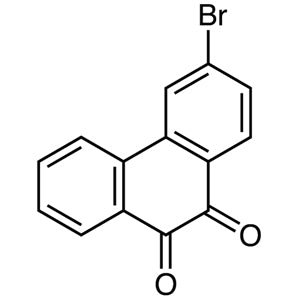
- TCI B6037 13292-05-2 3-Bromophenanthrene-9,10-dione
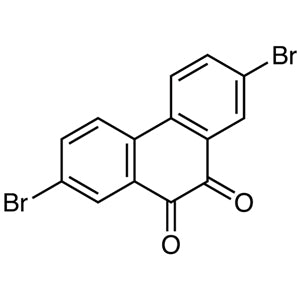
- TCI D4363 84405-44-7 2,7-Dibromophenanthrene-9,10-dione
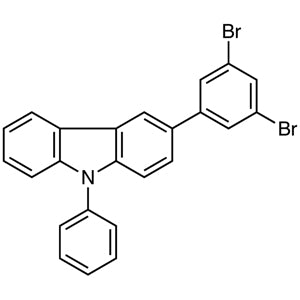
- TCI D4979 1345021-52-4 3-(3,5-Dibromophenyl)-9-phenyl-9H-carbazole
- TCI D4978 750573-26-3 9-(3,5-Dibromophenyl)carbazole
- TCI D4902 1073062-59-5 2-(3,5-Dibromophenyl)-4,6-diphenyl-1,3,5-triazine
- TCI P3265 605-87-8 Phenanthren-3-ol
- Dibenzo[a,c]phenazine synthesis: the adjacent nine and ten ketone groups condense directly with aromatic diamines, giving research groups a reliable route to strong acceptor frameworks used in light-emitting materials.
- Palladium-catalysed cross-coupling chemistry: the bromine atoms at the three and six positions serve as defined connection points for attaching aryl, donor, or solubilising fragments to the phenanthrene core.
- Conjugated polymer building block work: the symmetric pair of bromine sites allows the molecule to be incorporated as a repeating acceptor segment within extended conjugated polymer chains.
- Organic electronic device material development: the electron-accepting phenanthrenequinone core provides a starting scaffold for preparing small-molecule semiconductors intended for evaluation in device studies.
- Sequential functionalisation studies: because the dione and the two bromine sites react under different conditions, researchers can carry out stepwise modification of one reactive site before addressing the other.
| Brand | TCI |
|---|---|
| CAS number | 53348-05-3 |
| Molecular formula | — |
| Purity | — |
| Category | Materials Science > Material Building Blocks > Small Molecule Semiconductor Building Blocks |
| Pack sizes | research-scale synthetic quantities; please confirm the available pack size when ordering |
| Physical form | — |
| Storage | keep in a closed original container under the conditions stated on the manufacturer label |
- Chemical name: 3,6-Dibromophenanthrene-9,10-dione
Store the container tightly closed in a cool, dry, and well-ventilated area, away from direct sunlight, heat sources, and incompatible reagents, following the conditions given on the manufacturer label. Keep the material in its original supplier container, or in a clean, chemically compatible and properly labelled vessel if transfer is required. Handle the solid inside a fume hood, using a laboratory coat, safety glasses, and suitable chemical-resistant gloves, and avoid generating or inhaling dust during weighing and transfer. Close the container promptly after use, keep it clearly labelled, and consult the manufacturer safety data sheet before handling, storage, or waste disposal.
—
Produk Terkait
-
3-Bromophenanthrene-9,10-dione TCI B6037
Regular price From Rp 1.405.950,00Regular price -
2,7-Dibromophenanthrene-9,10-dione TCI D4363
Regular price From Rp 769.650,00Regular price -
3-(3,5-Dibromophenyl)-9-phenyl-9H-carbazole TCI D4979
Regular price From Rp 1.035.300,00Regular price -
9-(3,5-Dibromophenyl)carbazole TCI D4978
Regular price From Rp 1.829.100,00Regular price -
2-(3,5-Dibromophenyl)-4,6-diphenyl-1,3,5-triazine TCI D4902
Regular price From Rp 1.353.450,00Regular price -
Phenanthren-3-ol TCI P3265
Regular price Rp 3.949.050,00Regular price -
Phenanthrene(purifiedbysublimation) TCI P2877
Regular price From Rp 1.353.450,00Regular price -
PhenanthreneZoneRefined(numberofpasses:30) TCI P0331
Regular price Rp 2.942.100,00Regular price