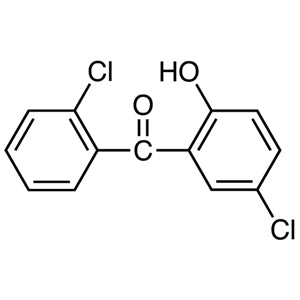
TCI D4703 with CAS number 61785-35-1 is 2',5-Dichloro-2-hydroxybenzophenone, a non-heterocyclic building block built on a benzophenone framework — two benzene rings joined by a single carbonyl group. The molecule carries a hydroxyl group at the position ortho to the carbonyl, together with two chlorine atoms distributed across the two aromatic rings. In organic synthesis laboratories, compounds of this type serve as starting materials for constructing larger aromatic systems, including fused heterocyclic frameworks and ultraviolet-absorbing compounds, because the substitution pattern is already established and is difficult to install directly through conventional acylation reactions.
The most notable characteristic of this compound is the presence of the ortho hydroxyl group, which forms an intramolecular hydrogen bond with the adjacent carbonyl group. That interaction generates a pseudo six-membered ring which confers additional stability and at the same time underlies the photophysical behaviour characteristic of the 2-hydroxybenzophenone family, namely the ability to dissipate ultraviolet light energy through excited-state proton transfer. The hydroxyl group also provides a reaction site for etherification or esterification, so the scaffold can be elaborated further without disturbing the rest of the structure.
In Indonesian laboratories, a building block of this kind is typically kept as part of a synthetic chemistry stock for research groups at universities, government research institutes, and industrial R&D units. It is drawn upon when a benzophenone core with a defined chlorine and hydroxyl substitution pattern is required, whether for method development work, for the preparation of intermediates in a multi-step route, or for teaching and postgraduate research projects in organic synthesis.
Related TCI products
- TCI T2028 33077-87-1 2,2',4-Trimethoxybenzophenone
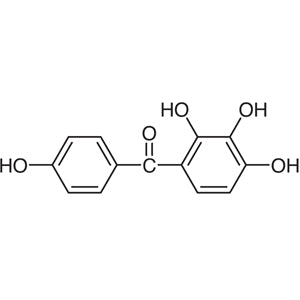
- TCI T1594 31127-54-5 2,3,4,4'-Tetrahydroxybenzophenone
- TCI B4504 54589-41-2 4-Benzyloxybenzophenone
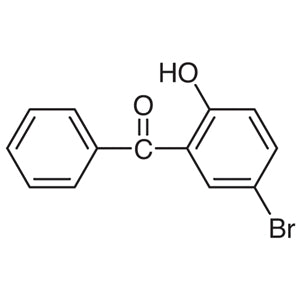
- TCI B2341 55082-33-2 5-Bromo-2-hydroxybenzophenone
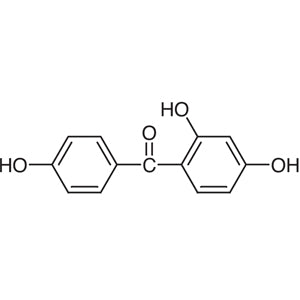
- TCI T0584 1470-79-7 2,4,4'-Trihydroxybenzophenone
- TCI T0118 131-55-5 2,2',4,4'-Tetrahydroxybenzophenone
- Non-heterocyclic building block in multi-step synthesis: the pre-installed chlorine and hydroxyl substitution pattern removes the need for difficult direct acylation steps when assembling larger aromatic targets.
- Precursor to fused heterocyclic frameworks: the benzophenone core with its ortho hydroxyl group provides the correct geometry for cyclisation onto adjacent aromatic positions during ring construction.
- Preparation of ultraviolet-absorbing compounds: the 2-hydroxybenzophenone motif dissipates ultraviolet energy by excited-state proton transfer, making it a logical starting point for UV-absorber research.
- Etherification and esterification chemistry: the free ortho hydroxyl group offers a defined, single reaction site for derivatisation while the remainder of the substituted scaffold stays intact.
- Photophysical and structural studies: the intramolecular hydrogen bond and resulting pseudo six-membered ring make this compound a useful reference substrate for investigating hydrogen-bonded carbonyl systems.
| Brand | TCI (Tokyo Chemical Industry) |
|---|---|
| CAS number | 61785-35-1 |
| Molecular formula | — |
| Purity | — |
| Category | Chemistry > Building Blocks > Non-Heterocyclic Building Blocks |
| Pack sizes | available in the standard research pack sizes supplied by TCI for this catalogue item; please confirm the required pack size when ordering. |
| Physical form | — |
| Storage | — |
- Chemical name: 2',5-Dichloro-2-hydroxybenzophenone
- Catalogue code: D4703
Store the container tightly closed in a cool, dry, well-ventilated area, away from direct sunlight, heat sources, and strong oxidising agents; protection from light is advisable for a compound with ultraviolet-absorbing character. Keep the material in its original supplier container, or in a clean, chemically compatible amber glass container that is clearly labelled if it must be transferred. Handle in a fume hood using safety glasses, gloves, and a laboratory coat, avoid generating dust, and avoid contact with skin, eyes, and clothing. Wash hands thoroughly after handling, keep the working area clean, and consult the manufacturer's safety data sheet for the compound before use and for disposal guidance.
—
Produk Terkait
-
2,2',4-Trimethoxybenzophenone TCI T2028
Regular price From Rp 3.312.750,00Regular price -
2,3,4,4'-Tetrahydroxybenzophenone TCI T1594
Regular price Rp 1.035.300,00Regular price -
4-Benzyloxybenzophenone TCI B4504
Regular price From Rp 1.035.300,00Regular price -
5-Bromo-2-hydroxybenzophenone TCI B2341
Regular price Rp 1.961.400,00Regular price -
2,4,4'-Trihydroxybenzophenone TCI T0584
Regular price Rp 6.070.050,00Regular price -
2,2',4,4'-Tetrahydroxybenzophenone TCI T0118
Regular price Rp 928.200,00Regular price -
4-Phenoxybenzophenone TCI P1328
Regular price Rp 2.016.000,00Regular price -
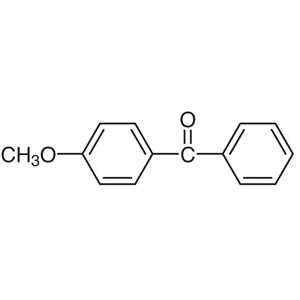
4-Methoxybenzophenone TCI M0357
Regular price Rp 1.115.100,00Regular price