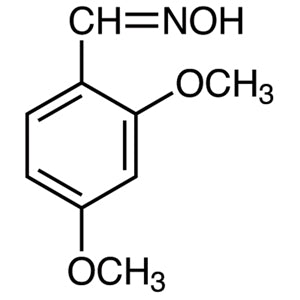
TCI D4851 2,4-Dimethoxybenzaldoxime is an aromatic oxime derivative produced by TCI and classified as a non-heterocyclic building block for organic synthesis work. The compound is built on a benzaldehyde framework carrying two methoxy groups at the 2 and 4 positions, with an aldoxime group (–CH=N–OH) serving as its reactive centre. In the laboratory, its role is that of a starting material or intermediate that already carries a defined substitution pattern, so researchers do not need to construct the substituted aromatic framework from scratch and can instead direct their effort straight to the transformation step that forms the core of their investigation.
The characteristic that makes this material a preferred choice is the versatility of its oxime group. Aldoximes are well known as a gateway to a number of classical transformations: dehydration to nitriles, Beckmann-type rearrangement to amides, reduction to amines, and the formation of nitrile oxides commonly used in cycloaddition reactions to construct isoxazole rings. At the same time, the two electron-donating methoxy groups impart a distinctive electronic character to the aromatic ring and influence the solubility and crystallisation behaviour of the resulting derivatives.
In Indonesian laboratories, a building block of this kind is typically used in university research groups, institutional research centres, and industrial development laboratories carrying out organic synthesis on a research scale. It is generally handled in reactions run at bench scale, where a ready-made substituted aromatic starting material shortens the route to the target compound and helps keep synthetic results consistent between repeat runs and between different operators working on the same project.
Related TCI products
- TCI B0011 622-31-1 alpha-Benzaldoxime
- TCI N0487 3717-19-9 syn-4-Nitrobenzaldoxime [Deprotecting Agent]
- TCI N0486 4836-00-4 syn-2-Nitrobenzaldoxime [Deprotecting Agent]
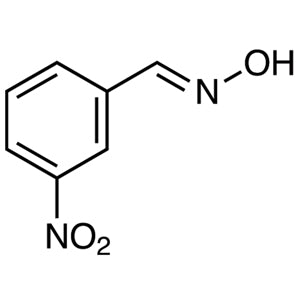
- TCI N0132 3717-29-1 syn-3-Nitrobenzaldoxime
- TCI D4850 54376-65-7 4-Diethylaminobenzaldoxime (mixture of isomers)
- TCI A0006 107-29-9 Acetaldoxime
- Nitrile synthesis via dehydration: the aldoxime group can be dehydrated to the corresponding nitrile, giving direct access to a dimethoxy-substituted aromatic nitrile without a separate cyanation step.
- Beckmann-type rearrangement studies: the oxime functionality undergoes rearrangement to amide products, making this compound suitable for methodology work that examines rearrangement conditions and selectivity on electron-rich aromatic rings.
- Reduction to amine derivatives: the oxime centre can be reduced to an amine, providing a convenient route into substituted benzylamine-type structures for further functionalisation in multi-step sequences.
- Isoxazole ring construction: conversion of the aldoxime into a nitrile oxide allows cycloaddition chemistry to be used for building isoxazole rings bearing the 2,4-dimethoxyphenyl substitution pattern.
- Intermediate in multi-step organic synthesis: the pre-installed methoxy substitution pattern lets research groups begin a synthetic route further along, saving preparative steps and reducing variability between repeat preparations.
| Brand | TCI |
|---|---|
| CAS number | 31874-34-7 |
| Molecular formula | — |
| Purity | — |
| Category | Chemistry > Building Blocks > Non-Heterocyclic Building Blocks |
| Pack sizes | available in laboratory research pack sizes as supplied by the manufacturer; please confirm the size required when ordering |
| Physical form | — |
| Storage | store under the conditions stated on the manufacturer's label and safety data sheet |
- Chemical class: aromatic aldoxime derivative, non-heterocyclic building block
Store the container tightly closed in a cool, dry, well-ventilated place, away from direct sunlight, heat sources, moisture, and incompatible materials, following the conditions stated on the manufacturer's label and safety data sheet. Keep the material in its original supplier container, or in a clean, chemically compatible and clearly labelled container if it must be transferred. Handle the compound in a fume hood using appropriate personal protective equipment, including safety goggles, laboratory gloves, and a laboratory coat. Avoid the generation and inhalation of dust, avoid contact with skin and eyes, and close the container promptly after use to limit exposure to atmospheric moisture. Waste material and contaminated packaging should be collected and disposed of in accordance with applicable laboratory chemical waste procedures.
—
Produk Terkait
-
alpha-Benzaldoxime TCI B0011
Regular price From Rp 1.565.550,00Regular price -
syn-4-Nitrobenzaldoxime[DeprotectingAgent] TCI N0487
Regular price From Rp 1.167.600,00Regular price -
syn-2-Nitrobenzaldoxime[DeprotectingAgent] TCI N0486
Regular price From Rp 848.400,00Regular price -
syn-3-Nitrobenzaldoxime TCI N0132
Regular price Rp 3.790.500,00Regular price -
4-Diethylaminobenzaldoxime(mixtureofisomers) TCI D4850
Regular price From Rp 610.050,00Regular price -
Acetaldoxime TCI A0006
Regular price Rp 1.035.300,00Regular price -
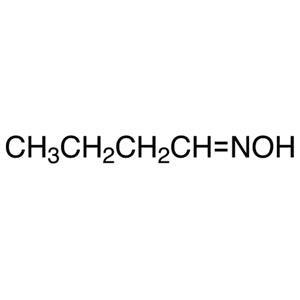
Butyraldoxime TCI B0753
Regular price From Rp 1.565.550,00Regular price -
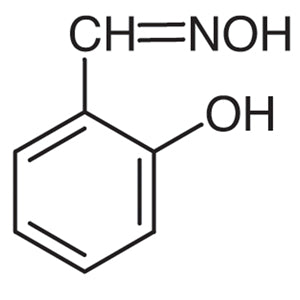
Salicylaldoxime TCI S0005
Regular price From Rp 1.115.100,00Regular price
![3717-19-9 syn-4-Nitrobenzaldoxime [Deprotecting Agent] - AMI Scientific](http://amiscientific.com/cdn/shop/files/TCI2510N0487.jpg?v=1767129926&width=533)
![4836-00-4 syn-2-Nitrobenzaldoxime [Deprotecting Agent] - AMI Scientific](http://amiscientific.com/cdn/shop/files/TCI2510N0486.jpg?v=1767129922&width=533)