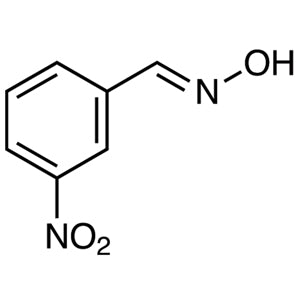
![3717-19-9 syn-4-Nitrobenzaldoxime [Deprotecting Agent] - AMI Scientific](http://amiscientific.com/cdn/shop/files/TCI2510N0487.jpg?v=1767129926&width=1946)
![3717-19-9 syn-4-Nitrobenzaldoxime [Deprotecting Agent] - AMI Scientific](http://amiscientific.com/cdn/shop/files/TCI2510N0487.jpg?v=1767129926&width=1445)
Syn-4-Nitrobenzaldoxime is a chemical compound widely used as a deprotecting agent in organic chemical reactions. It plays a crucial role in the laboratory by facilitating the removal of protective groups from molecules, enabling the formation of desired final compounds. This reagent is particularly valuable in complex synthesis processes where precise control over functional groups is essential. Its ability to selectively remove specific protecting groups helps minimize unwanted side reactions, ensuring the integrity of the target molecule.
The chemical and reactive properties of Syn-4-Nitrobenzaldoxime make it a preferred choice in various organic reactions. Its selectivity in reacting with specific protecting groups ensures high efficiency and reduced by-product formation. This characteristic is vital in synthetic pathways that demand accuracy and reproducibility. The compound’s stability and reactivity under controlled conditions further enhance its reliability in laboratory settings, making it a trusted tool for chemists working on intricate synthesis projects.
In Indonesian laboratories, Syn-4-Nitrobenzaldoxime is commonly used in organic chemistry research, especially in the development of new compounds. It is an essential component in the synthesis of pharmaceuticals, industrial chemicals, and advanced materials. Its role in selectively manipulating functional groups makes it indispensable for researchers aiming to achieve high-purity products in their experiments.
Related TCI products
- Organic synthesis of pharmaceutical compounds where selective deprotection is required to achieve target molecular structures.
- Development of industrial chemicals that involve complex functional group manipulations during the synthesis process.
- Research in material science for the creation of advanced polymers and specialty chemicals requiring precise chemical modifications.
- Synthesis of bioactive molecules in medicinal chemistry, where controlled deprotection is essential for drug development.
- Preparation of intermediates in multi-step synthetic routes that demand reliable and efficient deprotecting agents.
| Brand | TCI |
|---|---|
| CAS number | 3717-19-9 |
| Molecular formula | — |
| Purity | — |
| Category | Chemistry > Building Blocks > Non-Heterocyclic Building Blocks |
| Pack sizes | Available in various quantities as per standard laboratory supply |
| Physical form | Solid or liquid, depending on the specific product variant |
| Storage | Store in a cool, dry place away from direct sunlight and moisture |
Syn-4-Nitrobenzaldoxime should be stored in a cool, dry environment to maintain its chemical stability. It is recommended to keep the compound in a tightly sealed container to prevent exposure to moisture and air. Due to its reactivity, it should be handled in a well-ventilated area, preferably under a fume hood, to minimize inhalation risks. Avoid contact with skin and eyes, and use appropriate personal protective equipment such as gloves and safety goggles. The compound should not be stored near incompatible substances to prevent any potential chemical interactions. Proper labeling of containers is essential to ensure safe handling and storage in the laboratory.
—
Produk Terkait
-
syn-2-Nitrobenzaldoxime[DeprotectingAgent] TCI N0486
Regular price From Rp 848.400,00Regular price -
syn-3-Nitrobenzaldoxime TCI N0132
Regular price Rp 3.790.500,00Regular price -
4-Bromo-3-nitrobenzaldehyde TCI B5101
Regular price From Rp 717.150,00Regular price -
3-Bromo-5-nitrobenzaldehyde TCI B4982
Regular price From Rp 637.350,00Regular price -
5-Bromo-2-nitrobenzaldehyde TCI B4192
Regular price From Rp 1.035.300,00Regular price -
alpha-Benzaldoxime TCI B0011
Regular price From Rp 1.565.550,00Regular price -
5-Methoxy-2-nitrobenzaldehyde TCI M3593
Regular price From Rp 1.087.800,00Regular price -
2-Methyl-5-nitrobenzaldehyde TCI M2957
Regular price From Rp 2.174.550,00Regular price
![4836-00-4 syn-2-Nitrobenzaldoxime [Deprotecting Agent] - AMI Scientific](http://amiscientific.com/cdn/shop/files/TCI2510N0486.jpg?v=1767129922&width=533)