![Dibenzo[b,d]furan-2-ylboronic Acid (contains varying amounts of Anhydride) (CAS 402936-15-6) - TCI D4869 - AMI Scientific](http://amiscientific.com/cdn/shop/files/TCI2510D4869.jpg?v=1768197290&width=1946)
![Dibenzo[b,d]furan-2-ylboronic Acid (contains varying amounts of Anhydride) (CAS 402936-15-6) - TCI D4869 - AMI Scientific](http://amiscientific.com/cdn/shop/files/TCI2510D4869.jpg?v=1768197290&width=1445)
TCI D4869 Dibenzo[b,d]furan-2-ylboronic Acid is an organoboron reagent that carries a boronic acid group at the 2-position of the dibenzofuran framework. The material acts as the nucleophilic partner in palladium-catalyzed cross-coupling reactions, particularly Suzuki–Miyaura couplings, allowing researchers to attach a dibenzofuran unit in a directed manner onto other aromatic or heteroaromatic cores. In organic synthesis laboratories and materials research, a reagent of this type serves as the link between simple small molecules and larger conjugated architectures, without the researcher having to construct the dibenzofuran ring from scratch through a long and material-intensive sequence of steps.
The characteristics that make this reagent a preferred choice are the combination of a rigid, planar, electron-rich dibenzofuran framework with the readily controlled reactivity of the boronic acid group. In line with the product name, the material contains varying amounts of anhydride (boroxine), the condensation form commonly encountered with arylboronic acids. This condition generally does not hinder the progress of the coupling, because the boroxine hydrolyzes back to the boronic acid in aqueous-basic reaction media; nevertheless, researchers need to take it into account when weighing out material and calculating stoichiometry for a given reaction.
In Indonesian laboratories, reagents of this class are typically used in university and institutional research groups working on organic synthesis, medicinal chemistry intermediates, and functional organic materials. They are handled at the bench in small-scale coupling reactions under inert conditions, alongside a palladium catalyst, a base, and a suitable solvent system. Because the dibenzofuran unit is otherwise laborious to build in-house, purchasing the ready-made boronic acid shortens the route considerably for research teams working with limited synthetic infrastructure and time.
TCI brochures (PDF)
- Boron Compounds 2025-10-07 · p. 14
- Building Blocks for Organic Semiconductor 2026-03-24 · p. 23
Related TCI products
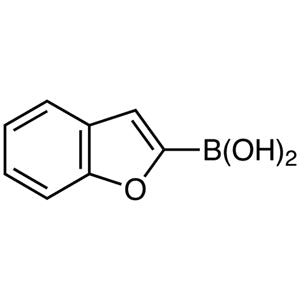
- TCI B2978 98437-24-2 Benzofuran-2-boronic Acid (contains varying amounts of Anhydride)
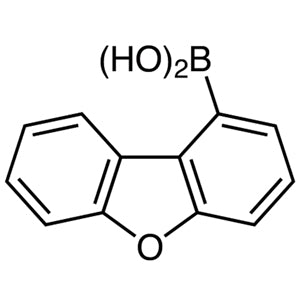
- TCI D5758 162607-19-4 Dibenzofuran-1-boronic Acid (contains varying amounts of Anhydride)
- TCI D4567 100124-06-9 Dibenzofuran-4-boronic Acid (contains varying amounts of Anhydride)
- TCI T2621 160032-40-6 Thieno[3,2-b]thiophene-2-boronic Acid (contains varying amounts of Anhydride)
- TCI B4774 113893-08-6 Benzo[b]thiophene-3-boronic Acid (contains varying amounts of Anhydride)
- TCI B2893 98437-23-1 Benzo[b]thiophene-2-boronic Acid (contains varying amounts of Anhydride)
- Suzuki–Miyaura cross-coupling: the boronic acid group transfers the dibenzofuran unit to aryl or heteroaryl halides under palladium catalysis, making this the reagent's primary and most direct application.
- Construction of conjugated organic materials: the rigid, planar, electron-rich dibenzofuran core is well suited to building extended conjugated architectures for functional materials research programs.
- Medicinal chemistry building block: researchers can install a dibenzofuran fragment onto candidate scaffolds in a directed way, expanding structural diversity without redesigning the entire synthetic route.
- Heteroaromatic scaffold elaboration: the reagent couples to heteroaromatic cores as well as simple arenes, giving synthetic chemists a single partner for a broad range of acceptor substrates.
- Route shortening in multistep synthesis: using this ready-made reagent avoids constructing the dibenzofuran ring in-house through a long, material-intensive sequence, saving both bench time and starting material.
| Brand | TCI |
|---|---|
| CAS number | 402936-15-6 |
| Molecular formula | — |
| Purity | — |
| Category | Chemistry > Organometallic Reagents > Organoboron [Organometallic Reagents] |
| Pack sizes | available in the standard research-scale packaging offered by the manufacturer; please confirm the size required when ordering |
| Physical form | — |
| Storage | keep in the closed original container under the conditions stated on the manufacturer's label |
- Composition note: contains varying amounts of anhydride (boroxine), the usual condensation form of arylboronic acids
Store the reagent in its original, tightly closed container in a cool, dry place away from moisture, direct sunlight, and sources of ignition, following the conditions stated on the manufacturer's label and safety data sheet. Arylboronic acids are sensitive to humidity, so the container should be closed promptly after weighing and, where practical, handled under an inert atmosphere. Because the material contains varying amounts of boroxine anhydride, take this into account when calculating stoichiometry. Handle in a fume hood using gloves, safety glasses, and a laboratory coat, and keep the container clearly labeled and segregated from incompatible materials.
—
Produk Terkait
-
Benzofuran-2-boronicAcid(containsvaryingamountsofAnhydride) TCI B2978
Regular price Rp 1.035.300,00Regular price -
Dibenzofuran-1-boronicAcid(containsvaryingamountsofAnhydride) TCI D5758
Regular price From Rp 2.704.800,00Regular price -
Dibenzofuran-4-boronicAcid(containsvaryingamountsofAnhydride) TCI D4567
Regular price From Rp 664.650,00Regular price -
Thieno[3,2-b]thiophene-2-boronicAcid(containsvaryingamountsofAnhydride) TCI T2621
Regular price Rp 5.830.650,00Regular price -
Benzo[b]thiophene-3-boronicAcid(containsvaryingamountsofAnhydride) TCI B4774
Regular price From Rp 1.220.100,00Regular price -
Benzo[b]thiophene-2-boronicAcid(containsvaryingamountsofAnhydride) TCI B2893
Regular price From Rp 743.400,00Regular price -
4-(2-Phenyl-1H-benzimidazol-1-yl)phenylboronicAcid(containsvaryingamountsofAnhydride) TCI P2282
Regular price Rp 2.625.000,00Regular price -
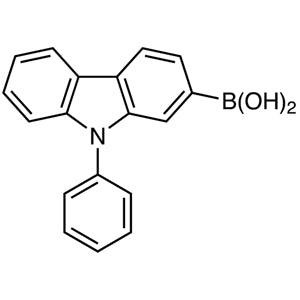
9-Phenylcarbazole-2-boronicAcid(containsvaryingamountsofAnhydride) TCI P2169
Regular price From Rp 477.750,00Regular price

![160032-40-6 Thieno[3,2-b]thiophene-2-boronic Acid (contains varying amounts of Anhydride) - AMI Scientific](http://amiscientific.com/cdn/shop/files/TCI2510T2621.jpg?v=1768206488&width=533)
![113893-08-6 Benzo[b]thiophene-3-boronic Acid (contains varying amounts of Anhydride) - AMI Scientific](http://amiscientific.com/cdn/shop/files/TCI2510B4774_65b85fee-ce4d-45b9-ad87-4962d8f3452c.jpg?v=1767853515&width=533)
![98437-23-1 Benzo[b]thiophene-2-boronic Acid (contains varying amounts of Anhydride) - AMI Scientific](http://amiscientific.com/cdn/shop/files/TCI2510B2893_29d53da9-04a5-422a-acac-439fc05f1bb6.jpg?v=1767339122&width=533)