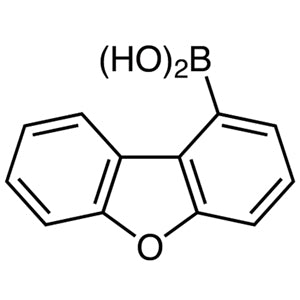
Dibenzofuran-1-boronic Acid, supplied by TCI under catalogue number D5758, is an organoboron reagent that combines a dibenzofuran framework with a boronic acid group at the 1-position. In organic synthesis laboratories, this compound serves as the nucleophilic partner in palladium-catalysed cross-coupling reactions, particularly the Suzuki–Miyaura reaction, allowing researchers to attach the dibenzofuran unit directly to another aromatic or heteroaromatic core. Its role matters to teams building conjugated molecules, ligands, and active compound candidates, because a single coupling step can replace a far longer and more complicated synthetic sequence.
The characteristics that make this reagent a frequent choice are the controlled reactivity of the boronic acid group together with the stability of the dibenzofuran framework under common coupling conditions. It should be noted that this product contains varying amounts of anhydride (boroxine), the natural condensation form of boronic acids. This condition is normal for reagents of this type and does not prevent its use, but it does mean that stoichiometric calculations are best performed with a slight excess of reagent and verified against the data for the specific lot supplied.
In Indonesian laboratories, the reagent is typically used in university research groups and industrial R&D units carrying out methodology development and target-oriented synthesis on a milligram to gram scale. It is normally handled alongside a palladium catalyst, a base, and a degassed solvent system on a Schlenk line or in a standard reflux setup. Because it is an imported specialty reagent, working groups generally plan their coupling experiments around the pack size on hand and record lot information for reproducibility.
TCI brochures (PDF)
- Suzuki-Miyaura Cross Coupling Reaction 2025-12-01 · p. 14
- Building Blocks for Organic Semiconductor 2026-03-24 · p. 24
Related TCI products
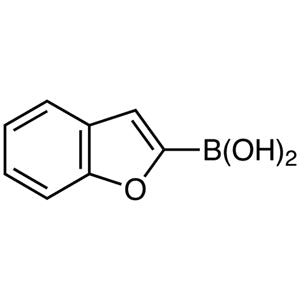
- TCI B2978 98437-24-2 Benzofuran-2-boronic Acid (contains varying amounts of Anhydride)
- TCI D4869 402936-15-6 Dibenzo[b,d]furan-2-ylboronic Acid (contains varying amounts of Anhydride)
- TCI D4567 100124-06-9 Dibenzofuran-4-boronic Acid (contains varying amounts of Anhydride)
- TCI T2621 160032-40-6 Thieno[3,2-b]thiophene-2-boronic Acid (contains varying amounts of Anhydride)
- TCI B4774 113893-08-6 Benzo[b]thiophene-3-boronic Acid (contains varying amounts of Anhydride)
- TCI B2893 98437-23-1 Benzo[b]thiophene-2-boronic Acid (contains varying amounts of Anhydride)
- Suzuki–Miyaura cross-coupling: the boronic acid group transfers the dibenzofuran unit to aryl or heteroaryl halides under palladium catalysis, making it the reagent's primary and most direct application.
- Construction of conjugated molecules: the rigid, planar dibenzofuran framework is introduced in one step, which suits research groups assembling extended conjugated systems for materials-oriented studies.
- Ligand synthesis: the dibenzofuran core can be coupled onto aromatic scaffolds to build ligand structures, with the boronic acid providing a predictable and controllable point of attachment.
- Preparation of active compound candidates: medicinal chemistry work uses this coupling partner to install the dibenzofuran motif into candidate structures without a long multi-step preparative sequence.
- Synthetic methodology development: the reagent's controlled reactivity and framework stability make it a suitable substrate when screening catalysts, bases, and solvent systems for coupling optimisation.
| Brand | TCI |
|---|---|
| CAS number | 162607-19-4 |
| Molecular formula | — |
| Purity | — |
| Category | Chemistry > Organometallic Reagents > Organoboron [Organometallic Reagents] |
| Pack sizes | available in the standard research pack sizes offered for this catalogue item; please confirm the current option when ordering |
| Physical form | — |
| Storage | — |
- Catalogue number: D5758
- Composition note: contains varying amounts of the anhydride (boroxine) condensation form
Store the reagent in its original tightly closed container in a cool, dry place, protected from moisture and away from direct sunlight. Boronic acids are sensitive to humidity, so the container should be closed promptly after each use and allowed to reach room temperature before opening to avoid condensation on the solid. Weighing and transfer are best carried out in a fume hood using clean, dry spatulas and glassware. Wear safety glasses, gloves, and a laboratory coat when handling the material, keep it separate from strong oxidising agents, and dispose of residues and contaminated consumables through the laboratory's chemical waste procedure. Always consult the manufacturer's safety data sheet before first use.
—
Produk Terkait
-
Benzofuran-2-boronicAcid(containsvaryingamountsofAnhydride) TCI B2978
Regular price Rp 1.035.300,00Regular price -
Dibenzo[b,d]furan-2-ylboronicAcid(containsvaryingamountsofAnhydride) TCI D4869
Regular price From Rp 1.856.400,00Regular price -
Dibenzofuran-4-boronicAcid(containsvaryingamountsofAnhydride) TCI D4567
Regular price From Rp 664.650,00Regular price -
Thieno[3,2-b]thiophene-2-boronicAcid(containsvaryingamountsofAnhydride) TCI T2621
Regular price Rp 5.830.650,00Regular price -
Benzo[b]thiophene-3-boronicAcid(containsvaryingamountsofAnhydride) TCI B4774
Regular price From Rp 1.220.100,00Regular price -
Benzo[b]thiophene-2-boronicAcid(containsvaryingamountsofAnhydride) TCI B2893
Regular price From Rp 743.400,00Regular price -
4-(2-Phenyl-1H-benzimidazol-1-yl)phenylboronicAcid(containsvaryingamountsofAnhydride) TCI P2282
Regular price Rp 2.625.000,00Regular price -
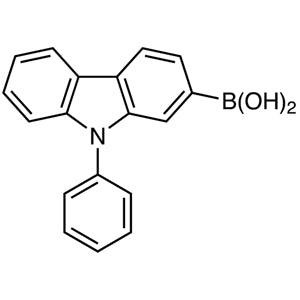
9-Phenylcarbazole-2-boronicAcid(containsvaryingamountsofAnhydride) TCI P2169
Regular price From Rp 477.750,00Regular price
![Dibenzo[b,d]furan-2-ylboronic Acid (contains varying amounts of Anhydride) (CAS 402936-15-6) - TCI D4869 - AMI Scientific](http://amiscientific.com/cdn/shop/files/TCI2510D4869.jpg?v=1768197290&width=533)

![160032-40-6 Thieno[3,2-b]thiophene-2-boronic Acid (contains varying amounts of Anhydride) - AMI Scientific](http://amiscientific.com/cdn/shop/files/TCI2510T2621.jpg?v=1768206488&width=533)
![113893-08-6 Benzo[b]thiophene-3-boronic Acid (contains varying amounts of Anhydride) - AMI Scientific](http://amiscientific.com/cdn/shop/files/TCI2510B4774_65b85fee-ce4d-45b9-ad87-4962d8f3452c.jpg?v=1767853515&width=533)
![98437-23-1 Benzo[b]thiophene-2-boronic Acid (contains varying amounts of Anhydride) - AMI Scientific](http://amiscientific.com/cdn/shop/files/TCI2510B2893_29d53da9-04a5-422a-acac-439fc05f1bb6.jpg?v=1767339122&width=533)