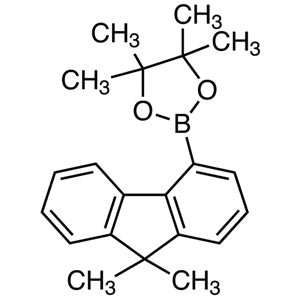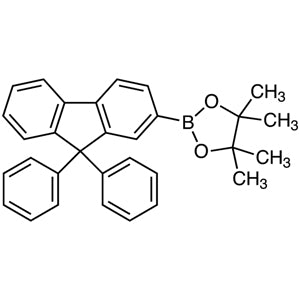
2-(9,9-Diphenyl-9H-fluoren-2-yl)-4,4,5,5-tetramethyl-1,3,2-dioxaborolane is an organoboron compound widely used in chemical research, particularly in organic synthesis. This reagent plays a crucial role in various reactions, including S-N coupling and Suzuki reactions, which are essential for constructing complex molecular structures. Its unique chemical structure, combining a fluorene group with a dioxaborolane moiety, provides both reactivity and stability, making it a versatile tool in synthetic chemistry.
The compound is favored for its ability to participate in multiple functional group reactions, offering high efficiency and selectivity in laboratory settings. Its molecular design allows for compatibility with a wide range of substrates, enabling chemists to achieve desired products with minimal side reactions. The compound’s stability under certain reaction conditions further enhances its reliability, making it a preferred choice for researchers aiming to optimize synthetic pathways.
In Indonesian laboratories, this compound is commonly used in organic chemistry research, especially in the synthesis of complex compounds and drug development. Its role in facilitating efficient and selective chemical transformations has made it a valuable asset in academic and industrial research environments. The compound is also utilized in studies involving reactions that require controlled reactivity and stability, contributing to the advancement of chemical sciences in the region.
TCI brochures (PDF)
- Boron Compounds 2025-10-07 · p. 15
- Building Blocks for Organic Semiconductor 2026-03-24 · p. 14
Related TCI products
- TCI S0994 1161009-89-7 2-(9,9'-Spirobi[fluoren]-4-yl)-4,4,5,5-tetramethyl-1,3,2-dioxaborolane
- TCI S0980 884336-44-1 2-(9,9'-Spirobi[fluoren]-7-yl)-4,4,5,5-tetramethyl-1,3,2-dioxaborolane
- TCI P2562 1346007-05-3 2-(9,9'-Spirobi[fluoren]-3-yl)-4,4,5,5-tetramethyl-1,3,2-dioxaborolane
- TCI F1245 922706-40-9 2-(9H-Fluoren-2-yl)-4,4,5,5-tetramethyl-1,3,2-dioxaborolane
- TCI D5800 1005771-03-8 2-[3-(9,9-Dimethyl-9H-fluoren-2-yl)phenyl]-4,4,5,5-tetramethyl-1,3,2-dioxaborolane
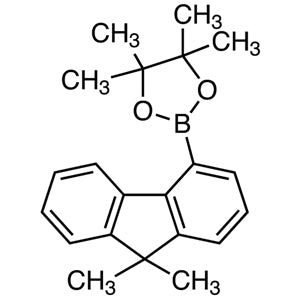
- TCI D5408 1365692-79-0 2-(9,9-Dimethyl-9H-fluoren-4-yl)-4,4,5,5-tetramethyl-1,3,2-dioxaborolane
- Organic synthesis applications benefit from this compound’s ability to participate in coupling reactions, enabling the formation of complex molecular structures with high efficiency.
- Drug development research utilizes this reagent for constructing diverse molecular frameworks, supporting the creation of novel pharmaceutical compounds.
- S-N coupling reactions rely on its reactivity and stability, making it an essential component in the synthesis of nitrogen-containing organic molecules.
- Suzuki cross-coupling reactions leverage its compatibility with various substrates, allowing for the efficient formation of carbon-carbon bonds.
- Research on functional group transformations benefits from its versatility, enabling chemists to explore a wide range of synthetic strategies.
| Brand | TCI |
|---|---|
| CAS number | 462128-39-8 |
| Molecular formula | — |
| Purity | — |
| Category | Chemistry > Organometallic Reagents > Organoboron [Organometallic Reagents] |
| Pack sizes | — |
| Physical form | — |
| Storage | Store in a cool, dry place away from moisture and direct sunlight |
This compound should be stored in a cool, dry environment, away from moisture and direct sunlight to maintain its chemical integrity. It is recommended to use airtight containers made of materials that are chemically inert, such as glass or polyethylene, to prevent any unwanted reactions. Due to its organoboron nature, it is important to handle it with care, using appropriate personal protective equipment like gloves and goggles. The compound should not be exposed to strong oxidizing agents or incompatible substances. Regular monitoring of storage conditions is advised to ensure optimal stability and safety in the laboratory setting.
—
Produk Terkait
-
2-(9,9'-Spirobi[fluoren]-4-yl)-4,4,5,5-tetramethyl-1,3,2-dioxaborolane TCI S0994
Regular price From Rp 1.724.100,00Regular price -
2-(9,9'-Spirobi[fluoren]-7-yl)-4,4,5,5-tetramethyl-1,3,2-dioxaborolane TCI S0980
Regular price Rp 1.961.400,00Regular price -
2-(9,9'-Spirobi[fluoren]-3-yl)-4,4,5,5-tetramethyl-1,3,2-dioxaborolane TCI P2562
Regular price From Rp 1.988.700,00Regular price -
2-(9H-Fluoren-2-yl)-4,4,5,5-tetramethyl-1,3,2-dioxaborolane TCI F1245
Regular price From Rp 2.837.100,00Regular price -
2-[3-(9,9-Dimethyl-9H-fluoren-2-yl)phenyl]-4,4,5,5-tetramethyl-1,3,2-dioxaborolane TCI D5800
Regular price From Rp 1.565.550,00Regular price -
2-(9,9-Dimethyl-9H-fluoren-4-yl)-4,4,5,5-tetramethyl-1,3,2-dioxaborolane TCI D5408
Regular price From Rp 2.386.650,00Regular price -
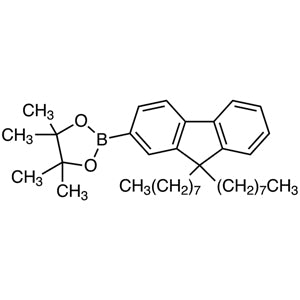
2-(9,9-Di-n-octyl-9H-fluoren-2-yl)-4,4,5,5-tetramethyl-1,3,2-dioxaborolane TCI D5371
Regular price Rp 3.525.900,00Regular price -
2-(9,9-Diphenyl-9H-fluoren-4-yl)-4,4,5,5-tetramethyl-1,3,2-dioxaborolane TCI D5033
Regular price From Rp 1.749.300,00Regular price
![1161009-89-7 2-(9,9'-Spirobi[fluoren]-4-yl)-4,4,5,5-tetramethyl-1,3,2-dioxaborolane - AMI Scientific](http://amiscientific.com/cdn/shop/files/TCI2510S0994.jpg?v=1769181254&width=533)
![884336-44-1 2-(9,9'-Spirobi[fluoren]-7-yl)-4,4,5,5-tetramethyl-1,3,2-dioxaborolane - AMI Scientific](http://amiscientific.com/cdn/shop/files/TCI2510S0980.jpg?v=1768206304&width=533)
![1346007-05-3 2-(9,9'-Spirobi[fluoren]-3-yl)-4,4,5,5-tetramethyl-1,3,2-dioxaborolane - AMI Scientific](http://amiscientific.com/cdn/shop/files/TCI2510P2562.jpg?v=1769143372&width=533)

![2-[3-(9,9-Dimethyl-9H-fluoren-2-yl)phenyl]-4,4,5,5-tetramethyl-1,3,2-dioxaborolane (CAS 1005771-03-8) - TCI D5800 - AMI Scientific](http://amiscientific.com/cdn/shop/files/TCI2510D5800.jpg?v=1769142139&width=533)