

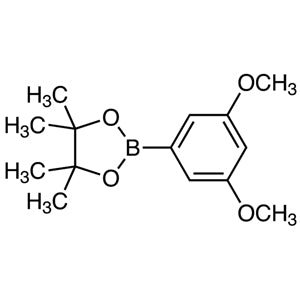
2-(3,5-Dimethoxyphenyl)-4,4,5,5-tetramethyl-1,3,2-dioxaborolane is an organoboron compound widely used in chemical reactions, particularly in the synthesis of aromatic and heterocyclic compounds. This reagent plays a crucial role in various organic transformations, especially in coupling reactions that require precise control over reaction conditions. Its unique structure allows it to act as a stable and reactive source of boron hydride, making it an essential component in synthetic chemistry. The compound is valued for its ability to participate in complex molecular constructions with high efficiency and reliability.
The compound's properties, including its electron-donating dimethoxyphenyl group and the stabilizing tetramethyl structure, make it a preferred choice in laboratory settings. These features contribute to its stability under certain conditions while maintaining reactivity in targeted reactions. The combination of reactivity and stability ensures that it can be used in a wide range of applications without compromising the integrity of the final product. Its versatility and reliability have made it a staple in both academic and industrial research environments.
In Indonesian laboratories, this compound is extensively used in organic chemistry research, particularly in pharmaceutical and materials science applications. It is commonly found in research facilities and universities where the development of new compounds with medical or industrial applications is a priority. Its role in coupling reactions, such as the Suzuki-Miyaura reaction, makes it an essential tool for synthesizing complex molecules with high precision and efficiency.
TCI brochures (PDF)
- Suzuki-Miyaura Cross Coupling Reaction 2025-12-01 · p. 19
Related TCI products
- TCI D5533 365564-10-9 2-(3,4-Dimethoxyphenyl)-4,4,5,5-tetramethyl-1,3,2-dioxaborolane
- TCI T4407 1609484-75-4 4,4,5,5-Tetramethyl-2-(spiro[fluorene-9,9'-xanthen]-4-yl)-1,3,2-dioxaborolane
- TCI T4387 1160862-12-3 4,4,5,5-Tetramethyl-2-(spiro[fluorene-9,9'-xanthen]-2-yl)-1,3,2-dioxaborolane
- TCI T4061 870004-04-9 4,4,5,5-Tetramethyl-2-(4-vinylphenyl)-1,3,2-dioxaborolane
- TCI T3875 1080632-76-3 2-([1,1':4',1''-Terphenyl]-4-yl)-4,4,5,5-tetramethyl-1,3,2-dioxaborolane
- TCI T3831 269410-26-6 4,4,5,5-Tetramethyl-2-(4-phenoxyphenyl)-1,3,2-dioxaborolane
- Suzuki-Miyaura coupling reactions for the synthesis of aromatic and heterocyclic compounds due to its stability and reactivity in transition metal-catalyzed systems.
- Organic synthesis of pharmaceutical intermediates where controlled reactivity and selectivity are required for the formation of complex molecular structures.
- Development of new materials in polymer chemistry, where the compound contributes to the formation of functionalized polymers with specific properties.
- Research in medicinal chemistry for the synthesis of bioactive compounds that require precise functional group transformations.
- Academic research in chemical synthesis, supporting the exploration of novel reaction pathways and molecular architectures.
| Brand | TCI |
|---|---|
| CAS number | 365564-07-4 |
| Molecular formula | — |
| Purity | — |
| Category | Chemistry > Organometallic Reagents > Organoboron [Organometallic Reagents] |
| Pack sizes | Available in various quantities as per standard laboratory supply formats |
| Physical form | Solid or liquid, depending on the specific formulation and supplier packaging |
| Storage | — |
This compound should be stored in a cool, dry, and well-ventilated area away from direct sunlight and sources of heat. It is recommended to use airtight containers made of glass or high-density polyethylene to prevent moisture absorption and contamination. Due to its chemical nature, it should be handled with appropriate personal protective equipment, including gloves and safety goggles. It is important to ensure that the storage area is free from incompatible materials such as strong oxidizers. Regular inspection of storage conditions and container integrity is advised to maintain the compound's stability and effectiveness in laboratory applications.
—
Produk Terkait
-
2-(3,4-Dimethoxyphenyl)-4,4,5,5-tetramethyl-1,3,2-dioxaborolane TCI D5533
Regular price From Rp 1.220.100,00Regular price -
4,4,5,5-Tetramethyl-2-(spiro[fluorene-9,9'-xanthen]-4-yl)-1,3,2-dioxaborolane TCI T4407
Regular price From Rp 955.500,00Regular price -
4,4,5,5-Tetramethyl-2-(spiro[fluorene-9,9'-xanthen]-2-yl)-1,3,2-dioxaborolane TCI T4387
Regular price Rp 3.870.300,00Regular price -
4,4,5,5-Tetramethyl-2-(4-vinylphenyl)-1,3,2-dioxaborolane TCI T4061
Regular price From Rp 4.056.150,00Regular price -
2-([1,1':4',1''-Terphenyl]-4-yl)-4,4,5,5-tetramethyl-1,3,2-dioxaborolane TCI T3875
Regular price Rp 3.340.050,00Regular price -
4,4,5,5-Tetramethyl-2-(4-phenoxyphenyl)-1,3,2-dioxaborolane TCI T3831
Regular price From Rp 743.400,00Regular price -
4,4,5,5-Tetramethyl-2-(4-nitrophenyl)-1,3,2-dioxaborolane TCI T3710
Regular price From Rp 1.035.300,00Regular price -
4,4,5,5-Tetramethyl-2-[3-(trifluoromethyl)phenyl]-1,3,2-dioxaborolane TCI T3707
Regular price From Rp 2.016.000,00Regular price

![1609484-75-4 4,4,5,5-Tetramethyl-2-(spiro[fluorene-9,9'-xanthen]-4-yl)-1,3,2-dioxaborolane - AMI Scientific](http://amiscientific.com/cdn/shop/files/TCI2510T4407.jpg?v=1768206674&width=533)
![1160862-12-3 4,4,5,5-Tetramethyl-2-(spiro[fluorene-9,9'-xanthen]-2-yl)-1,3,2-dioxaborolane - AMI Scientific](http://amiscientific.com/cdn/shop/files/TCI2510T4387.jpg?v=1768206674&width=533)

![1080632-76-3 2-([1,1':4',1''-Terphenyl]-4-yl)-4,4,5,5-tetramethyl-1,3,2-dioxaborolane - AMI Scientific](http://amiscientific.com/cdn/shop/files/TCI2510T3875.jpg?v=1769143785&width=533)


![325142-82-3 4,4,5,5-Tetramethyl-2-[3-(trifluoromethyl)phenyl]-1,3,2-dioxaborolane - AMI Scientific](http://amiscientific.com/cdn/shop/files/TCI2510T3707.jpg?v=1768206618&width=533)
![325142-82-3 4,4,5,5-Tetramethyl-2-[3-(trifluoromethyl)phenyl]-1,3,2-dioxaborolane - AMI Scientific](http://amiscientific.com/cdn/shop/files/TCI2510T3707_33e9f8e4-e658-4057-bacc-a15dbe367597.jpg?v=1769058281&width=533)