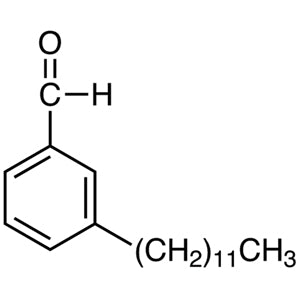
TCI D5682 3-Dodecylbenzaldehyde is an aromatic aldehyde that carries a twelve-carbon dodecyl chain at the meta position relative to the aldehyde group. The material is classified as a non-heterocyclic building block, and its role in the laboratory is to supply a highly reactive aldehyde group together with a long hydrocarbon tail that imparts lipophilic character. That combination makes the compound a practical starting point for constructing molecules that must dissolve well in organic solvents or must be able to self-assemble at interfaces, something that is difficult to achieve when researchers work with plain benzaldehyde bearing no substituent.
The property that makes this compound a preferred choice lies in the versatility of the aldehyde carbonyl group, which is ready to enter condensation reactions with amines to form imines or Schiff bases, reduction reactions to the corresponding alcohol, oxidation to the carboxylic acid, and chain-extension reactions such as Wittig and aldol chemistry. The meta position exerts a more electronically neutral influence on the carbonyl group than the para position does, so aldehyde reactivity remains high. The dodecyl chain lowers the melting point and raises solubility in non-polar solvents, which makes processing and purification more straightforward.
In Indonesian laboratories, a building block of this type is typically used in university and institutional research groups working on organic synthesis, materials chemistry, and surfactant or amphiphile design. It suits work where a long-chain aromatic aldehyde is needed as an intermediate for Schiff base ligands, functional molecules, or specialty formulations. Because it is supplied as a catalogue reagent from TCI, it fits research-scale synthesis, method development, and teaching work at the postgraduate level rather than bulk production.
- Schiff base and imine synthesis: the reactive aldehyde carbonyl condenses readily with primary amines, while the dodecyl tail keeps the resulting ligand soluble in organic reaction media.
- Amphiphile and surfactant research: the molecule already pairs a polar reactive head with a long lipophilic tail, so it serves as a direct scaffold for molecules designed to assemble at interfaces.
- Materials and functional molecule synthesis: the aldehyde group allows attachment to amine-, phosphorus-, or carbonyl-based partners so that a long alkyl chain can be built into a larger target structure.
- Chain-extension chemistry such as Wittig and aldol reactions: the aldehyde acts as the electrophilic partner, and the meta substitution leaves its reactivity essentially undiminished.
- Redox transformation studies: the compound can be reduced to the corresponding benzyl alcohol or oxidised to the carboxylic acid, giving a convenient route to related long-chain aromatic derivatives.
| Brand | TCI |
|---|---|
| CAS number | 307498-21-1 |
| Molecular formula | — |
| Purity | — |
| Category | Chemistry > Building Blocks > Non-Heterocyclic Building Blocks |
| Pack sizes | available in standard TCI research-scale packaging; please confirm the pack size when ordering. |
| Physical form | — |
| Storage | store in a tightly closed original container in a cool, dry, well-ventilated place, following the manufacturer's safety data sheet. |
- Catalogue code: D5682
Keep the container tightly closed and store it in a cool, dry, well-ventilated area away from direct sunlight, heat sources, and strong oxidising agents. Aromatic aldehydes are generally sensitive to air, so minimise headspace exposure and reseal the container promptly after each use; the original manufacturer container is the most suitable storage vessel. Handle the material in a fume hood using safety glasses, chemical-resistant gloves, and a laboratory coat, and avoid contact with skin and eyes as well as inhalation of vapours. Transfer with clean, dry glassware, label all secondary containers clearly, and consult the manufacturer's safety data sheet before use and for waste disposal.
—
Produk Terkait
-
4-Ethylbenzaldehyde TCI E0325
Regular price From Rp 1.008.000,00Regular price -
4-Butylbenzaldehyde TCI B1014
Regular price From Rp 3.551.100,00Regular price -
2,4,5-Trimethylbenzaldehyde TCI T1411
Regular price Rp 1.961.400,00Regular price -
2,4,6-Trimethylbenzaldehyde TCI T1368
Regular price Rp 2.147.250,00Regular price -
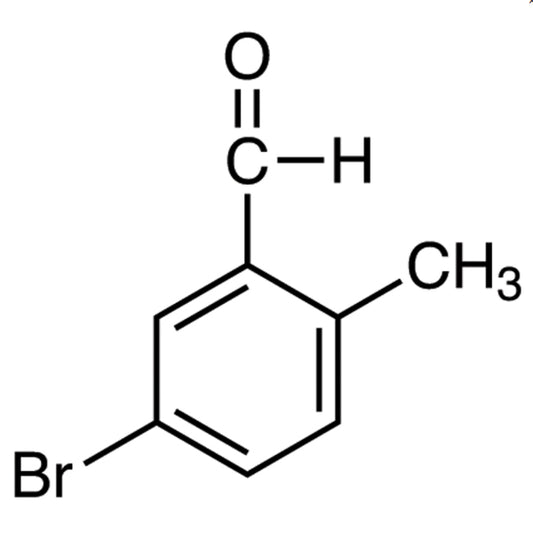
5-Bromo-2-methylbenzaldehyde TCI B5036
Regular price From Rp 2.677.500,00Regular price -
4-Hydroxy-3-methylbenzaldehyde TCI H1419
Regular price From Rp 2.016.000,00Regular price -
4-Hydroxy-3,5-dimethylbenzaldehyde TCI H1023
Regular price From Rp 637.350,00Regular price -
2,4-Dimethoxy-3-methylbenzaldehyde TCI D5789
Regular price From Rp 2.279.550,00Regular price