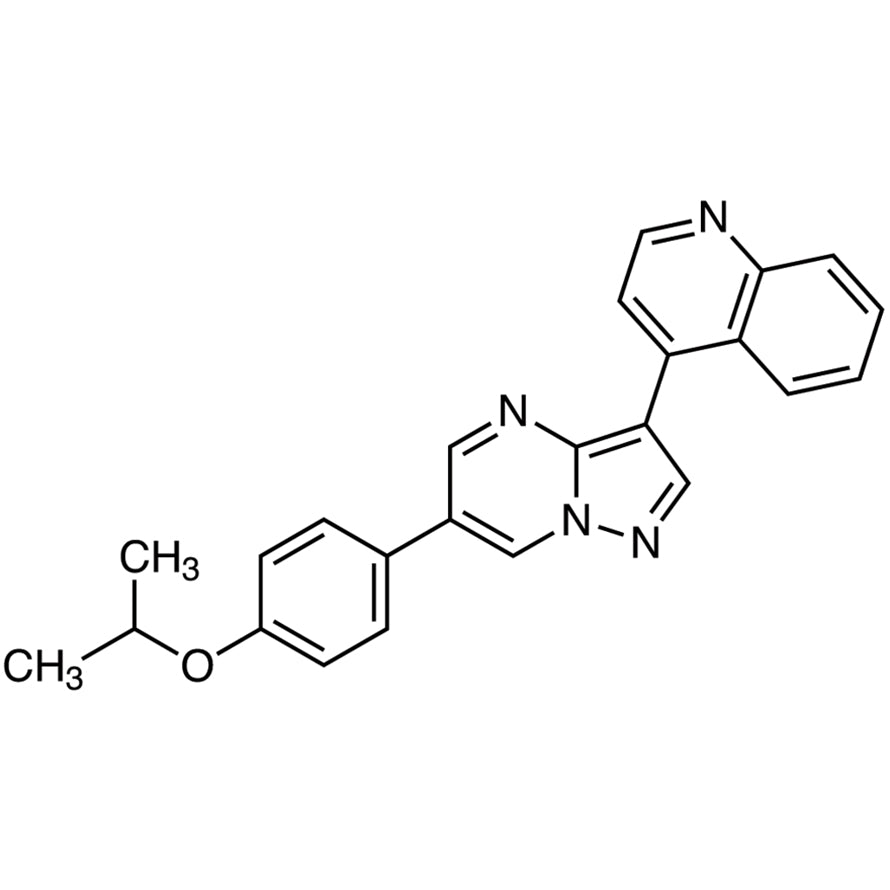
DMH-1 is a small-molecule compound used as a selective inhibitor of the bone morphogenetic protein (BMP) signaling pathway. It belongs to the dorsomorphin family of derivatives and is recognized for its selectivity toward the type I receptors of the BMP pathway, particularly ALK2, with relatively low cross-activity against other pathways. In cell biology and stem cell research laboratories, a material of this kind functions as a pharmacological tool for shutting down a single signaling pathway in a targeted manner, allowing researchers to observe the role of that pathway in cell differentiation, growth, and development without resorting to genetic manipulation.
The principal reason this compound is chosen is its selectivity. Early-generation BMP pathway inhibitors frequently also inhibited other receptor kinases, which made experimental results difficult to interpret. The more focused selectivity profile of DMH-1 yields cleaner data that can be attributed more confidently to the BMP pathway specifically. As a small molecule, the compound also acts quickly, its dose can be adjusted, and its effects are reversible once the compound is removed from the culture medium — advantages that are difficult to match with other approaches.
In Indonesian laboratories, this compound is typically encountered in cell biology, developmental biology, and stem cell research settings, where signaling pathways are dissected using defined pharmacological tools rather than genetic constructs. Research groups in universities, hospital research units, and institutional laboratories generally use it in cell culture work, where a compound that can be added to and withdrawn from the medium fits well with study designs that compare treated and untreated cultures side by side.
- BMP pathway inhibition studies — the compound blocks type I BMP receptors selectively, so researchers can suppress this pathway and attribute the resulting cellular changes to BMP signaling rather than to unrelated kinases.
- Stem cell differentiation experiments — because BMP signaling directs differentiation decisions, a reversible small-molecule inhibitor lets researchers steer or halt differentiation programs in culture without introducing permanent genetic changes.
- Cell signaling mechanism research — as a targeted pharmacological tool, it allows a single pathway to be switched off at a chosen time point, making it possible to establish which downstream events depend on BMP input.
- Developmental biology investigations — the ability to inhibit BMP signaling at controlled doses and defined time windows supports studies of how this pathway shapes growth and developmental processes in experimental models.
- Neuroscience and cell culture work — its low cross-activity against other pathways suits experiments in which several signaling routes operate simultaneously and clean attribution of the observed effect is essential.
| Brand | TCI |
|---|---|
| CAS number | 1206711-16-1 |
| Molecular formula | — |
| Purity | — |
| Category | Life Science > Cell Biology > Cell Signaling and Neuroscience |
| Pack sizes | available in research-scale pack sizes; please confirm the current options when ordering |
| Physical form | — |
| Storage | store according to the manufacturer's instructions stated on the product label and certificate |
- Product code: D5737
Store this compound under the conditions specified by the manufacturer on the product label, keeping the container tightly closed and protected from moisture and light. Original manufacturer containers are the most suitable primary packaging; where stock solutions are prepared, use clean, chemically compatible, clearly labelled vials. Handle the material in a well-ventilated area or a suitable enclosure, and wear standard laboratory personal protective equipment including gloves, safety glasses, and a laboratory coat. Avoid the generation of dust and avoid direct contact with skin and eyes. Consult the manufacturer's safety data sheet before use, follow institutional laboratory safety procedures, and dispose of residues and contaminated consumables in accordance with local chemical waste regulations.
—
Produk Terkait
-
Imatinib TCI I0906
Regular price From Rp 1.326.150,00Regular price -
WHI-P180Hydrochloride TCI W0021
Regular price Rp 3.340.050,00Regular price -
WHI-P154 TCI W0013
Regular price From Rp 2.491.650,00Regular price -
Wortmannin TCI W0007
Regular price Rp 11.580.450,00Regular price -
VE-821 TCI V0206
Regular price From Rp 2.889.600,00Regular price -
Vandetanib TCI V0199
Regular price From Rp 2.121.000,00Regular price -
UK-5099 TCI U0146
Regular price Rp 4.823.700,00Regular price -
SU1498 TCI U0103
Regular price From Rp 3.578.400,00Regular price