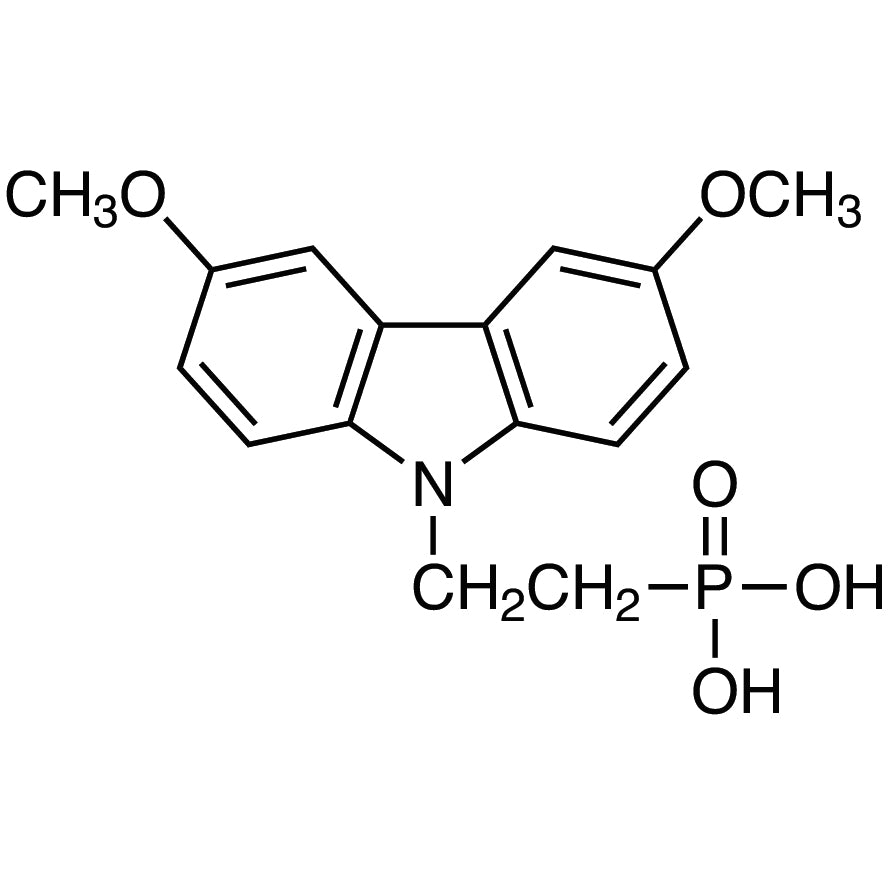
TCI D5798 MeO-2PACz is a carbazole-based molecule bearing a phosphonic acid group, designed specifically to form a self-assembled monolayer (SAM) on conductive oxide surfaces. The material belongs to the 2PACz family of reagents, which has become a standard building block in perovskite solar cell research, particularly for inverted (p-i-n) architectures. Its role in the laboratory is that of a hole-transporting layer and interface modifier at the same time: it anchors to electrodes such as ITO through the phosphonic acid group, then orders its own molecular orientation so that an extremely thin and uniform single-molecule-thick layer is formed across the substrate.
The properties that lead researchers to choose this material are quite distinctive. First, the methoxy groups on the carbazole core raise the electron density and shift the energy levels, so that energy alignment with the perovskite layer becomes better, which in turn affects the open-circuit voltage of the device. Second, because the layer is only one molecule thick, the series resistance it introduces is very small compared with conventional hole-transporting layers that are far thicker. Third, layer formation can be carried out by a simple procedure, namely immersion of the substrate, which keeps the fabrication workflow accessible.
In Indonesian laboratories, this reagent is typically found in university and institutional research groups working on next-generation photovoltaics, thin-film electronics, and materials science. It is normally used at small scale on laboratory-sized substrates, where the solution-based deposition route suits facilities that do not have extensive vacuum deposition infrastructure. Because the material is consumed in very small quantities per substrate, a single research pack generally supports an extended series of device fabrication and optimisation experiments.
Advantages (TCI brochure)
- Known as a high-performance HCM
TCI brochures (PDF)
- SAM Formation Reagent with Face-on Orientation to Substrate Surface 3PATAT-C3 2025-12-16 · p. 1
- Polymer Hole Transport Material PTAA 2024-04-05 · p. 1
- Hole-selective SAM Forming Agent Contributing to Improved Performance of OPVs Cl-2PACz 2024-01-26 · p. 1
- For Highly Efficient Solar Cells, Hole-Selective, Self-Assembled Monolayer (SAM)-Forming Agents 2024-09-02 · p. 1
- n-Type SAM Forming Agent Enabling Efficient Perovskite Solar Cell PANDI 2026-09-10 · p. 2
- SAM Forming Agent Enabling a Superwetting Layer for Uniform Perovskite Formation: MPA-CPA 2026-07-07 · p. 2
Related TCI products
- TCI Z0037 14320-04-8 Zinc Phthalocyanine (purified by sublimation)
- TCI T3656 952431-34-4 N,N,N',N'-Tetra([1,1'-biphenyl]-4-yl)[1,1':4',1''-terphenyl]-4,4''-diamine
- TCI T3634 189363-47-1 2,2',7,7'-Tetrakis(diphenylamino)-9,9'-spirobi[9H-fluorene]
- TCI T2233 517-51-1 5,6,11,12-Tetraphenylnaphthacene (purified by sublimation)
- TCI B4576 1048679-01-1 Bis-PCBM (mixture of isomers)
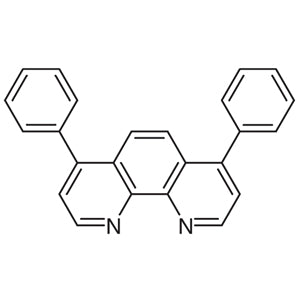
- TCI B2695 1662-01-7 Bathophenanthroline (purified by sublimation)
- Inverted (p-i-n) perovskite solar cell fabrication, where the molecule serves as the hole-transporting and interface-modifying layer anchored directly onto the transparent conductive oxide electrode.
- Self-assembled monolayer deposition on ITO substrates, since the phosphonic acid group binds to the conductive oxide and the molecules spontaneously order into a uniform single-molecule film.
- Energy level alignment studies, because the methoxy substituents on the carbazole core shift the energy levels and allow researchers to examine their effect on open-circuit voltage.
- Series resistance reduction experiments in thin-film devices, as the monolayer thickness contributes far less resistance than conventional and substantially thicker hole-transporting layers.
- Solution-processed device engineering, where layer formation proceeds by simple substrate immersion and therefore fits laboratories building devices without complex deposition equipment.
| Brand | TCI |
|---|---|
| CAS number | 2377770-18-6 |
| Molecular formula | — |
| Purity | — |
| Category | Materials Science > Electronic Materials > Perovskite Solar Cell (PSC) Materials |
| Pack sizes | supplied in research-scale packs; please confirm the available sizes when ordering. |
| Physical form | — |
| Storage | store according to the conditions stated on the manufacturer's label and safety data sheet. |
- Product code: D5798
Data from the TCI brochure
| JSC | 23.4 mA·cm-2 |
|---|---|
| VOC | 1.12 V |
| FF | 0.80 |
| PCE | 21.0 % |
Source: TCI brochure FF169 (2025-12-16)
Keep the container tightly closed and store it in a cool, dry place away from direct sunlight, moisture, and sources of heat, following the storage conditions stated on the manufacturer's label and safety data sheet. Use the original supplier container or a clean, well-sealed, chemically compatible vessel, and label any subdivided portion clearly. Handle the material in a well-ventilated area or fume hood, wear gloves, safety glasses, and a laboratory coat, and avoid contact with skin and eyes as well as inhalation of dust. Weigh and transfer the solid using clean, dry tools to prevent contamination, and close the container promptly after use. Consult the safety data sheet before first use and dispose of residues and contaminated materials according to applicable laboratory waste procedures.
—
Produk Terkait
-
ZincPhthalocyanine(purifiedbysublimation) TCI Z0037
Regular price Rp 4.954.950,00Regular priceRp 3.480.750,00Sale price Rp 4.954.950,00 -
N,N,N',N'-Tetra([1,1'-biphenyl]-4-yl)[1,1':4',1''-terphenyl]-4,4''-diamine TCI T3656
Regular price Rp 4.001.550,00Regular priceRp 2.814.000,00Sale price Rp 4.001.550,00 -
2,2',7,7'-Tetrakis(diphenylamino)-9,9'-spirobi[9H-fluorene] TCI T3634
Regular price Rp 4.531.800,00Regular priceRp 3.184.650,00Sale price Rp 4.531.800,00 -
5,6,11,12-Tetraphenylnaphthacene(purifiedbysublimation) TCI T2233
Regular price From Rp 2.279.550,00Regular priceRp 1.593.900,00Sale price From Rp 2.279.550,00 -
Bis-PCBM(mixtureofisomers) TCI B4576
Regular price Rp 6.545.700,00Regular priceRp 4.576.950,00Sale price Rp 6.545.700,00 -
Bathophenanthroline(purifiedbysublimation) TCI B2695
Regular price Rp 5.485.200,00Regular priceRp 3.851.400,00Sale price Rp 5.485.200,00