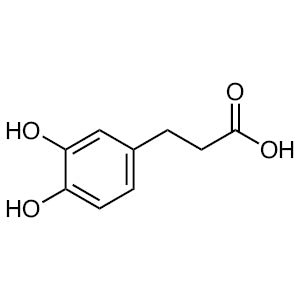
TCI D5901 3,4-Dihydroxyhydrocinnamic Acid is an aromatic building block that combines a catechol group — two adjacent hydroxyl substituents on the benzene ring — with a saturated propanoic chain terminating in a carboxylic acid. The compound is the hydrogenated derivative of caffeic acid and is widely recognized in research as a naturally occurring phenolic motif. In everyday laboratory practice, this molecule serves as a versatile starting material because it presents two distinct classes of functional groups that can be addressed separately, making it well suited to the construction of esters, amides, and conjugates on a broad range of research scaffolds.
The most prominent characteristic of this material is the ability of the catechol group to act as a strong electron donor and chelating unit. The pair of adjacent hydroxyl groups binds metal ions and metal oxide surfaces tightly, and it is precisely this property that underpins its use in mussel-inspired adhesive chemistry and in surface coating work. Unlike caffeic acid, which carries a conjugated double bond, the saturated side chain of this compound removes Michael-type reactivity from the chain, so chemical transformations can be focused cleanly on the carboxylate group. The catechol group is also responsible for the compound's characteristic phenolic behaviour.
In Indonesian laboratories, this building block is typically used by university research groups, government research institutes, and industrial R&D units working on organic synthesis, phenolic compound studies, and surface functionalization. It is normally ordered in research-scale quantities for method development and small-batch preparative work, where a well-defined catechol-bearing acid is required as the entry point to a synthetic sequence rather than as a bulk process input.
- Organic synthesis building block — the separate carboxylic acid and catechol functionalities allow chemists to construct esters, amides, and conjugates through selective, stepwise transformations on a single scaffold.
- Mussel-inspired adhesive chemistry — the adjacent hydroxyl pair of the catechol group binds strongly to metal oxide surfaces, making it a standard anchoring motif in bio-inspired adhesion research.
- Surface functionalization and coating studies — the catechol unit attaches firmly to oxide substrates while the free carboxylic acid remains available for subsequent coupling to other molecules.
- Metal ion chelation research — the two neighbouring phenolic hydroxyl groups coordinate metal ions tightly, supporting investigations into complex formation and metal-binding behaviour of phenolic ligands.
- Phenolic compound and caffeic acid derivative studies — as the hydrogenated analogue of caffeic acid, it lets researchers examine natural phenolic motifs without the reactivity of the conjugated double bond.
| Brand | TCI (Tokyo Chemical Industry) |
|---|---|
| CAS number | 1078-61-1 |
| Molecular formula | — |
| Purity | — |
| Category | Chemistry > Building Blocks > Non-Heterocyclic Building Blocks |
| Pack sizes | available in standard TCI research-scale catalogue packaging; please confirm the currently offered pack size when ordering |
| Physical form | — |
| Storage | store in a tightly closed container in a cool, dry, well-ventilated place, protected from light and air |
- Product code: D5901
Keep the container tightly closed and store it in a cool, dry, well-ventilated area away from direct sunlight and sources of heat. As a catechol-bearing phenolic compound, the material is best protected from prolonged exposure to air and light, and the original supplier container should be retained wherever possible; if transfer is necessary, use clean, chemically compatible glass or an equivalent inert vessel with a secure closure and a clear label. Handle the solid in a fume hood or well-ventilated workspace to limit dust formation, and wear appropriate personal protective equipment including safety goggles, gloves, and a laboratory coat. Avoid contact with skin and eyes and avoid inhaling any dust generated during weighing. Store away from strong oxidizing agents and strong bases, use clean dry spatulas to prevent contamination of the bulk material, and always consult the manufacturer's Safety Data Sheet before use and for disposal guidance.
—
Produk Terkait
-
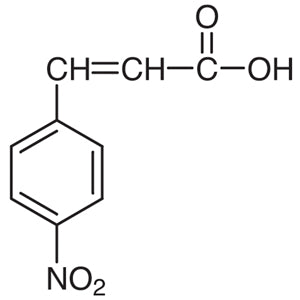
4-NitrocinnamicAcid TCI N0355
Regular price From Rp 1.670.550,00Regular price -
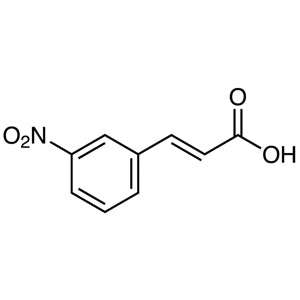
(E)-3-NitrocinnamicAcid TCI N0354
Regular price From Rp 530.250,00Regular price -
Methyl6-Hydroxyhexanoate TCI H1938
Regular price From Rp 1.538.250,00Regular price -
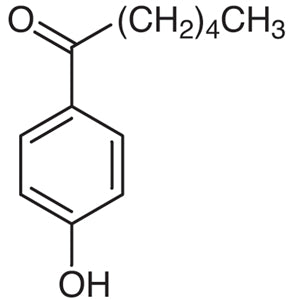
4'-Hydroxyhexanophenone TCI H0884
Regular price Rp 2.306.850,00Regular price -
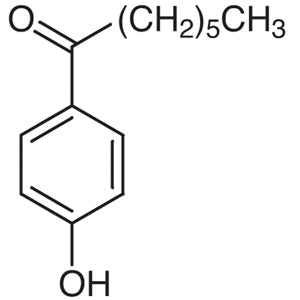
4'-Hydroxyheptanophenone TCI H0864
Regular price From Rp 743.400,00Regular price -
Ethyl6-Hydroxyhexanoate TCI E1305
Regular price From Rp 3.100.650,00Regular price -
Ethyl3-Hydroxyhexanoate TCI E0788
Regular price From Rp 2.545.200,00Regular price -
2,4-Dimethoxy-beta-methylcinnamicAcid TCI D5047
Regular price From Rp 1.431.150,00Regular price